


Part 1 – Understanding the options
From the horse’s evolution and digestive physiology, we know he is designed to receive a high fibre ration, and therefore forage should in all cases represent majority of the ration. This is why we advocate a forage-first approach when it comes to putting together a feed programme for your horse. If we can base rationing decisions upon good foundations by selecting the most appropriate forage (or managing forage to make it more appropriate), we can optimise not only nutrition but also health, welfare and performance. In turn, this may also help us to save money and time. For example, careful selection of forage for poor doers can reduce the need for concentrate feed, while better doers may benefit from a later cut forage, allowing for a less restricted diet. Even if forage selection isn’t always within your control, the same principles apply when choosing between available options or making the best of what’s provided. In this article we aim to provide you with the tools necessary to make informed decisions when selecting forage for your horse.
The most challenging factor when it comes to forage is that environmental conditions during growth and at point of harvest have the greatest bearing on nutritional content and therefore suitability. It is for this reason, that an early cut (less mature) hay may can contain more calories/energy than a later cut (more mature) haylage. As such, blanket recommendations regarding suitability of forage type, hay or haylage, or even specific maturity or cut, should be avoided.
When selecting the most appropriate forage there are factors beyond the horse itself which may impact decision making. Availability of storage and the number of horses fed a particular forage may also inform your decision. For example, if you don’t have covered storage, buying hay in large quantities is likely to be less feasible. Equally, if you only have one horse, large bale haylage is unlikely to be a sustainable option in terms of shelf-life once open.

Forage type: Understanding the Options
The suitability of hay versus haylage depends on various factors, and for this reason, generalisations about their nutritional content can be misleading. Both can vary significantly due to environmental factors like growth stage, time of cutting, grass species, soil fertility, and light. Even forage from the same field can differ based on when it’s harvested. As mentioned previously, this is why we should avoid generalisation or blanket recommendations when it comes to suitability of forage type. It is for this same reason that older hay, i.e., last year’s hay does not infer lower sugar content; this is determined at point of harvest (Müller et al. 2015).
The key difference between hay and haylage is their dry matter content (material remaining after water has been removed). Hay has less moisture, making it more concentrated in nutrients but also more prone to dust. Whereas haylage is typically harvested earlier than hay, to ensure adequate moisture and sugars for fermentation. Due to its higher moisture content, haylage often requires feeding in larger quantities – it is key to consider this to ensure we are meeting a horse’s minimum fibre requirements.
As forage rations are devised based on dry matter, the choice between hay or haylage has a direct impact on the volume or ‘as fed’ ration. For example, at 1.5% bodyweight, the dry matter requirement for a 500kg horse is 7.5kg dry matter. Based on typical dry matter (90% for hay, 60% haylage), the horse would require ‘as fed’ either: 8.3kg of hay (7.5kg dry matter; 0.83kg moisture) or 12.5kg of haylage (7.5kg dry matter; 5kg moisture). Bear in mind that dry matter values can vary and therefore it is worth asking your forage provider for values if available or utilising forage analysis.
Palatability and digestibility also need to be considered when selecting forage. While on paper, the nutrient content of haylage can appear suitable, the higher digestibility and palatability may mean that it results in weight gain and/or does not occupy as much time (Müller and Uden, 2007) deeming haylage inappropriate for some.
Due to its higher dry matter content, hygiene can be a challenge with hay. Additional management practices like soaking can be employed to manipulate water-soluble carbohydrate (WSC) content and thereby improve suitability (Martinson et al. 2012).
Shelf-life is also a consideration. When open, haylage may only last between 2-7 days (depending on the time of year) and therefore may not be suitable for fewer horses, where its use may lead to high levels of wastage. While smaller bales of haylage are available, this can be more costly. Hay on the other hand, when appropriately stored, can still be fed after several years. However, the nutrient level will decline over time along with hygiene (making soaking and/or steaming at this point advisable, although very dusty and/or visibly mouldy hay should not be fed).
Seed vs. Meadow
In addition to choosing between hay and haylage, there’s also a decision to make about the grass species it contains. Forage can be largely categorised as either meadow or seed hay/haylage. Typically, a meadow hay/haylage refers to a forage that is harvested from permanent pasture and usually contains a variety of grass species. Whereas seed hay/haylage tends to refer to a forage that has been specifically sown for forage production, typically of one or two species. Timothy and ryegrass are the most common seed hay or haylage, single grass species products or a combination of the two being widely available. Pastures used for seed hay are typically less than five years old (not a permanent ley) and are often rotationally cropped. Seed forages are produced under controlled conditions, where specific species are planted and managed. This approach can allow for greater accuracy when aiming to produce forage with specific nutritional parameters (e.g. low sugar/energy/calorie) because the level of maturity tends to be more uniform at point of harvest (being planted and managed the same). Meadow forage on the other hand, with more diverse species which each mature at a different rate, is likely to be much more varied across when it comes to level of maturity at point of harvest. As the level of nutrients within grass changes as it matures, crops of meadow forage can be subject to much greater variability with the potential for reduced consistency in comparison to a seed forage. There are, however, potential benefits to either choice; seed hay or haylage often offers greater consistency and availability due to more intensive production, while meadow forage may promote more diversity within the ration and promote local biodiversity.
If selecting a seed forage, it is worth noting that timothy grasses tend to be lower in overall energy/calories when compared to ryegrass forages, making timothy-based forages more often recommended for those requiring lower energy/calories. However, as with forage type, blanket recommendations based on grass species should be avoided, acknowledging the significant role of environmental conditions.

Nutritional considerations
When it comes to meeting a horse’s nutritional requirements, it is completely feasible that energy, protein and fibre needs can be met through forage alone. The only thing hay and haylage cannot guarantee is the correct balance of vitamins and minerals, meaning that while concentrate feeds can be reduced significantly through selection of an appropriate forage, a balancer or vitamin and mineral supplement is still recommended. Some guidelines which can provide a starting point for forage selection for good and poor doers are summarised below.
Low energy/calorie requirement e.g. good doers, those at rest or in light work:
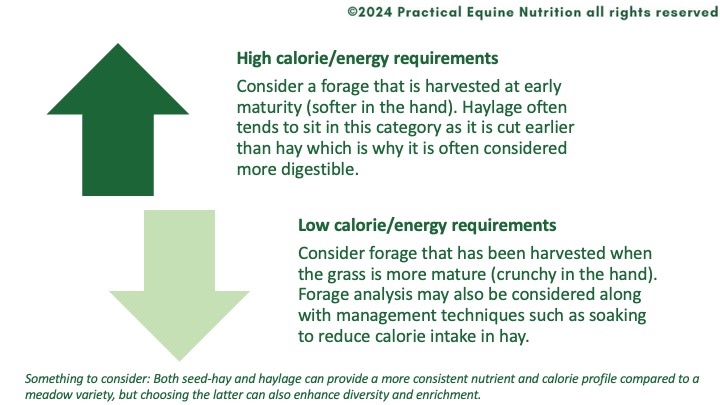
Look for a forage with a calorie/energy content (digestible energy) of less than 8MJ/Kg. Forages which fall within this specification are likely to be those that are cut when the grass is more mature (crunchy in the hand). Common challenges with these types of forage are that they can have reduced palatability and hygiene (potential of dust/mould). Therefore, it is likely that forage management such as steaming or a short soak for hay before feeding will be required.
Higher energy/calorie requirements e.g. poor doers, those in moderate to hard work:
Look for, earlier cuts of forage (when the grass is less mature), these are more digestible and therefore tend to have higher overall energy content. These forages also tend to be more palatable – ideal for fussier types. The better-quality forage you can source, the less reliance you will have upon the concentrate ration to maintain weight and condition.
Low sugar requirements e.g. clinical issues such as laminitis or tying up:
Water Soluble Carbohydrate (WSC) levels within UK forages can range widely, from 10% to 25% dry matter (DM) in hay (and typically lower than this in haylages due to the ensiling process). Starch levels tend to be very low (0.1-0.8%), due to UK grass species preferentially storing carbohydrates as sugars and fructans.
Current best practice guidelines suggest the use of WSC or Non-Structural Carbohydrates (NSC – starch and sugars) to estimate appropriateness for horses and recommend that these are derived from wet chemistry analysis for accuracy. The current guidelines for those requiring a low sugar forage ration recommend NSC levels <10-12% dry matter or WSC of approximately 8-10% dry matter. While Ethanol Soluble Carbohydrates (ESC) can be used to allow for further assessment of appropriateness– if we subtract ESC from WSC we get an estimate of fructan content, ESC analysis can underestimate fructan values and therefore interpretation of appropriateness using ESC alone (or ESC plus starch) at this stage are not recommended in isolation.
Changing forage sources
- Where possible, mix the two together for a couple of weeks and then gradually increase the new forage in place of the old forage until the ration is fully transitioned.
- Where transitioning from grass only to hay. Start by feeding the hay damp. The difference in moisture content is one of the key challenges to the gut when changing between these two types of forage, so this can help. Introduce gradually out in the field or bring in for a few hours each day, increasing up to the desired quantity over 2-4 weeks.
- For those with a history of colic or that tend to get ‘loose’ during a change in routine and forage, provide a prebiotic supplement 2 weeks prior to and post new forage introduction to help support the digestive system. For these types, the transition period may need to be nearer 4 weeks, keep a close eye on manure to guide you as to whether the change is too quick for that individual. Any sign of digestive disruption, pause or reduce the new forage slightly until manure returns to normal and then continue.
Take home points
- Forage-First Approach: Forage should form the majority of your horse’s diet due to its high fibre content, which supports healthy digestive function.
- Forage Variety and Quality: The nutritional content of forage, varies significantly based on environmental factors like growth stage, grass species, and weather conditions. It’s important to avoid blanket recommendations and select forage based on specific horse needs. When selecting between hay and haylage, prioritise consistent quality and a reliable source rather than preconceived beliefs.
- Consider Storage and Management: Practical factors like available storage, number of horses being fed, and potential wastage should be considered when selecting forage. Haylage, for example, has a limited shelf-life once opened, making it less suitable for smaller quantities or individual horses.
- Transitioning Forage: When switching forages, it’s crucial to transition gradually to avoid digestive upset. A slow, controlled introduction helps the horse adjust, particularly when changing from grass to hay or switching forage types.
Key References
Harris, P.A., Ellis, A.D., Fradinho, M.J., Jansson, A., Julliand, V., Luthersson, N., Santos, A.S., Vervuert, I. (2017) Review: Feeding conserved forage to horses: recent advances and recommendations. Animal: An International Journal of Animal Science, 11 (6): 958-967
Muller, C.E. (2012) Impact of harvest, preservation and storage conditions on forage quality. In: Forages and grazing in horse nutrition, EAAP, Volume 132
Muller, CE; Uden, P. 2007. Preference of horses for grass conserved as hay, haylage or silage. Animal feed science and technology 132(1-2): 66-78.
Watts, K.A., Chatterton, N.J., (2004) A review of factors affecting carbohydrate levels in forage. Journal of Equine Veterinary Science, 24 (2): 84-86
