


Horseflies! Horses hate them! We hate them! Nasty biting and blood-sucking flies of the family Tabanidae. At least the females are as it’s only the females that bite and suck blood as they need this to be able to produce eggs. And whilst they are called ‘horse’ flies, they don’t restrict themselves to horses; cattle, camels, deer and even people are on the menu. Horse flies have particularly vicious mouthparts and once they have hold it’s very difficult to dislodge them by shaking or kicking out. Unlike many other flies, horse flies don’t bother with injecting an ‘anaesthetic’. They do, however, inject an anti-coagulant to stop the blood clotting at the site of the bite so they can lap up as much as they want. Horse flies have evolved to pierce the much tougher skin of horses or cattle and so for a person, being bitten by a horsefly is usually pretty painful.
There are estimated to be over 4000 different species of horse fly worldwide! In the UK alone there are estimated to be at least 30 different species. A common horse fly species in the UK is the Notch-horned cleg-fly which lives in long grassland and damp woodland habitats. Females wait in shady areas for prey to pass by, locating it by sight. Eggs are laid on stones and plants, or in mud, close to water. When the larvae hatch, they fall onto the damp earth where they predate other invertebrates (1). Whilst horse flies might be seen as pure pests, like wasps, they also play an important role in pollination.
Horse flies prefer to fly in the daytime, especially if it’s sunny, and they are pretty much inactive at night! They tend to appear around April/May and persist throughout the summer into September. They may also be particularly active when there are heatwaves – and lots of bare flesh exposed! And they are fast! One study reported them flying at up to 90mph. And these monsters have pretty much colonised all of the world, apart from the coldest Polar regions and Iceland and Greenland.
For people, most bites will result in inflammation with a raised, red and sore area. Horse fly bites can also more rarely lead to allergic reactions which may need urgent medical treatment or can become infected.
What to do if you or your horse get bitten.
Apply an ice pack to reduce the inflammation and pain ideally as soon as possible for 15-20 min and then 15-20min every hour for 3-4 hours. Clean the bite area with some saltwater or a mild antiseptic. If your horse starts to show signs of becoming ill or the bite looks to become infected then contact your vet for advice. In rare cases, and less so in the UK, horse flies are reported to be vectors for diseases such as anthrax, anaplasmosis, tularaemia and equine infectious anaemia virus2.
How can you tell a horse fly from other flies? First, they are generally much bigger than the majority of flies, being 10-25mm long, and they have coloured and patterned eyes. They are also usually black or brown in colour and make a low humming noise.
How can you reduce the risk of being bitten by horse flies? Probably the easiest way is to wear clothing that covers as much as possible, but even then horse flies can bite through clothing, so loose-fitting clothing is better than tight clothing.
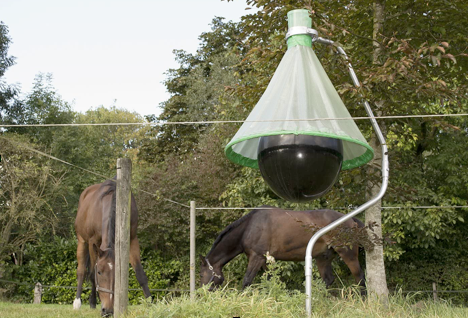
Around the stables, you can reduce the risk of you or your horses getting bitten by removing or covering any standing water as much as possible, such as ponds, buckets, troughs, water butts, etc and keep grass and vegetation around the stables as short as possible, especially around ditches. Some types of traps designed specifically for horse flies claim up to 95% reduction, such as the H-Trap.3
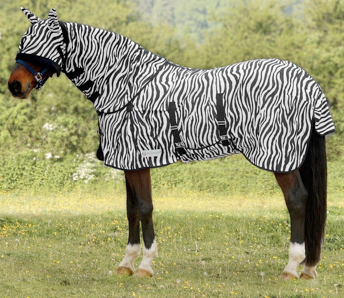
When out riding avoid long grass or thick vegetation, especially near water. Riding early morning or late evening can also reduce the risk. A physical barrier such as a fly rug and an effective insect repellent should also help. One study has suggested that Zebra stripes reduce the incidence of horse fly landings 4 5 and some Zebra patterned fly rugs are available, although some scientists dispute this study.
Dr David Marlin recently carried out an independent online survey on fly repellents and asked owners to rate the effectiveness of products that had previously used and or were currently using specifically against horse flies. Goodbye Flys was the clear winner for horse flies, with Farnham Tri-Tec 14, Leovet Power Phaser and Deosect all scoring well in both categories.
Follow this link to read the full repellent survey and results.
References
- https://www.wildlifetrusts.org/wildlife-explorer/invertebrates/flies/notch-horned-cleg-fly-horse-fly
- https://www.msdvetmanual.com/horse-owners/skin-disorders-of-horses/flies-and-mosquitoes-of-horses
- https://www.h-trap.net/
- Caro T, Argueta Y, Briolat ES, Bruggink J, Kasprowsky M, Lake J, Mitchell MJ, Richardson S, How M. Benefits of zebra stripes: Behaviour of tabanid flies around zebras and horses. PLoS One. 2019 Feb 20;14(2):e0210831. doi: 10.1371/journal.pone.0210831 https://pubmed.ncbi.nlm.nih.gov/30785882/
- How MJ, Gonzales D, Irwin A, Caro T. Zebra stripes, tabanid biting flies and the aperture effect. Proc Biol Sci. 2020 Aug 26;287(1933):20201521. doi: 10.1098/rspb.2020.1521. Epub 2020 Aug 19. https://pubmed.ncbi.nlm.nih.gov/32811316/
