


by Debbie Symes and Dr David Marlin
Consider equestrian portraiture from the Greek, the Mughal, the Renaissance and the Age of Enlightenment. We find through this long time the rider is a person of importance, and his horse is consistently portrayed with the high arched neck and vertical face line of an alert stallion. This stylish head and neck carriage was a matter of fashion, a human construct of beauty.
The ambiguous status of the ‘poll position’ has an unclear beginning. Early literature (de le Guérinière) wants this high arched neck but is more focused on the rideability of the horse in the movements and the connection. Between WWI and WWII dressage was principally practised as a military sport but slowly evolved towards a competitive civilian sport. The popularity increased following WWII, giving rise to a fair amount of literature. The focus in this later literature, though, remained on the movements, the head carriage, and the connection. The flexion of the jaw and softness are considered to be paramount in training the dressage horse. There are a few comments regarding the poll being the highest point, and occasional mention of the nose being in front of the vertical.
Photographs of dressage horses, pre and post WWII, show horses of rather different confirmation from today’s sport horse. Typically, of a thoroughbred type with little topline and a much thinner neck confirmation. To our eye, these horses look too high and too short in the neck, although the nose is generally in front of the vertical.
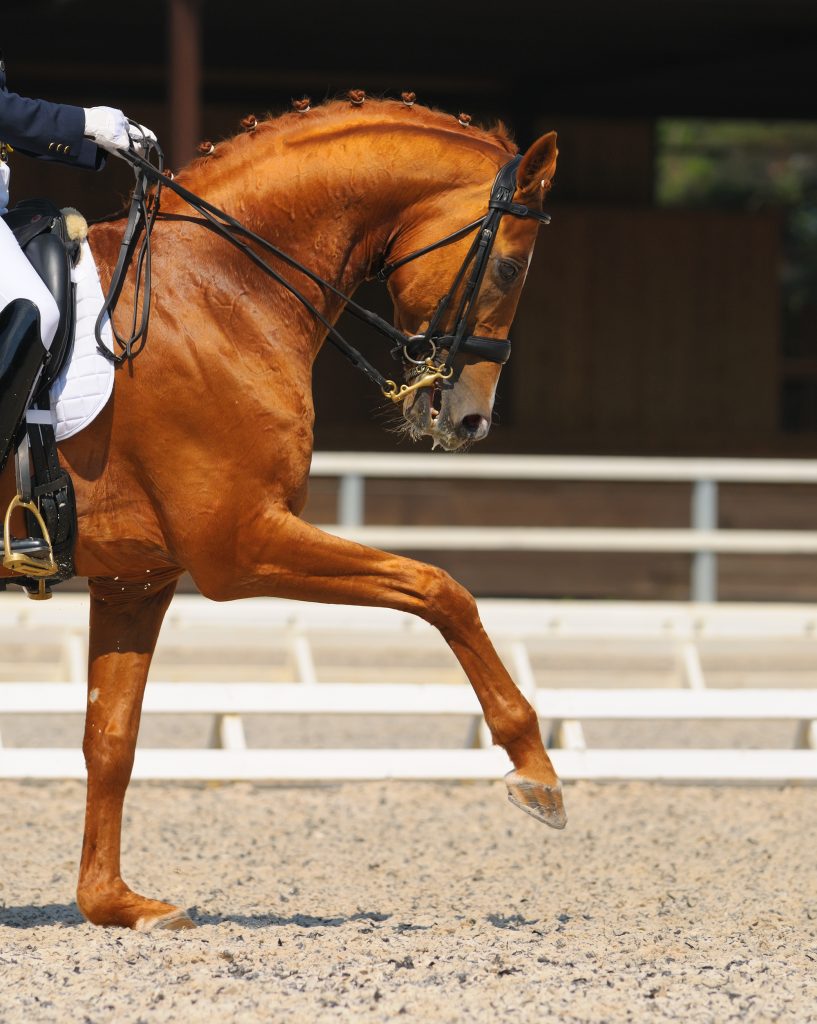
Today the ideal high arched neck and vertical face seem to have crept to an extreme focus. Here we have our conundrum. Where is the Poll? Is it a bony landmark or is it a joint? It cannot logically be both, nor flit from one status to the other.
Anatomical Poll definition. The poll is part of the occipital bone, at the posterior of the external sagittal crest, and above the crista nuchae, the attachment site of the supraspinous ligament. This bony landmark is not part of the Atlas – the skull/ the first cervical vertebra.
Reading through the FEI Dressage Judging Guidelines 2024 there is mention of:
- A supple poll. This would indicate that the poll is a joint.
- Flexion of the poll. Again, this implies that the poll is a joint.
- Elasticity of the poll. Another phrase indicating that the poll is a joint.
- Controlling the poll. A vague phrase, may mean the position, or it could mean a joint that is controlled – flexion, extension, rotation – by the action of the rider.
- Resistance of the poll. This implies that the movement can be limited by tension in muscles.
‘slightly flexed in the poll and bent in the direction in which it is turning,’ This is an interesting statement. The movement between the skull and C1 is flexion and extension – rotation of the frontal axis in the sagittal plane. Between C1 and C2 there is rotation of the sagittal axis of the frontal plane. The FEI description appears to cover the skull-C1-C2 movement, four degrees of freedom.
Occurrences of vertical.
The head approaches the vertical position. This is ambiguous as the head could be either ‘behind’ or ‘in front’ of the vertical.
The degree of ‘in front’ of the vertical differs from the collected to medium and to extended paces. ‘A little more’ is an imprecise definition.
Points from the FEI Dressage Rules 26th edition.
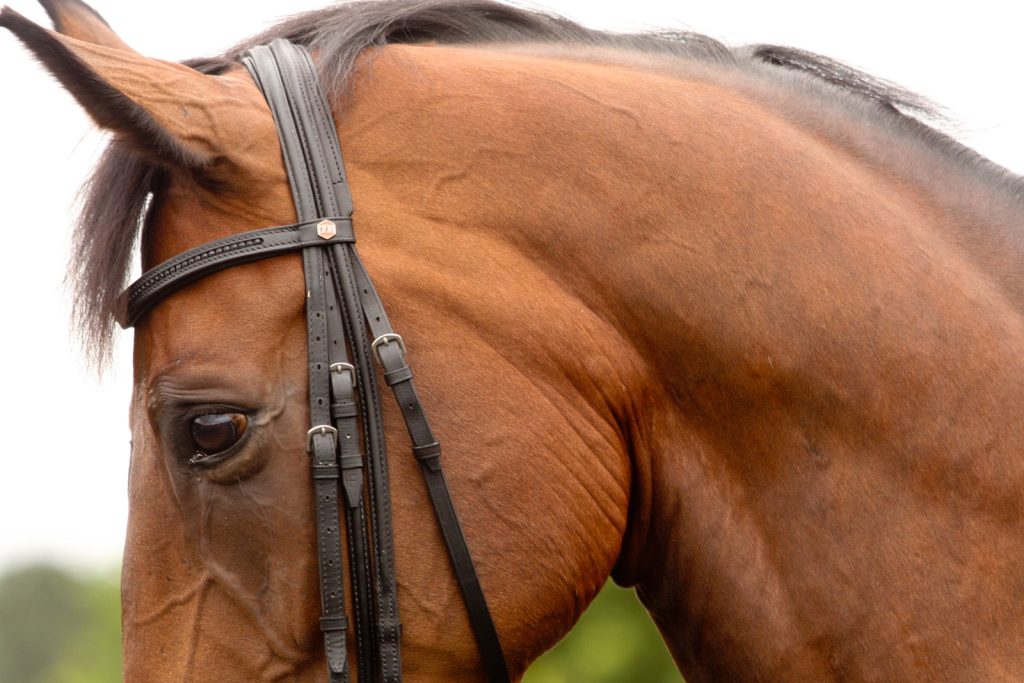
When discussing the position of the head or crownpiece of the bridle. ‘. The crownpiece of the bridle must lie immediately behind the poll and may extend forward onto the poll but must not be fitted to lie behind the skull’. This statement is contrary to the statements in the judging guidelines where the poll appears to be either one or two joints that move. This statement is in line with the anatomical landmark definition. The crownpiece sits behind the skull over the skull-C1 joint.
This ambiguous status – a bony landmark or a joint/joints causes considerable misunderstanding for riders, coaches, and judges. This confusion impacts horse welfare as the coaches and riders chase an impossible ideal. This status is one of the prime, if not the prime ‘attacks’ on modern dressage. The head/neck position is easy to see. One does not have to be an expert. There is a growing group of people who consider dressage or even riding horses is not appropriate today. This vociferous group are equally confused about the poll status. This unhappy state should not be allowed to continue. The FEI need to make their position clear.
Little research has been done on this issue. Is it possible for a horse to have the poll-occipital crest as the highest point whilst the nose is on or slightly (what is slightly?) in front of the vertical? In halt, walk, trot, canter, collected to extended, passage, and piaffe.
Possible scenarios
The highest point is the anatomical poll. The nose would be in front of the vertical. However, with a modern sport horse with a big crest, the neck would have to have little flexion, and the head is high with the nose quite a way in front of the vertical.
Or the occipital bone is not the highest point, but the nose must be on or in front of the vertical at all times. Here the ‘poll’ is the skull/C1/C2/C3. The joints must move freely without being fixed at the end of their ROM.
Or the neck is much lower but longer, so the nose is behind the vertical. Arguably, this is more natural and comfortable as the integrity of the long neck would be maintained. This scenario would present the largest challenge to change.
For the sake of the sport and certainly for the sake of the horses, doing nothing is not an option.
Written by Debbie Symes and Dr David Marlin.
Debbie has a BSc Hons in Sport Science and Human Biology, was a dressage coach and still competes at Advanced in dressage. Last year Debbie helped David collect data with the British Eventing Speed Study and it was then that they had a conversation that led to this article.

References:
Notes from the FEI Rules 12th edition 1967.
The rule book consists of 23 A5 pages.
Chapter I Dressage
Article I Object and General Principles
401(e) In all his work the horse must be on the bit. A horse is said to be ‘on the bit’ when the hocks are correctly placed, the neck is more or less raised according to the collection or extension of the pace, the head remains steadily in position, the contact with the mouth is light and no resistance is offered to the rider
This description could be termed vague
Article II Specific requirements
402 –‘the neck raised, the poll high, the head a little in front of the vertical, the mouth light’
403 (b) The Collected Walk – The horse moves resolutely forward, with his neck raised and arched. The head approaches the vertical position,
This is the first mention of arching the neck. Approaching the vertical position is vague. No mention of the poll position.
404 (b) The Collected Trot – the neck is raised this enabling the shoulders to move with greater ease in all directions
This is an interesting statement. Does it imply that when the neck is in another position, e.g. lower, that the shoulders are restricted? This is in conflict with our current knowledge of the biomechanics of the horse.
405 (d) Counter Canter – The horse maintains his natural flexion at the poll to the outside of the circle.
The first mention of the poll as a joint.
411 (d) The movement on two tracks
(e) All bending or flexion at the poll has of necessity repercussions on the whole spine. Consequently, in all work on two tracks the horse is bent to the direction in which he is looking.
Debatable!
415 The Piaffe – The neck is raised, the poll supple, the head perpendicular-
Implies the poll is a joint.
416 The Collected Paces
A normal position of the head and neck suitable for all horses does not exist. Only a position that gives the rider a lever with which to influence the quarters judiciously, will make him master of the horse in all circumstances.
This position is characterised by the neck raised unconstrained, forming a harmonious curve from the withers to the poll, the highest point, with the head perpendicular. However, this perpendicular position of the head should only be attained at the moment the rider applies his aids in order to attain a momentary and passing collecting effect. Otherwise, the head should be slightly in front of the perpendicular.
For me the first sentence is in conflict with the rest of the two paragraphs. The movement from in front to perpendicular to the perpendicular and back to in front would likely be penalised by judges today as an unsteady connection.
