


Have you ever looked through the mesh of a fly mask and wondered what your horse can see? If not, you might be surprised.
The effect of mesh size
Firstly, let’s look at the impact of the mesh size. Clearly the larger the mesh, the less your horse’s vision will be impaired and it will let more light in. Of course, a small mesh will keep out smaller flies and a larger mesh will only keep out the larger flies and let small ones like midges get in. So mesh size is important as the primary reason for using a “fly mask” is of course to keep flies off the horses’ face. But if you don’t have a problem with midges and smaller flies, then of course, you could opt for a larger mesh size to allow your horse better vision. Of course, no mask is likely to prevent Thunderbugs (also known as thrips, thunder flies, storm bugs, corn flies, corn lice, thunder blights or harvest flies) from getting in!

Does the colour of the mesh make a difference?
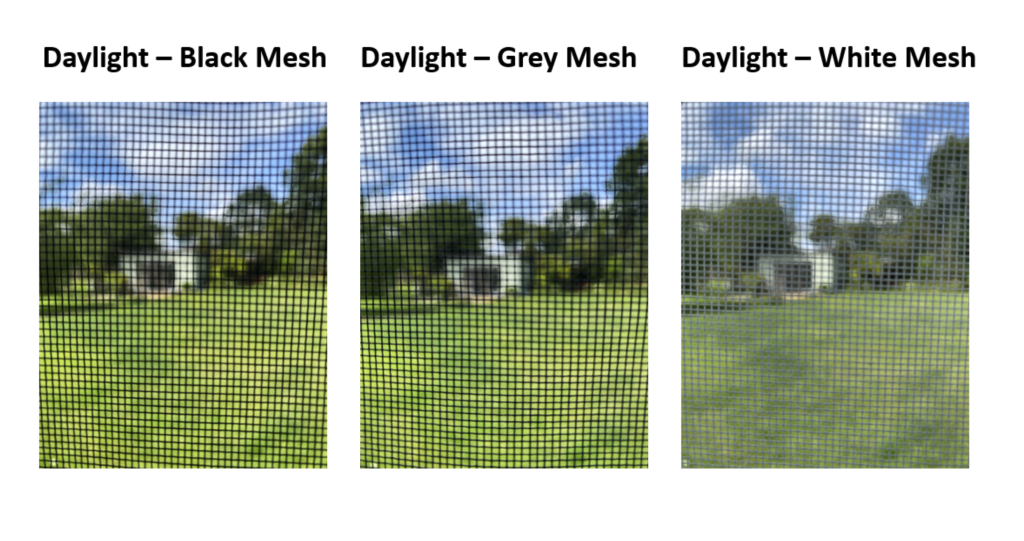
The next most important consideration is colour. Fly masks tend to come with black, grey or white mesh mainly. For samples of the same 1.5mm x 1.5mm square mesh in black, grey and white, we can see that during good daylight the black and grey are similar, but the white mesh doesn’t give such as clear view. This is because the white mesh allows any light that has passed into the mask to be reflected inside the mask. So, if you have an older horse or a horse with poor vision, it would be better to choose a fly mask with a dark-coloured mesh.
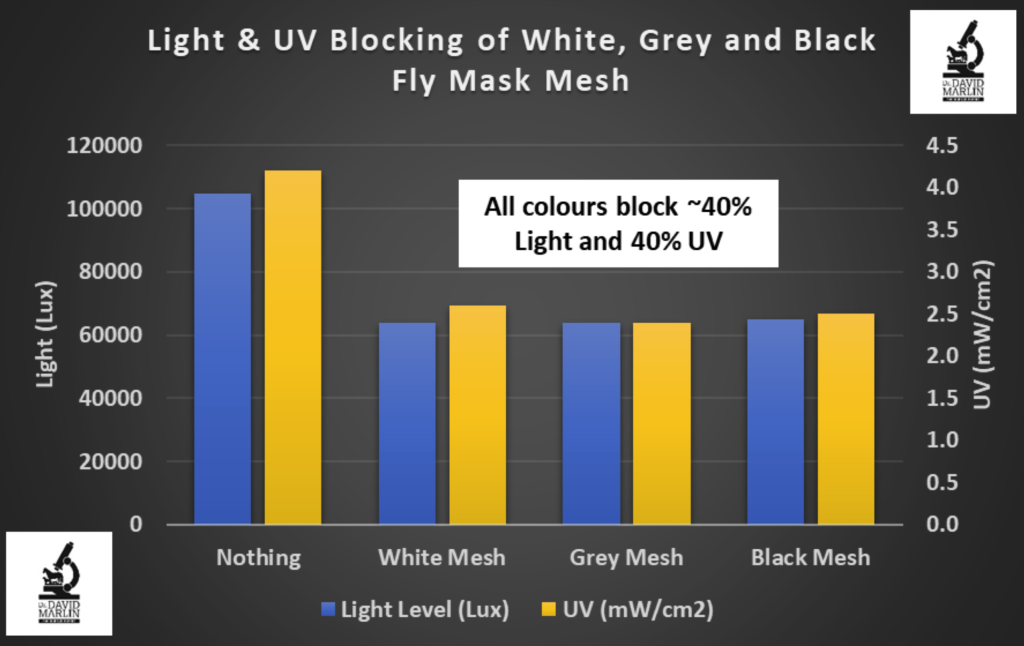
Light and UV blocking by different colours of mesh
Of course some owners will want a mask that reduces light and or UV. For example, horses with uveitis or who have had eye surgery or horses with pink exposed skin on the face or horses affected by headshaking (trigeminal mediated headshaking). The amount of light and UV that are blocked are a function more of the mesh size and the material than the colour of the mesh. Below we can see that on a bright summer day, black, grey and white 1.5mm x 1.5mm plastic mesh all block around 40% of light and 40% of UV.
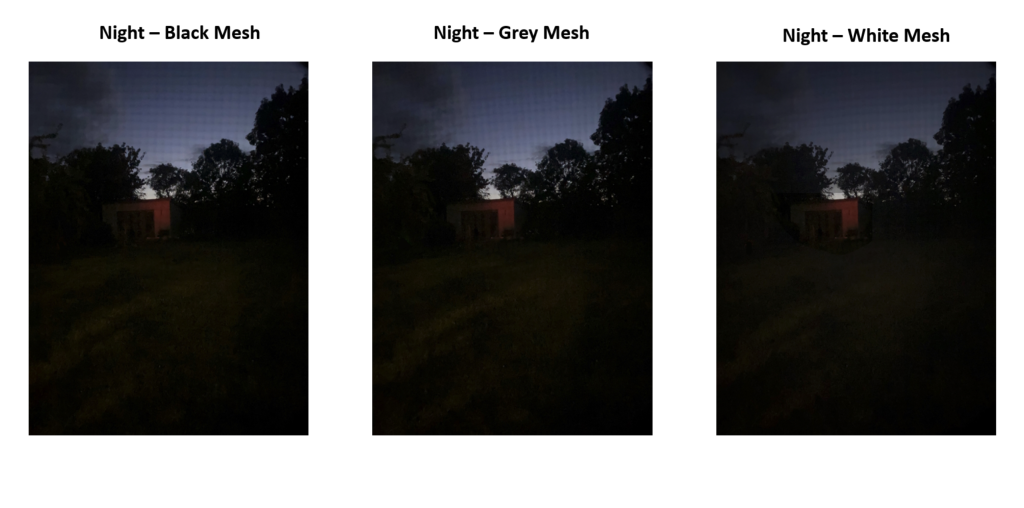
How does Mesh colour affect horse vision at night?
Whilst in strong sunlight, black and grey give better vision, in low light, the black, grey and white mesh all give a similar level of vision.
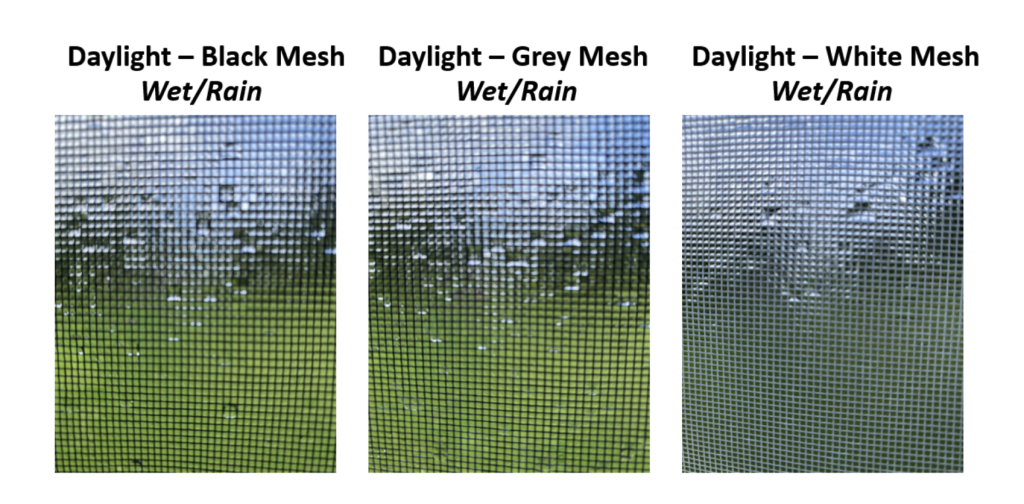
What about the rain?
Have you ever wondered how your horse’s ability to see is affected when it rains? These images are quite surprising and show that after wetting, none of the mesh’s allow good vision and the white is also worse than the black and grey.
What about temperature?
One further consideration is that dark colours absorb more heat. So a black mesh and fly mask will be warmer and possibly more uncomfortable for a horse in hot weather than a white mesh and mask as shown in the thermal images of white and black mesh taken with a Flir thermal imaging sensor in full sunlight at an air temperature of 30°C.

Bottom Line
- Large mesh = better vision, but small mesh keeps out smaller flies!
- In daylight, black and grey mesh gives better vision for the horse. White mesh gives poorer vision as any light passing into the mask can be reflected off the inside of the white mesh
- The black, grey and white 1.5mm x 1.5mm plastic mesh tested here all blocked around 40% of light and 40% of UV on a sunny summers day. Colour didn’t affect how much was blocked.
- In low light, black, grey and white all give similar good vision
- Darker colours absorb more heat than light colours in warm-hot weather
- When wet, all mesh colours give poor vision, with white poorer than black or grey
