


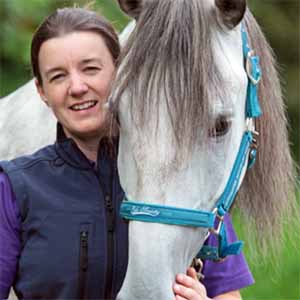
In this podcast, Dr Gillian Tabor critiques her own research on the effects of percussive therapy on equine thoracic profiles, mechanical nociceptive thresholds, spinal and limb kinematics, and gait symmetry. The study aimed to provide evidence for the efficacy of percussive therapy devices, which are often marketed with unverified claims. The research methodology included a randomised, blinded crossover design, and the results indicated no significant differences between treatment and sham groups, although no adverse effects were observed. The discussion highlights the importance of distinguishing between statistical and clinical significance and suggests areas for future research.
Dr Gillian Tabor is MSc ResM MCSP HCPCreg, a Chartered Physiotherapist, Cat A member ‘Association of Chartered Physiotherapists in Animal Therapy and has lots of great help and advice for horse owners – check out all of her work here – Dr Gillian Tabor
Discussed in this podcast:
- The study critiques the efficacy of percussive therapy devices.
- Percussive therapy is often marketed with unverified claims.
- The research aimed to provide evidence for these claims.
- A randomized, blinded crossover design was used in the study.
- No significant differences were found between treatment and sham groups.
- The study observed no adverse effects from the therapy.
- Minor changes inthe thoracolumbar profile were noted but not clinically significant.
- Future research should consider longer treatment durations.
- Behavioural aspects of therapy should be assessed in future studies.
- The importance of distinguishing between statistical and clinical significance was emphasized.
Read the full research paper here.
Tabor, G., Nason, N. and Maddock, C., 2024. The effect percussive therapy on equine thoracic profile, mechanical nociceptive thresholds, spinal and limb kinematics and gait symmetry. Comparative Exercise Physiology, 1(aop), pp.1-9.
CLICK here to head over to the main Podcast page to see the complete list of podcasts available.
Transcription
Here is a transcription of the podcast. (Please note this is an automated transcription, so we apologise for any errors from the original podcast.)
Hello, this is Gillian Table, and today I’m coming to you with a report on a published research paper, but this time it’s a little bit different because I am the first author on this research, so I’m going to critique my own study. The title of the study is “The Effect of Percussive Therapy on Equine Thoracic Profile, Mechanical Nociceptive Thresholds, Spinal and Limb Kinematics and Gait Symmetry.”
This paper was published in the Comparative Exercise Physiology Journal and became available at the end of last year. My co-authors were Nicole Nason and a colleague from Hartbury University, Kristy Maddox. As the title suggests, this study focuses on percussive therapy. If you’re not familiar with it, you may associate it with a form of mechanical massage.
A percussive therapy device imparts vibration to the tissues it is placed upon. Some of these are percussion guns, while others are handheld devices. It fits in the same category as electrical massages, such as vibration units that people can sit, lie, or stand on. Specifically for horses, this therapy involves applying an electromechanical device to the external soft tissues of the body.
Why Conduct This Study?
I am somewhat sceptical about some of the therapeutic devices on the market that claim to enhance performance, improve healing, and promote well-being. Many of these claims are not backed by research. David and I have published posts, hosted webinars, and delivered teaching sessions on this topic, often struggling to find solid evidence to support these claims.
Nicole Nason, one of my co-authors, approached me because she uses a percussive therapy device and has observed positive effects. After discussing the lack of research, we decided to conduct a study to investigate whether there is scientific evidence for these perceived benefits.
A common critique in research is the potential for bias, especially when studies are funded by companies that manufacture or sell the product being tested. I want to clarify that I did not receive any financial incentive to conduct this research. The company did not fund the study or participate in its design. The research was funded through an internal grant from Hartbury University, for which I am very grateful.
Study Design
As with any research paper, we began with an introduction to therapeutic devices and vibration therapy. However, there is very little research on the use of these tools in horses. One paper by Russell McKett-Newguire examined a different vibration therapy pad and handheld unit. Their study showed small changes in spinal range of motion, but no comprehensive biomechanical or physiological research had been done using the handheld device we tested.
This gave us an opportunity to investigate whether there were any measurable effects of percussive therapy on horses. We aimed to design a robust methodology to minimise bias. The study used a pre and post-intervention data collection method with a randomised, blinded, crossover design.
This meant that:
- Each horse participated in both an active treatment group, where the percussive therapy device was used, and a sham group, where they did not receive therapy.
- The order in which the horses received treatment was randomised.
- As the primary data collector, I was blinded to which group each horse was in.
The treatment lasted 12 minutes, with the device applied to major superficial muscle groups in a structured manner. It was moved across specific regions for 30 seconds each, working from the head down to the hindquarters. The device had a pressure gauge to ensure consistent application. Behavioural responses were observed, but none of the horses exhibited signs of discomfort.
Data Collection
To assess the effects of percussive therapy, we measured:
- Mechanical Nociceptive Thresholds (Pain Sensitivity):
- A pressure algometer was used to test pain perception at specific marked locations.
- Thoracic Profile (Muscle & Spinal Changes):
- A flexi-curve ruler was used to measure thoracic region dimensions at T10, T13, and T18.
- Gait and Spinal Kinematics:
- IMUs (Inertial Motion Units) were attached to the horses.
- Horses were trotted at a set speed, and data was collected on:
- Gait symmetry
- Spinal displacement (dorsal-ventral, cranial-caudal, medial-lateral)
- Roll, pitch, and yaw
- Stride Length:
- Captured via video analysis before and after treatment.
Results
- Mechanical Nociceptive Thresholds (Pain Sensitivity):
- No significant differences were found between the treatment and sham groups.
- No evidence of increased sensitivity or habituation.
- Thoracic Profile Measurements:
- Minor differences were noted, but they were within the range of biological variation and not clinically significant.
- Kinematic and Gait Data:
- Some minor changes were observed, but they occurred in both the treatment and sham groups.
- No significant effect size indicated a true treatment effect.
- No significant differences in gait symmetry (i.e., no changes in movement that could indicate improvements or impairments).
Interpretation of Results
These findings suggest that percussive therapy does not negatively affect horses, which is important, as concerns exist about its potential adverse effects. However, the study did not provide evidence of significant short-term biomechanical or pain threshold improvements.
The study was conducted on polo ponies, chosen for their consistent management, care, and training to reduce variability. However, due to their discipline, they exhibited asymmetries similar to thoroughbreds in training. This could have influenced results, and future research may need a more tailored treatment approach.
Additionally, the 12-minute duration of therapy may have been too short to elicit measurable effects. Longer applications could be explored in future studies.
Areas for Future Research
- Testing effects at walk:
- Measuring stride length and spinal mobility at different gaits.
- Behavioural Analysis:
- Collaborating with equine behaviourists to analyse facial expressions and body language.
- Heart Rate & Stress Indicators:
- Measuring heart rate variability to assess potential relaxation effects.
- Alternative Application Methods:
- Individualised treatment based on each horse’s asymmetry or needs.
Key Takeaways
- No negative effects were observed, meaning percussive therapy is safe to use.
- No significant biomechanical or pain threshold improvements were recorded.
- Short treatment duration may have limited measurable effects.
- Further research is needed, particularly in different gaits and with behavioural measures.
One aspect I am particularly proud of in this study is the objective reporting of non-significant results. Many studies overemphasise minor statistical changes, but this research highlights the difference between statistical significance and clinical significance—ensuring that results are meaningful in real-world settings.
Conclusion
The study concludes:
- Percussive therapy did not significantly change pain thresholds or movement patterns.
- Minor changes were observed in thoracolumbar profile and spinal motion.
- Anecdotal evidence of relaxation during therapy was noted.
- Future research should explore longer treatments, ridden assessments, and physiological responses.
This was an important first step in researching percussive therapy in horses. If you’d like to read the full paper, the citation will be in the podcast notes.
A huge thank you to my co-authors Nicole Nason and Kristy Maddox, and to Hartbury University for their support in making this research possible.
