WHAT DO PHYSICS, RESEARCH AND COMMON SENSE TELL US?
Some points to consider when discussing saddles of any kind!
➡ Essentially, the saddle has remained the same for 4000 years.
➡ Studies show that up to 80% of ridden horses can have back pain.
➡We don’t have ideal saddles! We have saddles that are at best “adequate”.
➡ There must be a better solution; it just hasn’t been discovered yet!
Saddles are such an important aspect of equestrian activity – ideally protecting the horses’ back by spreading the rider’s force as well as possible and minimising peak forces, within the laws of physics, and providing the rider with a stable and secure platform. The past decade has seen a great deal of new research into saddle function and fit. But how much has really changed. The Quantum saddle, the BUA saddle, Reactor Panel saddles, WOW, Stride Free and Ipotane saddles, for example, have all claimed to have made significant step changes in saddle design and function, although evidence to support these claims from independent studies is still almost totally lacking.
The basics of trying to solve the rider-saddle-horse interface are relatively simple. Providing an optimal solution is extremely challenging. The horse moves both symmetrically and asymmetrically. The horses’ thoracic musculature may not be statically or dynamically symmetrical due to being trained asymmetrical or due to injury. Saddles may not be symmetrical, and riders are rarely symmetrical. This produces a vast range of possibilities for how the rider will interact with the saddle and how the saddle will react with the horse.
When we combine motion into the equation (i.e. when the horse and rider are moving), the situation becomes even more complex with an increase in force on the horses’ back (force = mass (“weight of rider” x acceleration (the vertical movement of the rider). So, a rider with a mass of 75kg sitting still on a 5kg saddle is exerting a force of 80kg on the horse’s back. But when the rider moves up and down at 2-3g (g = acceleration), then the force becomes 160 to 240kg! Strictly speaking, when we discuss force in this context, we should be referring to Newtons rather than kg, where 1kg = 9.81N. (9.81 comes from the acceleration due to gravity of 9.81 m/s2 (or 1g). So, a rider of 80kg landing at 2g on the saddle exerts a force of 80kg x 2g x 9.81 = 1570N. Combine this with slight phase “timing” differences between the rider and the saddle, and the impact on the horse is significant!
Many people will be familiar with pressure mat measurements, which have been used extensively in saddle research and by an increasing number of saddle manufacturers and saddle fitters. The only way we can reduce force is by having a lighter rider and or reducing vertical acceleration. So, this is not the solution to reducing average or peak pressures on the horses’ backs. Pressure is force ÷ area, where the area is the area that the saddle contacts with the horse’s back. In everyday life, we might be familiar with blood pressure in mmHg (millimetres of mercury) or car tyre pressures in PSI (pounds per square inch), both of which are older and no longer the standard “standard internation” (SI) scientific units for pressure. So, in most cases, the pressures you see reported in saddle research will be in the SI units of Pascals (P) or Kilopascals (kPa), where a Pascal is the pressure exerted by a force of 1N applied over an area of 1 square metre (m2). A kPa is simply 1000 Pascals.
Let us look at how saddle contact area affects the average pressure on the horses’ backs. Let’s say we have the same rider in the same gait on the same horse but in two different saddles.
Saddle A – Saddle contact area 0.5m2; rider average force 1500N; Average pressure = 3000P or 3kPa.
Saddle B – Saddle contact area 1.0m2; rider average force 1500N; Average pressure = 1500P or 1.5kPa.
So clearly, if we double the contact area of the saddle with the horse then the average pressure (assuming equal distribution) would be halved! Unfortunately, not all areas of the saddle are of course in contact at the same time and rider centre of mass (where the rider is positioned in the saddle) vary dynamically over the course of a stride. But this is the basis for understanding fundamentally how force and contact area influence saddle-horse pressures.
So ideally, we want to distribute force as evenly as possible and over as large an area as possible. We also want to minimise peak pressure. From previous research, we have some concept of the pressures we want to avoid which cause injury; For example, continuous pressure of greater than 12kPa and peak pressures of greater than 31kPa are considered to cause soft tissue damage to the horses’ back (Latif et al. 2010). But, and it’s a big but, A saddle can only distribute force effectively if it has a HIGH DEGREE OF STIFFNESS!
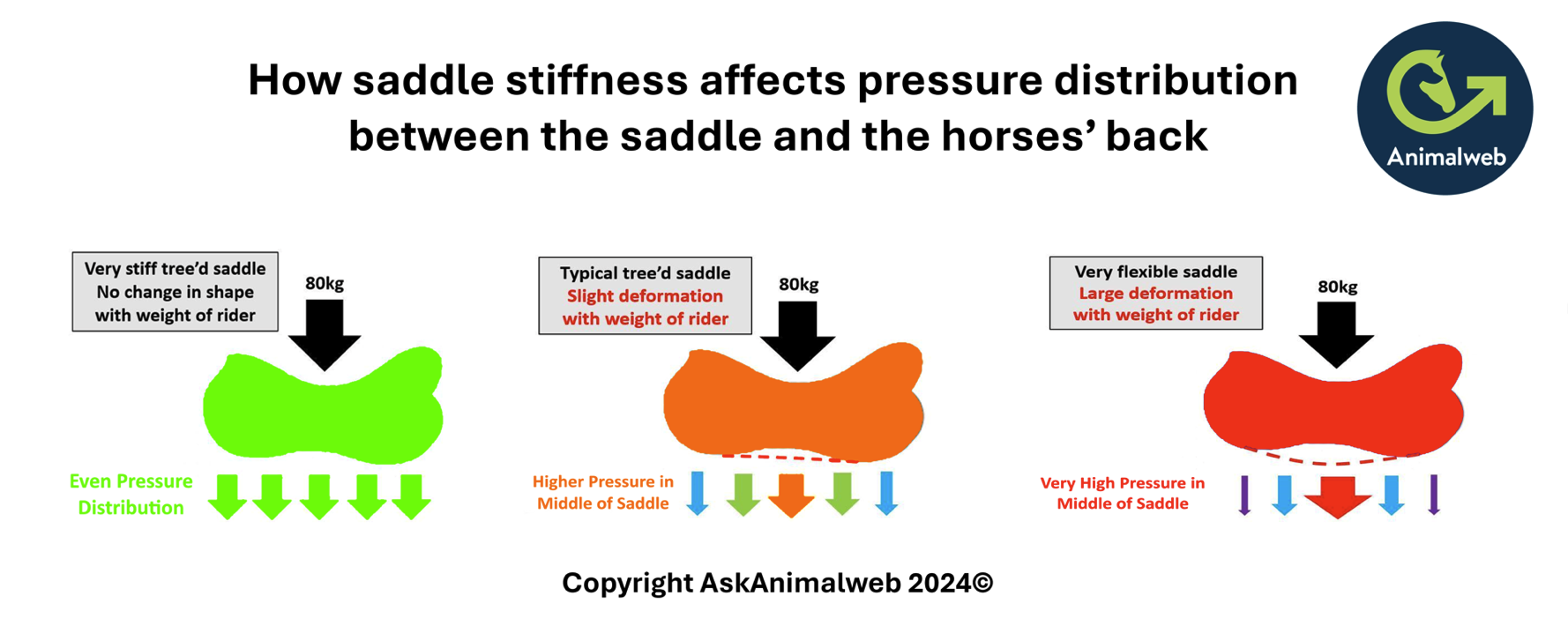
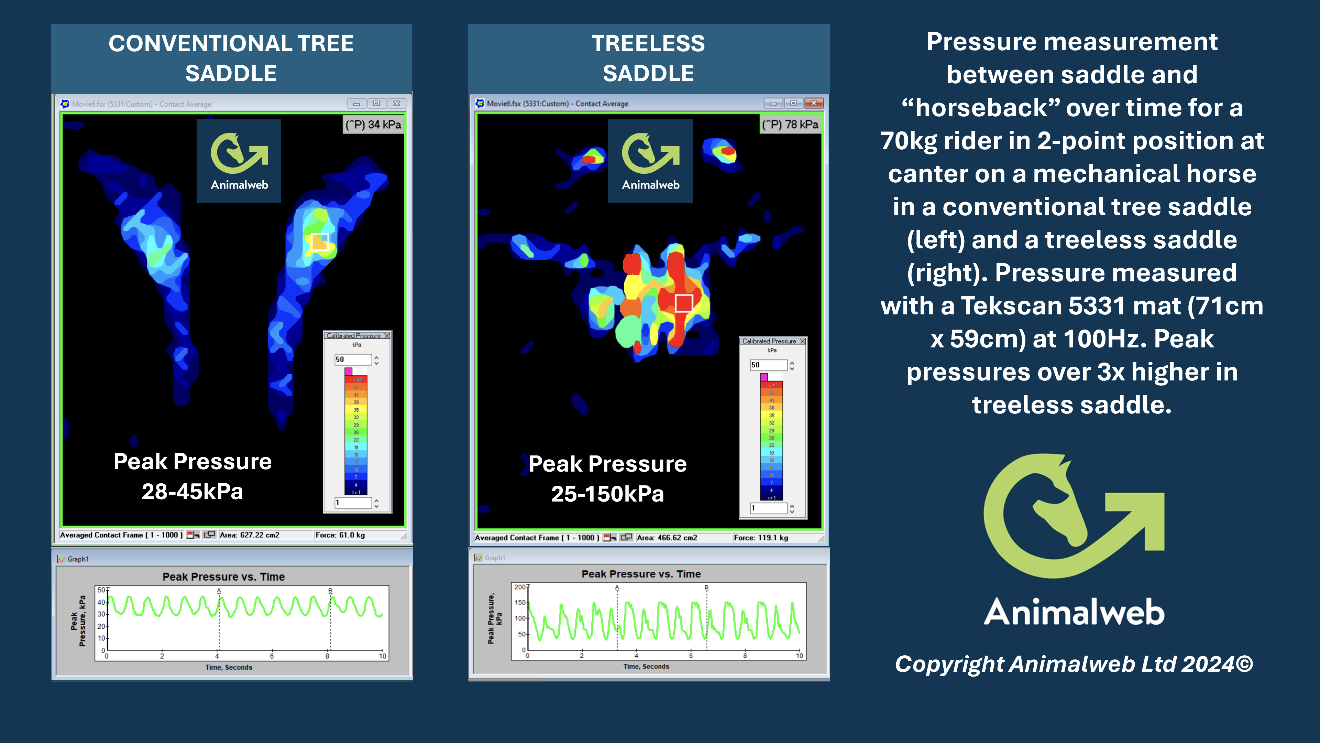
BUT whilst a stiff saddle may have the capacity to distribute pressure more evenly, it of course does not move dynamically with the horse’s back and it will impact on the function of the underlying muscles and restrict normal back motion. So this brings us nicely to the “TREELESS” saddle, where by definition, there is limited stiffness because of a lack of any internal supporting structure. So the advantage of a treeless saddle will be that it has the potential to allow the horse’s back to move closer to how it would without a saddle and rider. However, because of an inability (by the laws of physics) to distribute the rider force, the pressures between the saddle and horse will be very HIGH and likely damaging if the horse is ridden by a heavy rider for long periods of time or at high speed or when jumping!
Back to the question? TREE’D or TREELESS?
I’m not a saddle maker. I’m not a saddle fitter. I’m not a qualified equine physio. However, for me, the answer to the question is simple based on my research and that of others. The figure below illustrates the issue! Treeless saddles CANNOT evenly distribute rider force across the horses’ back where the saddle is in contact. They result in high peak pressures which are known to cause soft-tissue damage. In my personal view, they are only suitable for light riders (up to a maximum of 15% of the horses’ bodyweight), for short durations of riding (less than an hour) in walk with very limited periods of trot. Definitely NOT for canter or gallop or jumping! TREE’D saddles are currently the only option with the potential to offer some protection to the horses’ back with heavier riders, high speeds and jumping. But this still comes at a cost. Real innovation is required to optimise both even force distribution and to allow maximal back motion, as close as to that without a rider on board.