


The noseband has rightly become a focal point of debate and research in international horse sport, as we know its impact on horse welfare and performance can be profound. The factors to consider are design (action), fit (position) and crucially, the tightness of a noseband. Noseband tightness has prompted justified scrutiny from vets, animal welfare advocates, governing bodies, and riders alike, leading to further research into the consequences of excessive tightness.
Even a correctly fitted cavesson has a purpose beyond pure aesthetics by adding a degree of stabilisation to the bridle. Other types of nosebands are designed to limit “evasive” behaviours such as opening the mouth, crossing the jaw, or tongue over bit/tongue sticking out, while some nosebands are designed to accentuate the rider’s rein aids.
Over time, however, tightening nosebands has become more common, particularly in high-level competition no doubt due to the belief that it improves performance. Or mask evasions?
Tight nosebands are now frequently observed across disciplines, including dressage, show jumping, and eventing. Noseband Use in Equestrian Sports – An International Study 2017 (Doherty, Casey, McGreevy, Arkins) worryingly showed that 44% of competitors assessed in eventing and dressage had their nosebands tightened to ‘0 fingers’ and only 7% allowed two fingers between noseband and nasal bone.
Research has shown that overly tight nosebands have detrimental physiological and psychological effects on horses, including (but not limited to):
- Reduced blood flow leading to discomfort or potential tissue damage.
- Discomfort, pain or potential ulceration of cheek mucosa as the noseband presses the tissue into the upper jaw cheek teeth (the horse’s maxilla is wider than the mandible)
- Restriction of natural jaw movement, creating tension, impeded swallowing, discomfort & stress.
- Increased stress indicators, elevated heart rates, increased heart rate variability & increased eye temperature have been observed & measured. The Effect of Noseband Tightening on Horses’ Behaviour, Eye Temperature, and Cardiac Responses 2016(Fenner, Yoon, White, Starling, McGreevy)
I am personally disappointed on two levels… firstly, that governing bodies have been slow to enforce their rule that nosebands should not cause harm and should not be too tight (or too loose), and secondly, that such enforcement is undoubtedly required. Ultimately, the responsibility for a horse’s welfare surely lies with the rider. But in elite competition, the fact is that governing bodies must lead the way with clear regulation, objective assessment, consistent application and standardised penalties for non-compliance.
Regulations have previously referenced the “Two Finger Rule” (two adult fingers between the noseband & nasal bone at the front of the face) – how do we define the size of an adult finger?
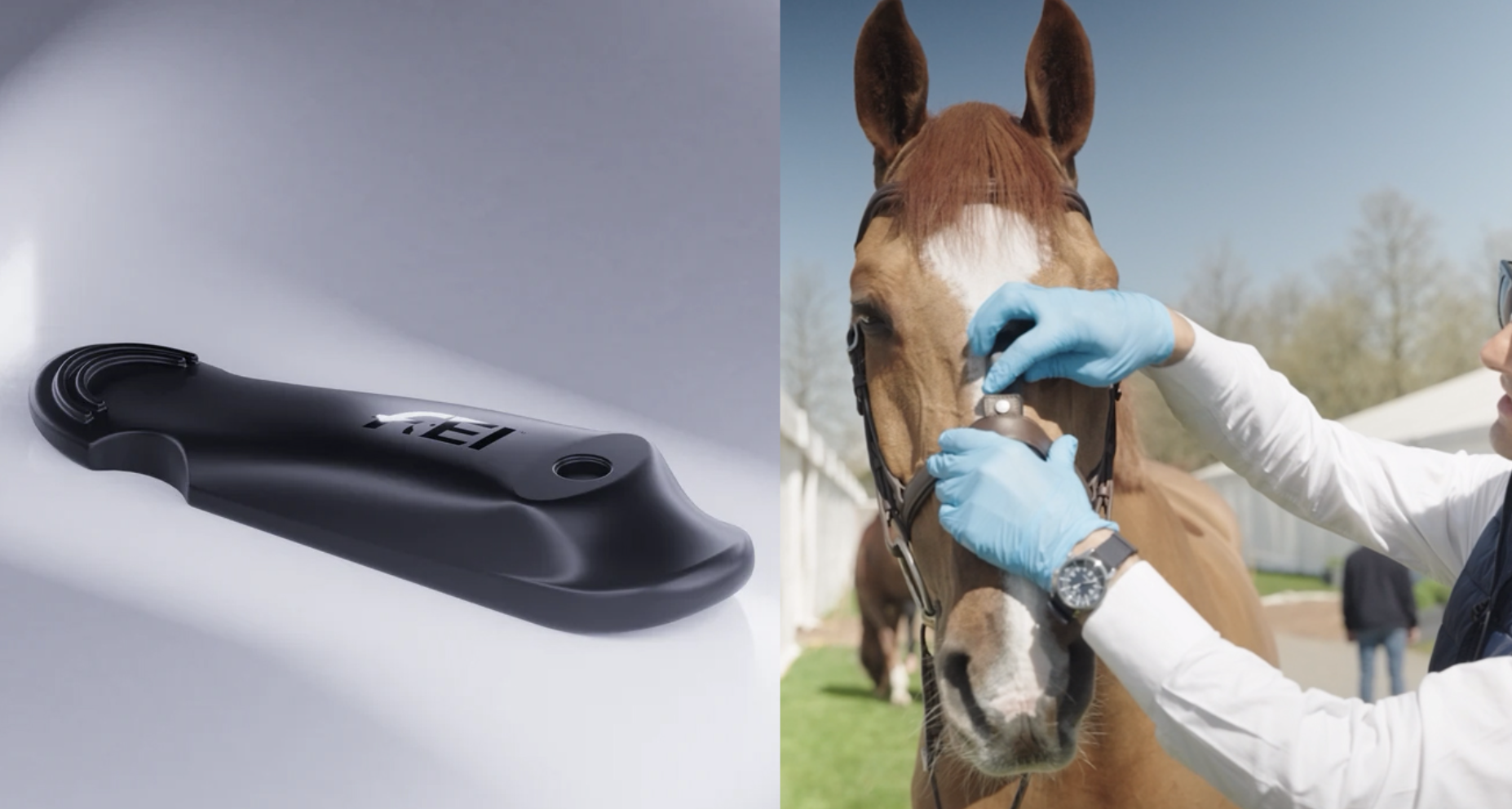
FEI Noseband Measuring Device
The introduction of the FEI Noseband Measuring Device is a massive step in the right direction, in conjunction with clear, consistent and significant penalties for violation. From 1 May 2025, the device will be used across all FEI disciplines; however, there is no requirement that all horses must be assessed. Also, horses may be assessed pre- or post-competition. If a horse’s noseband is deemed too tight before the competition, the combination will not be allowed to start unless the noseband is adjusted and passes the assessment. If the examination occurs after completion, the combination will be eliminated.
I have ‘tested’ the device on all my horses, as well as during consultations and am happy to share my thoughts and observations.
Pros
- The device is simple to use and has been well-tolerated by the horses I have used it on.
- It adds objectivity to the assessment – it either passes between the nasal bone & noseband or it doesn’t!
Cons
- The standardised dimensions (1.7cm high, 3cm wide and 11.5cm long) mean that large horses with large heads will have proportionally less laxity in the noseband than ponies or small horses with fine heads.
- The assessor should ‘hold the noseband with their free hand to make room for the device’ – this leaves room for inconsistency as I found that the application of more pressure to make room for the device compressed the soft tissue on the side of the face which could create slightly more room at the front of the nose. This would only be relevant in marginal cases.
- The device does not measure overly tight flash straps.
In terms of the regulation, I would like assessments to be made mandatory for all horses. Currently, assessment/examination can be either random or targeted. In my opinion, the latter places unfair emphasis on the stewards to identify which horses should be targeted. Additionally, allowing examination post-completion, despite the deterrent of elimination, doesn’t actually protect, on the day, the horse who subsequently fails the assessment. The welfare of equine athletes must be the top priority in all equestrian disciplines.
Conclusion
In conclusion, I believe education is as important as regulation… of riders, trainers, owners, officials and other stakeholders. I’m happy that the FEI is making changes in my area of expertise, but international collaboration between national governing bodies must occur to standardise regulation across different countries and disciplines to ensure consistent and ethical welfare standards, to provide a level competitive playing field and to protect our sports’ social license to operate.
