


(These are the workings and information from a PowerPoint Research Presentation)
Brought to you by – Thea L Cuff, Christopher M Deaton1, Demelza A Kingston, Rachel J Williams and David J Marlin1
Hartpury College, Hartpury House, Gloucester, UK, GL19 3BE, Centre for Equine Studies, Animal Health Trust, Lanwades Park, Kentford, Suffolk, UK, CB8 7UU
Introduction: RAO (Heaves, COPD)
- Exacerbation on exposure to allergens (e.g. mould spores present in poorly cured hay and straw)
- Inflammation and influx of neutrophils into the airways during clinical exacerbation
- ROS generated by activated neutrophils

Introduction: Comet Assay
- A highly sensitive method for the detection of DNA damage in single cells

AIMS
- Compare endogenous DNA damage in the respiratory epithelium of non-RAO and RAO affected animals in remission:
- At baseline (Pre-challenge)
- After mild natural allergen challenge (Post-Challenge)
- Does mild airway inflammation impair respiratory epithelium DNA integrity?

Study Design: Animals
- Four RAO-affected horses in remission
- as determined by standard diagnostic techniques (FOM,
TW, BAL cytology and bacteriology) - mean age 14 years (range 9-21)
- as determined by standard diagnostic techniques (FOM,
- Four control animals
- free from respiratory disease
- (determined as above), mean age 8 years (range 6-15)
- All animals at pasture and fed haylage for at least 6 weeks prior to study
- Horses were not exercised during the study period
Study Design: Challenge
- -7 Day (Pre)
- TW and BAL performed
- Tracheal epithelial cells collected
- Day 0 (Challenge)
- horses were stabled on wood shavings and fed haylage for 3 days
- Day 3 (Post)
- horses removed from the challenge environment
- TW and BAL performed
- Tracheal epithelial cells collected
Study Design: Sampling
- Sedation with romifidine (50ug/kg)
- Cells recovered from distal trachea during endoscopy using a cytology brush

- Brushings were collected directly into freezing medium (FBS + 10% DMSO) and slow frozen at -80ºC at optimum cooling rate of -1º/min
- After 24h, samples were transferred to -180ºC until processing
Study Design: Comet Assay
- Samples were analysed in pairs
- RAO and non-RAO, with a quality control
- Pre and post-challenge samples combined in same assay
- Cell viability
- Typan Blue exclusion following thawing and cell wash
- Existing (endogenous) DNA damage assessed
- Susceptibility to exogenous DNA damage
- estimated by incubation with 50uM H2O2

- Slides were incubated in alkaline electrophoresis solution (300mM NaOH, 1mM Na2EDTA, pH 13) for 40 min at 4°C
- Electrophoresis at 0.8V/cm, ~300mA, 30 min, 4°C
- Neutralisation at 4°C in 0.4M Tris, adjusted to pH 7.5 with 11M HCl
Imaging and Scoring
- Gels were stained with SYBR green
- Image acquisition = fluorescence microscopy and digital camera
- 100 cells per gel were selected at random and scored manually on a 5 point scale (0-4), scorer blinded to the identity of the samples

Results
- Brushings comprised greater than 95% epithelial cells
- Average cell numbers recovered per brushing (x105)


Discussion
- Cells recovered by bronchial and tracheal brushing can be maintained in culture for at least 16 days
- Cilia movement is considered a criterion for cell viability (de Jong et al., 1993)
- Cilia movement was clearly visible in tracheal epithelial cells in culture until day 12

Conclusions
- Tracheal epithelial cells from RAO affected horses in remission do not show greater endogenous DNA damage or susceptibility to damage (from H2O2) compared with non-RAO’s
- Following mild natural allergen challenge, RAO affected horses show greater endogenous DNA damage compared with non-RAO’s
- The degree of DNA damage does not show a clear association with either BAL or TW neutrophil numbers
Results & Discussion
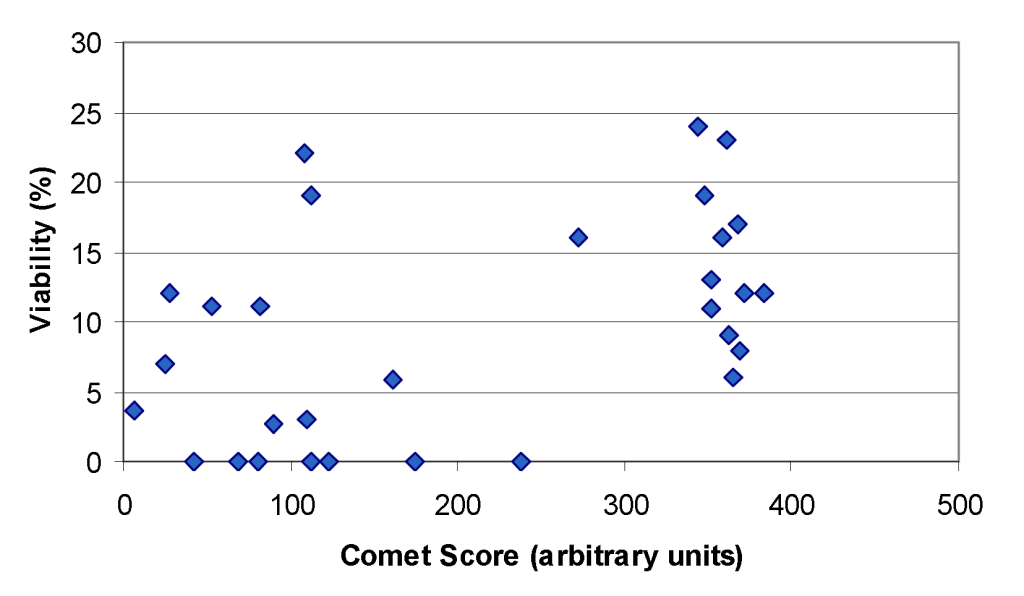
- Low cell viability on thawing (9 ± 8%)
- However, viability assessed via Trypan Blue exclusion was not correlated to final comet score
Manual scoring vs. image analysis software

