


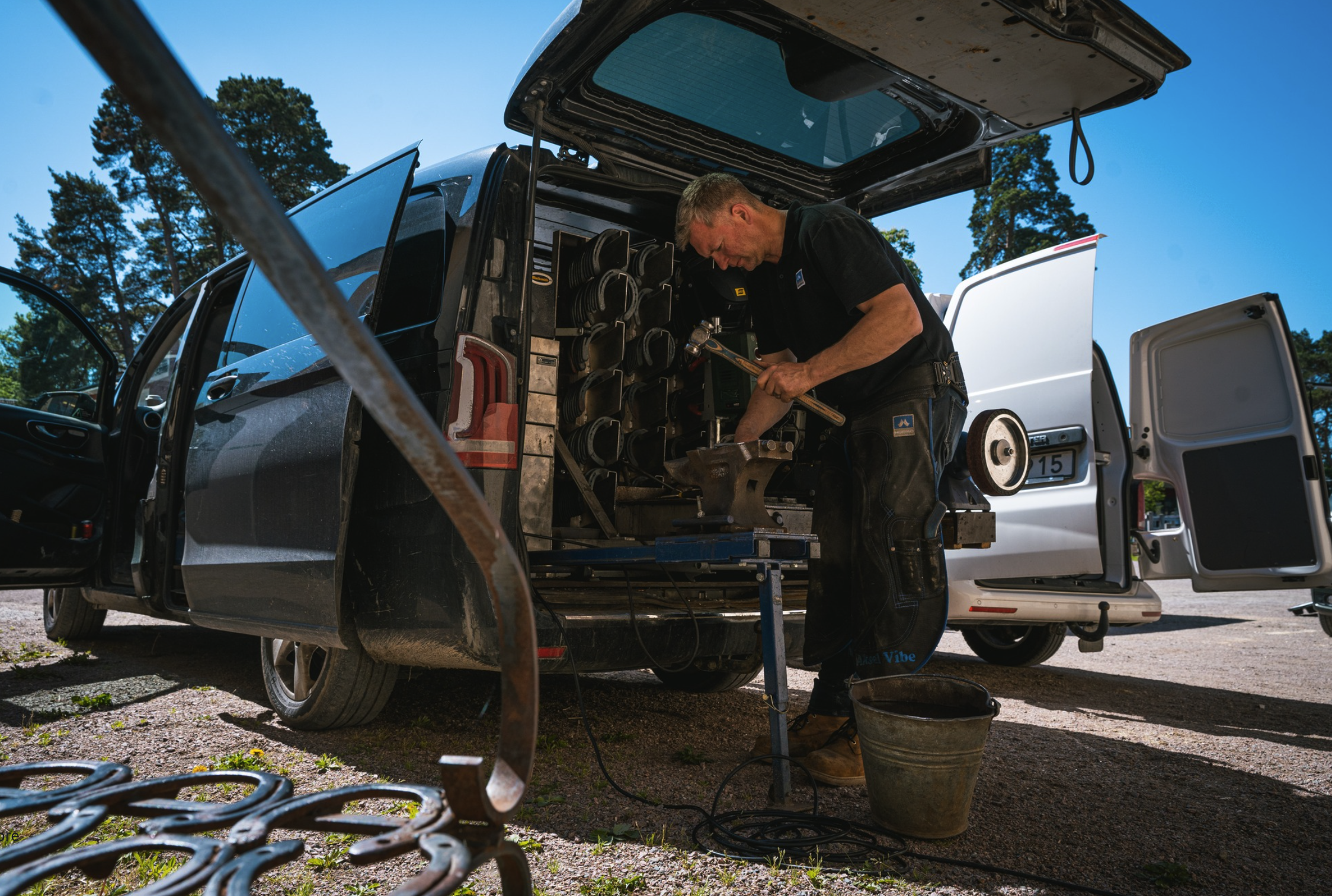
Aksel Vibe, the world-renowned farrier from Norway hosted a live webinar whilst he travelled across Norway for our community on 16 November.
Aksel cared for the feet of the horses ridden by Swedish showjumper Peder Fredricson – the same horses that won Gold whilst barefoot at the 2020 Summer Olympics in Tokyo!
Aksel talks about Modern farriery and barefoot, what is suitable for different working horses, and how the right shoeing for each horse is fundamental. He explains his involvement in recent research and how working with Peder Fredricson opened his eyes to Barefoot, but it only works for certain horses in certain circumstances. There is also a tremendous amount of work required to protect the horse’s feet and Barefoot is by no means an easy option.
LOG IN TO WATCH THE FULL WEBINAR BELOW:

To read the rest and learn how this will help you, join us by clicking the banner below.

Already a member? Log in here
Join us now to view this article PLUS 1000s of
- tips
- articles
- videos
- money saving ideas
- reviews
- webinars
- podcasts
- news
And so much more!
Science backed horse care at your fingertips - dip in for information when you need science to help you care for your horse.
Who is Aksel Vibe?
AWCF HOVSLAGER M/FAGBREV.
We know Aksel as a leading farrier who lectures to hundreds of students every year; he’s been part of the Norwegian team and competed at the International team competition at Stoneleigh several times, going on to judge and be the only non-British judge on the WCF list.
Aksel has among his customers Olympic and World Championship medal winners, World Cup
attendees’ Grand Prix National and International horses. Part of his job has been to follow
clients on international tours, and he has also been the Duty farrier at several World Cup and World Championship competitions.
As a farrier in competition, Aksel’s highlights include:
• Norwegian Champion nine times
• Nordic champion two times
• European Champion
• Five times top 20 Calgary
• Winning four-man draft in Calgary 2013 with Team Heller
• Second in World Team Comp Yorkshire 2014 with Team Heller
• Over several years competed and placed in UK.
• Been Part of Team Heller with G.Moon, J Nunn, J Eurenius, and latest J Cheney.
Currently, Aksle’s job consists of:
• shoeing and trimming sport horses, dressage and show jumping
• give hoof care to breeding and young horses from foal to athlete
• lecturing, practical and hands-on clinics for farriers, horse owners, veterinarians and other horse professionals.
• consulting
• remedial shoeing
• marked consult and product developer for Mustad Hoocare
• product developer for BHoof.
• consultant for Agria
“I have a keen interest in the “shoe the whole horse” concept and I’m eager to develop myself and optimise my shoeing and hoof care through understanding advanced horse assessment and diagnostics.” Said Aksel
Transcription
Here is a transcription of the webinar. (Please note this is an automated transcription, so we apologise for any errors.)
Certainly! Here’s the cleaned-up transcript with all timestamps and references to Helen Stock removed. The conversation is now presented as between Dr David Marlin and Aksel Vibe only, with all content preserved but structured more clearly:
Dr David Marlin:
Hi there and good evening, and thanks very much for joining us. This evening, as you know, we’re going to be talking about feet. I’m not going to say any more than that – I think to say more than that is often controversial. But I’m delighted that we’ve got Aksel Vibe with us tonight.
Hi Aksel, are you there?
Aksel Vibe:
Yes, I’m actually on my way back home from shoeing. I’m on the road – in Norway.
David:
Okay, great. It’s quite dark so we won’t see you on video, that’s fine – we’ll just hear from you.
Before we start, just to say for anyone new to the webinars, if you can see but not hear, check your audio settings. If you do have problems, please put them in the chat and we’ll try to help. Don’t put questions in the chat – if you want to ask a question, click the Q&A box. You can send anonymously if you like.
Aksel, would you like to share your screen?
Aksel:
Yes, thank you David. It was a very interesting study, and I’ll be talking a bit about that, about general management of barefoot horses at a high level, and where I think things are going in farriery in general.
This presentation is the same one I gave at the Farriery Focus in Stoneleigh three weeks ago and at the AFA convention last weekend. It’s aimed at farriers, but I think it’s easy enough to translate into normal terminology.
A little bit about myself – I’ve been a farrier for over 35 years. I live in Norway but work internationally, doing lectures and clinics. I also work with Mustad on product development and as an ambassador, and I work with a company called Booth on product development too.
I mainly shoe dressage horses, show jumpers, and do some therapeutic and remedial work. So, barefoot – the bare truth, or to shoe or not to shoe?
The research project we’ll discuss compares barefoot and shod horses, particularly at a high level. The big questions are: can anyone do this? How much resource does it take? And what are the benefits?
The study began with Peder Fredricson, who has been training and competing barefoot in showjumping. One of his horses was lame, and when he took it back into work barefoot, it seemed to function better than when it was shod – so he kept it barefoot. Very pragmatic.
Peder is also someone who likes to understand things in detail and control as much as he can about his horses. So, he started to take control of the feet. He wanted to do some research on it, and the insurance company Agria funded the project.
We did a motion capture study with reflective markers and over 40 cameras, looking at hoof expansion and also back motion in jumping horses. Some of this was presented at the ISO conference.
The focus of the research was performance – not health or pathology. It described locomotion: what moves and how.
I used a consistent trimming and shoeing protocol. It was a regular, conservative trim – not a barefoot-specific method. Some horses were shod first and then unshod, others the other way round, depending on logistics.
The horses were quite varied in size and experience, with four different riders involved. It was a pilot study with eight horses. We acknowledge the limitations, but it was done as realistically and practically as possible.
We used standard Mustad steel shoes, same size and weight for consistency, and avoided using clips to eliminate variables in expansion. No artificial substances or oils were used – just a normal day’s work, with 20 to 30 people measuring it!
What we saw was that hoof expansion was about 50% less when shod. The foot also flexes less in a shod horse – meaning one side of the hoof moves less independently of the other. That, to me, is more important than the expansion, especially when considering movement on uneven ground. This has implications for ligament and joint strain.
There was also a measurable change in something called the “duty factor” – the amount of time the hoof stays on the ground during the stride. Barefoot hooves stayed on the ground longer, allowing a more efficient stride, possibly saving energy and reducing strain. That might be great for showjumpers but less so for dressage, where you want more airtime.
We also observed different slide phases. A shod hoof, especially with a square toe, can actually have a shorter slide than a rounded barefoot hoof. That affects friction and traction, which are crucial in performance and injury prevention.
Peder trims the horses himself between my visits every four weeks, and his groom also helps maintain the feet daily. There’s a lot of maintenance – rasping, checking for gravel, ensuring balance. It’s not a case of turning the horse out and forgetting about it.
We do take radiographs – not necessarily to correct based on angles, but to monitor changes and keep things consistent for the horse.
Sometimes we do shoe them – especially for traction on grass when studs are needed. We’ve experimented with a lot: aluminium, plastic, thermal plastics, Hoofcast, and even CNC-cut plastic shoes from 3D scans via a French company called Value Feet.
We’re now exploring different stud placements – including more studs of smaller size, placed more evenly for better stability and grip.
There’s also controversy in the farriery world about this research. Some barefoot trimmers have jumped on it as validation, but they weren’t involved – only farriers were. Some farriers have been upset by it too, fearing that it encourages owners to remove shoes without understanding the maintenance and risks.
Looking ahead, I think we’ll see more lightweight and specialised shoes, boots with better design, and more hoof engagement through pads and shoe packages. And I believe farriers will need to shift into more of an advisory role – not just providing a service but educating clients and charging for that expertise.
As for cost-saving – maybe, if it’s done properly, you might see fewer vet visits. But barefoot done well takes a lot of time, effort, and often infrastructure changes – it’s not automatically cheaper.
David:
Thank you, Aksel. That was fantastic – incredibly detailed and thought-provoking. The animations from the study really show what’s going on, and I think this is going to have a big impact.
We’ll now open up for questions.
