Many horse owners use face masks or fly masks that claim to reduce UV exposure to the horse’s eyes and face. This can be important for horses with eye conditions such as uveitis, glaucoma or cataracts, horses with facial melanomas, horses recovering from an eye injury or eye surgery, horses prone to sunburn and horses with trigeminal mediated headshaking.
A range of masks that claim to block or reduce UV were purchased online or direct from manufacturers. One mask was hired. On sunny days the amount of UVA+UVB penetration through the mask in the area of the eyes was measured using a UV radiometer (UV340B, Amtast USA Inc, 438 Skyline Dr E Lakeland FL33809, USA) compared with direct exposure to full sun. In addition, the light penetration through each mask was measured compared with direct sunlight exposure using a lux meter (LX1330B, Dr meter, CA, USA). Briefly, each mask was fitted to a plastic anatomically correct large size horse head. The probes of the measuring devices were attached so that they were positioned over the eye. The peak UVA+UVB reading and peak Lux readings were then recorded in full sunlight (midday, Cambridge, UK) and then the mask was fitted to the head and the readings repeated. The UVA+UVB and Lux measurements were then repeated. Each mask was measured in triplicate and the median value used for presentation.
Results
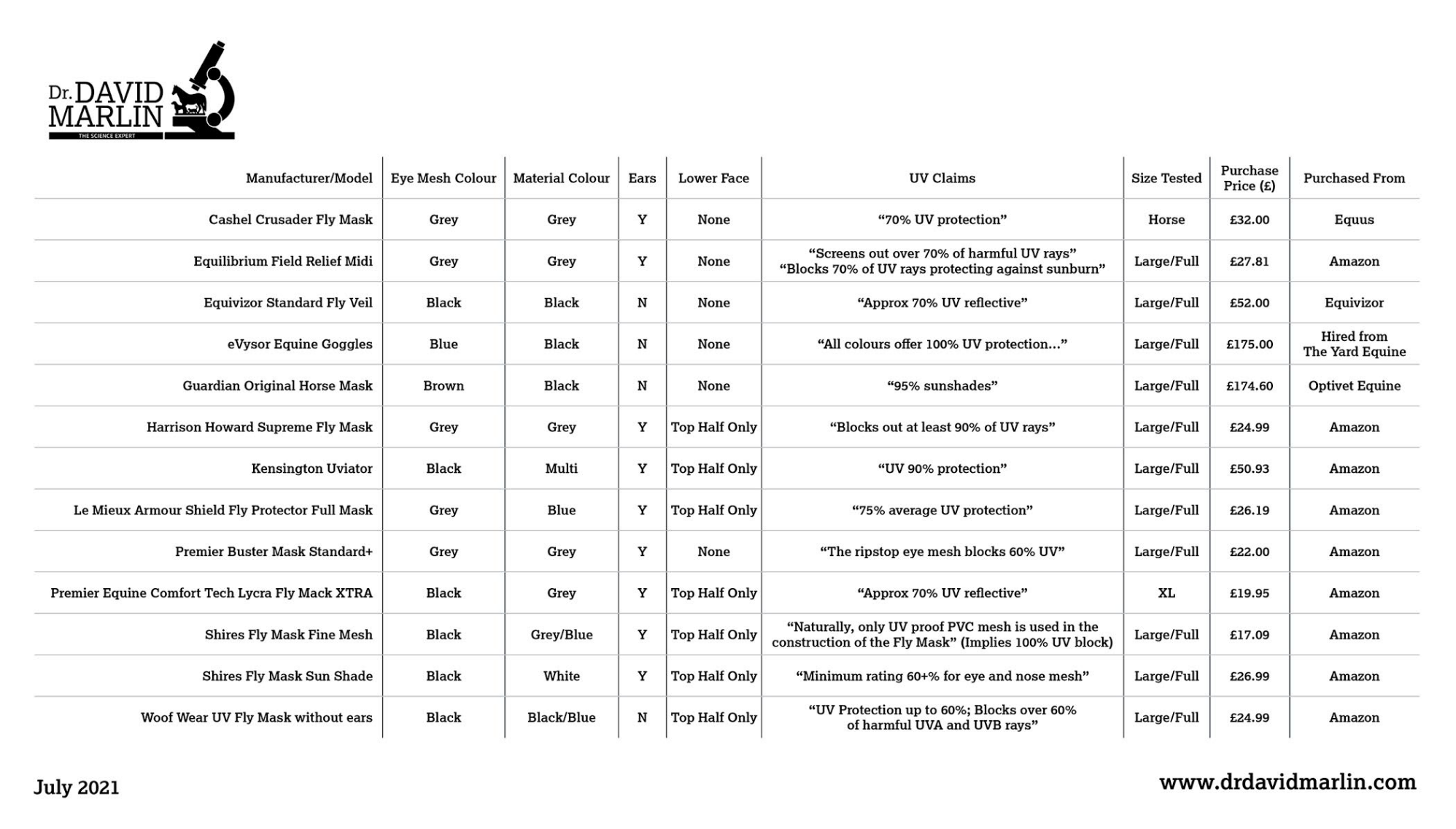
The products tested, the colour of the mesh covering the eyes, the colour of the material covering the rest of the face, covering of ears and lower face, UV claims made by the manufacturer, the size purchased, the purchase price and where purchased are shown in the table below.
The median UVA+UVB value for the testing was 5.7±1.2 mW/cm² and the median Lux value was 127,100±17,000 Lux.
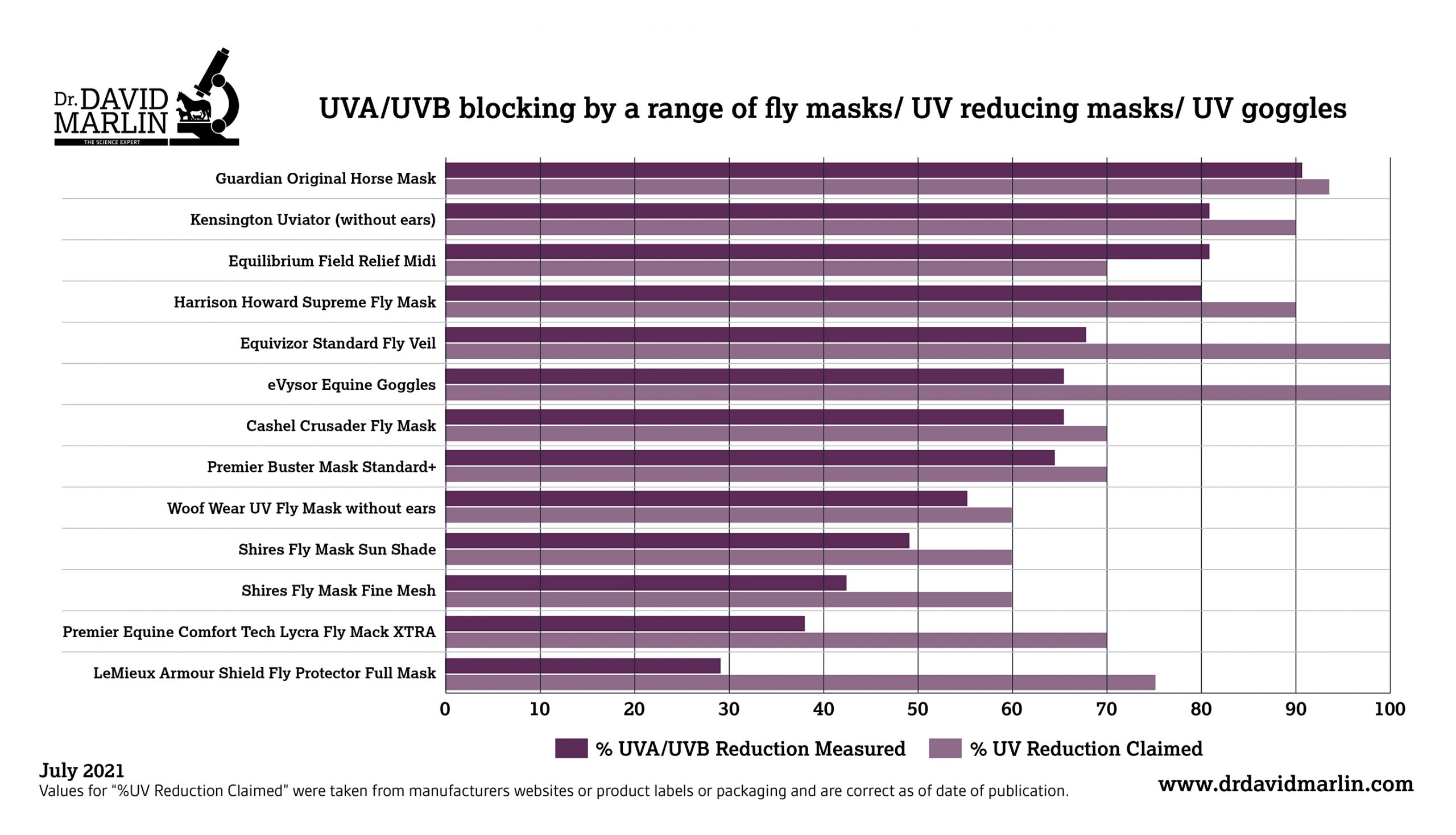
The amount of UVA+UVB blocked by each mask is shown below. The darker purple colour bar shows the amount of reduction measured in our tests, whilst the lighter purple bar shows the amount of blocking claimed by the manufacturer. Only one manufacturer met their claim – Equilibrium Products Ltd (Field Relief Midi). None of the other manufacturers’ products met their claims (taken from their websites and/or the product packaging). We did approach Equivizor (Australia) to clarify their claim but they were unwilling to provide clarification. The largest discrepancy between claimed UV blocking and measured UV blocking was for the LeMieux Armour Shield Fly Protector Full Mask. The mask that blocked the highest amount of UVA+UVB was the Guardian Original Horse Mask (91% reduction; purchase price £174.60), followed jointly by the Kensington Uviator (81%; purchase price £50.93) and Equilibrium Field Relief Midi (81%; £27.81) and the Harrison Howard Supreme Fly Mask (80%; purchase price £24.99).
 (Click graph to enlarge)
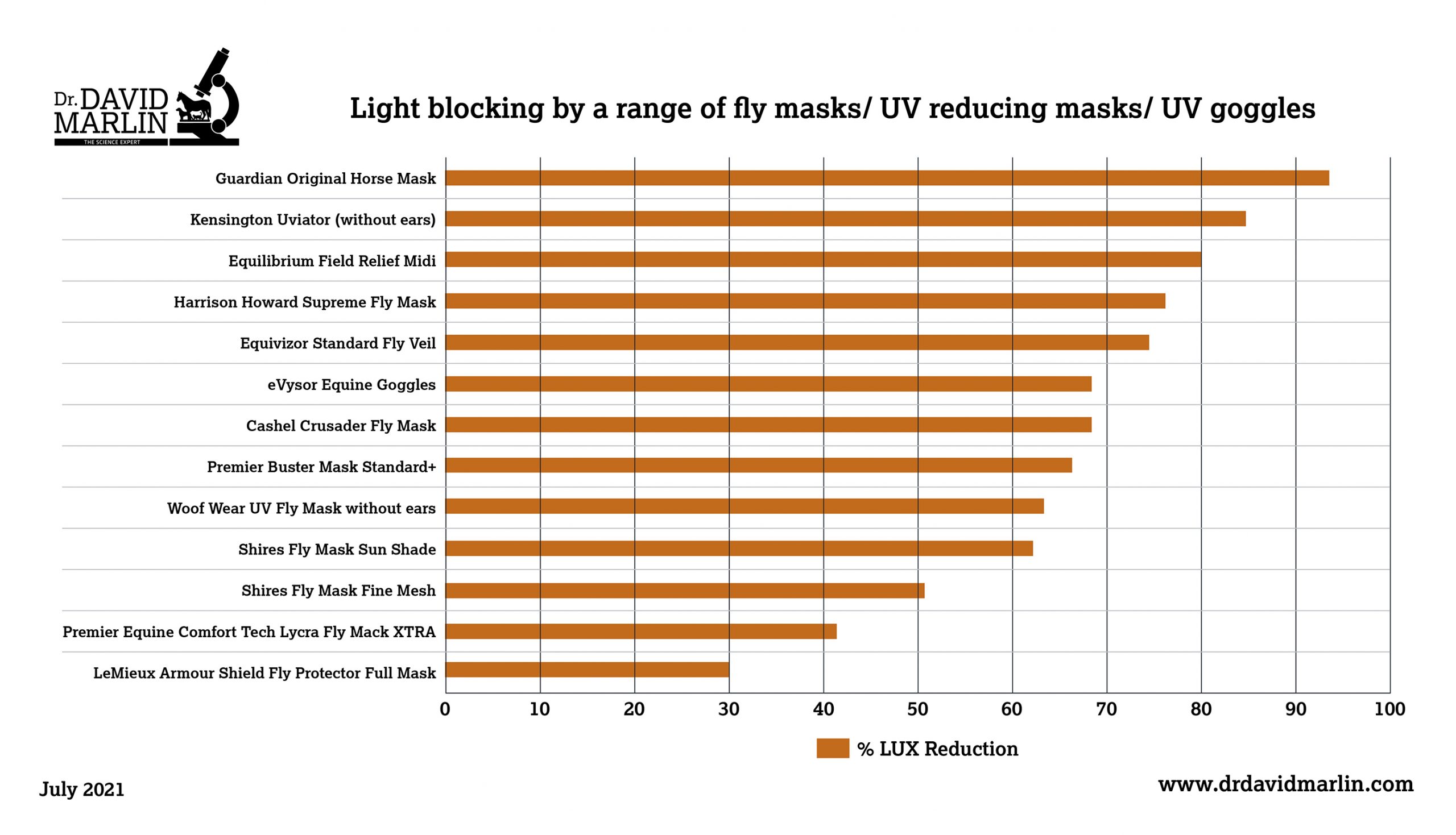
The figure below shows the amount of light blocked by each mask. Essentially the more UVA+UVB that a mask blocks the more light is also blocked.
 (Click graph to enlarge)
Our recommendations
- Choose a white or grey mesh and material mask in summer as dark colours will be hotter and more uncomfortable.
- Based on our independent testing, if you are looking for a mask to reduce UVA/UVB exposure to the eyes for a horse affected by uveitis or headshaking or any other medical condition then either the Equilibrium Field Relief Midi (£27.81; 81% UV blocked; Grey) or the Harrison Howard Supreme Fly Mask (£24.99; 80% UV blocked; Grey) would seem the best options to start with, followed by the more expensive Kensington Uviator (£50.93; 81% UV blocked; Black).
- I would only recommend spending over £170 for the Guardian Original Horse Mask for an extra 10% UVA+UVB protection if you try one of the 80% blocking masks and this doesn’t help your horse’s problems.
- The Kensington Uviator and Harrison Howard Supreme Fly Mask both have lower face coverage whereas the Equilibrium Field Relief Midi tested does not, although Equilibrium do sell the Field Relief Fly Mask Max in black or grey for £34.50 (Equilibrium website) which was also voted Horse & Rider Best in Test Winner 2021.
To read a member’s review on how these masks fitted a 16’2 and 17’2 horse click here.