


Facebook is filled with posts asking for advice on which bit will solve a problem the rider is experiencing with their horse. Now, I am the first to ask for advice when I am faced with a problem outside of my experience or expertise. But I notice that many of these posts either are looking for a stronger bit, or responses advise a stronger bit. This has prompted me to share my thoughts on this particular aspect of bitting.
Firstly, it’s important to consider what factors make a bit ‘stronger’. This is actually quite simple: a stronger bit exerts greater pressure, exerts pressure on more parts of the mouth/head, or a combination of both. This can be achieved through the addition of:
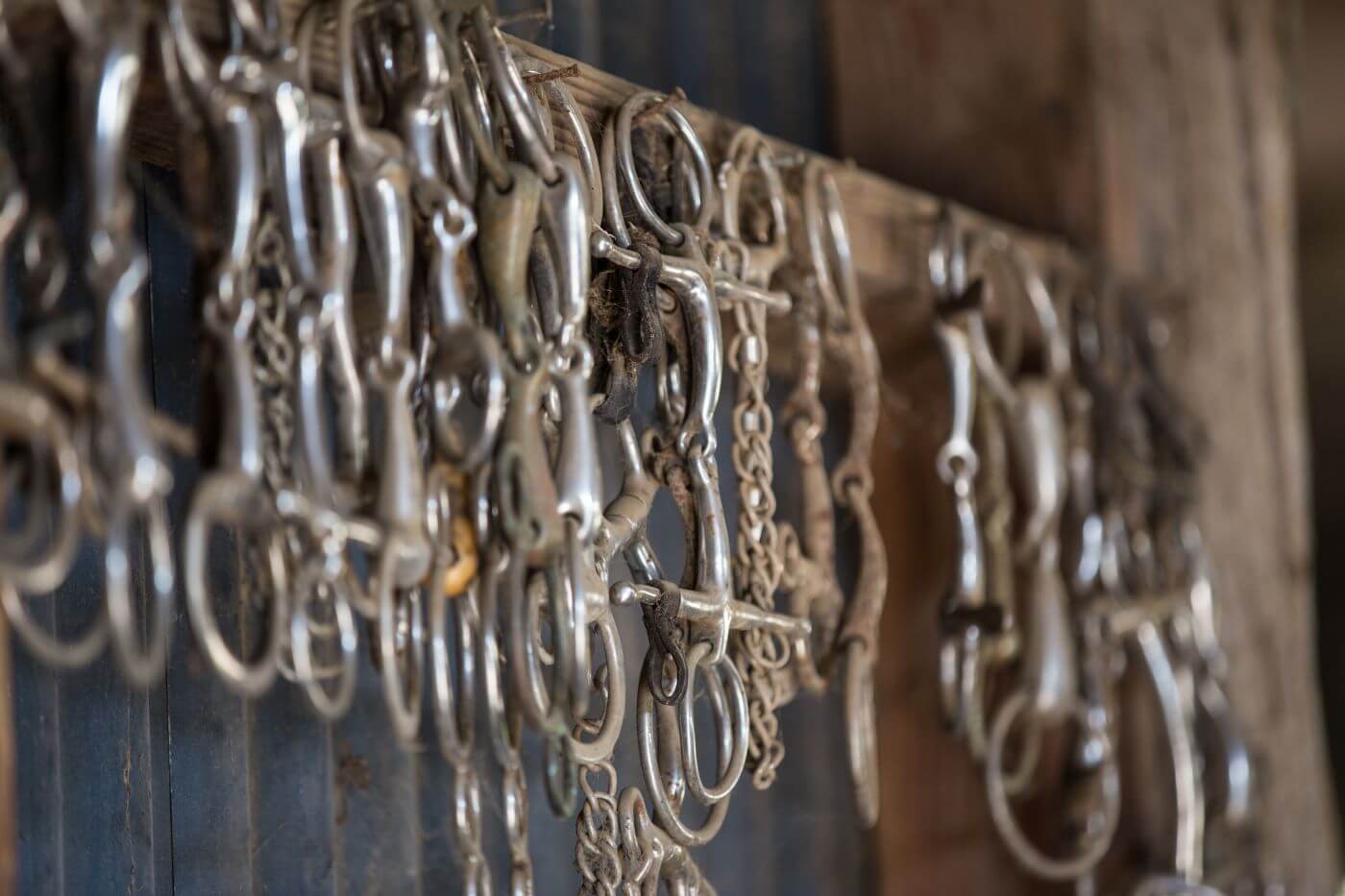
- Leverage. In the case of a shanked bit (where rein is attached lower that mouthpiece) that will bring lever action into play, not only adding pressure to the poll and chin groove (if curb chain is utilised) but also applies greater pressure with less effort.
- Pulley Action: in the case of running gags, pressure applied to mouth and poll is amplified requiring less effort from the rider.
It should be noted that, with both lever and pulley action bits, the force applied to the poll is less that would be expected with a mechanical lever or pulley as the fulcrum in this case is not ‘fixed’ because the soft tissues of the mouth compress. That said, the pressure applied is still greater that without the lever or pulley mechanisms and horses have varying tolerances to poll pressure.
- Mouthpiece design: the design of the mouthpiece can increase the number of areas in the mouth where the bit applies pressure.
This begs the question… why can stronger bits be effective? Well, they are a form of aversive training. Yes, all bits are to a greater or lesser extent; however, by definition, a stronger bit is applying more and stronger aversive forces.
Most of our aids when riding are the application of negative reinforcement to increase the desired response. Simplistically, we put our leg on, the horse moves forward, we remove the leg aid. We apply rein tension and release when the desired result is given. The negative in this context refers to the removal of a stimulus. Stronger bits apply a stronger stimulus.
As riders, we should be looking to train and achieve the best results through the application of tolerable and clear communication without compromising our own safety and that of our horses.
However, realistically, there are behaviours and issues that we want and need to remove. The list is long, but here are a handful I have seen in social media posts that riders are seeking to resolve. Now, while these may be down to the horse’s temperament, excitement levels, level of training, pain/discomfort unrelated to the bit or bridle, rider skill, these can also be caused by bit and/or bridle issues.
Leaning on the bit and/or Rushing can be caused by excess tongue pressure from the bit causing discomfort, or from restriction affecting the hyoid/TMJ impeding ability to use correct biomechanics. Bridle fit and a tight noseband can also contribute to or cause these issues.
Snatching the reins can be due to excess pressure from the bit (either design/fit or overly strong contact), pressure on the tongue, which can inhibit swallowing, or the bit putting pressure on the genioglossus (sensitive muscle of the tongue).
Tongue evasions and opening the mouth which impede ‘control’ such as tongue over bit, drawing the tongue back, sticking it out of the side or a gaping mouth are often due to excess pressure from the bit, especially if the mouthpiece is too thick for the horse’s mouth.
Head tossing can be caused by excess poll pressure, tight nosebands, pressure on the auricular cartilage, and other bridle issues.
Conflict behaviours can present due to pain or discomfort from either bit or bridle fit.
Increasing the forces that may be the root of the problem by employing a ‘stronger bit’ may mask the issue due to the aversive nature of the action of the bit or potentially cause further escalation of undesirable behaviours. In all instances, I strongly recommend assessment of existing tack to identify and remove any issues that are caused by either bit of bridle.
For example, one of the more common and easiest problems to solve is insufficient room in the mouth to accommodate a thicker mouthpiece. When a bit places pressure on the tongue, bars, hard palate and lips before a contact is taken, it is far harder for the horse to recognise and respond to a light rein aid. A bit that truly fits and is correctly placed in the mouth, enhances clear communication from rider to horse. Therefore, it may be possible to eradicate these behaviours and reactions by switching to bit that is suited to the horse’s oral conformation and individual sensitivities and preferences. A simple change of headpiece, or noseband, can also make significant improvements to performance, comfort and communication.
Pragmatically, however, in the real world there are circumstances when having that extra pressure ‘in the toolbox’ may be required, be that hunting, cross-country, fun rides, or jumping. If that is the case, I am an advocate of using two reins… the rider has that ‘extra’ rein aid available but can choose if, and when, they need to apply it.
In conclusion, identifying what causes a behaviour or reaction and removing the issue can have a surprisingly good outcome, improving a horse’s comfort, performance and responsiveness. A qualified and independent bit & bridle fitter will do just that and, if a stronger bit is required, will be able to recommend the most appropriate bit that will provide a clearer and more effective rein aid without compromising the horse’s comfort.
