


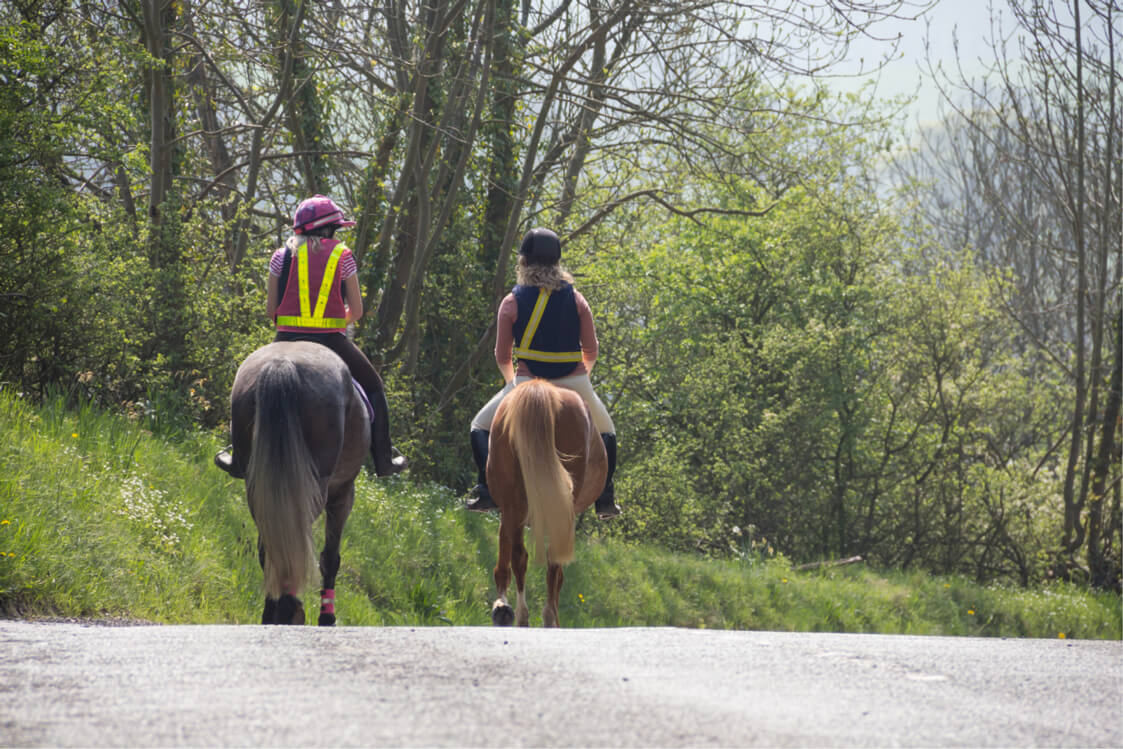
A new professional development course is aiming to ensure the needs of horse riders are considered more widely when roads and transport infrastructure are planned and designed.
The Horse Riders as Road Users course has been launched by the Chartered Institution of Highways and Transportation (CIHT) and is being supported by the British Horse Society (BHS) as part of efforts to improve safety for equestrians using the road network.
The one-hour online course is aimed specifically at transport planners, highway engineers, policymakers, active travel professionals and infrastructure designers.
Rather than focusing on educating riders or motorists, the training addresses another important part of the road safety picture – the people responsible for designing and managing the roads themselves.
Horse riders still overlooked in transport planning
According to CIHT, the course is the first eLearning programme dedicated specifically to equestrian road safety and has been developed to address gaps in transport policy, research and infrastructure design.
It examines the legal status of horse riders as road users, factors affecting equestrian road safety, infrastructure design and the importance of engaging with equestrians when developing transport schemes.
The issue is particularly significant because the Highway Code recognises horse riders as vulnerable road users, yet CIHT says they remain largely absent from mainstream transport planning.
The organisation estimates that around 1.5 million people ride horses on UK roads three to five times a week, while comparatively little research has been carried out into their needs as road users.
Course author Catherine Chapman, Managing Director of ADL Traffic & Highways Engineering Limited, said transport professionals need to recognise horse riders as vulnerable road users rather than treating equestrian access as a specialist or niche issue.
Almost 20,000 incidents in ten years
The course comes against the backdrop of continuing concern about the safety of horses and riders on UK roads.
Figures released by the BHS to mark ten years of its Dead Slow campaign show that 19,528 road incidents involving horses were recorded between 2016 and 2025.
During that period:
- 559 horses were killed and 964 injured
- eight people lost their lives
- 999 people were injured.
In 2025 alone, 2,810 incidents were reported to the BHS. Although this represented a 10% reduction compared with 2024, 59 horses were killed and 86 people were injured.
Unsafe passing remains a major concern. The BHS reported that 78% of incidents in 2025 involved a driver passing too closely, while 83% involved vehicles passing too quickly.
Changes to the Highway Code introduced in 2022 advise motorists to pass horses at no more than 10mph and to leave at least two metres of space.
Designing safer roads for equestrians
The new training takes the issue beyond individual driver behaviour by encouraging those responsible for future roads, active travel schemes and other transport infrastructure to consider how their decisions affect equestrians.
The five-module course covers road safety, infrastructure design, stakeholder engagement and real-world examples, with the aim of giving transport professionals practical approaches they can incorporate into future projects.
The BHS said the initiative represented an important step towards improving road safety and creating more inclusive infrastructure for horses and riders.
For horse owners, the development is significant because road safety is not simply about how an individual motorist behaves when approaching a horse. Decisions made much earlier – when roads, junctions, crossings and active travel routes are planned or altered – can also determine how safely equestrians are able to use and navigate the network.
The BHS continues to encourage riders to report road incidents and near misses through its Horse i app, with the information helping the charity identify problem areas and support its work with local authorities, police and policymakers.
For the full story, lease follow the link to CIHT Horse Riders as Road Users course information and the BHS Dead Slow campaign
*The figures are from the BHS’s latest ten-year Dead Slow statistics, while the detail about the course comes directly from CIHT.
