


Horses have large and mobile outer ears that they can direct towards sounds in order to hear more clearly. They can rotate the outer ear through 180° due to the presence of 10 auricular muscles – compared with our 3. In fact, in the absence of flies or other stimuli, often an indication that our horse can hear something that we can’t is the movement of the ears. The size and shape of the horse’s ears have been estimated to improve the horse’s hearing sensitivity between 10 and 20dB (decibels). The decibel scale of sound intensity (loudness) is a log scale. So, an increase of 10dB actually represents an increase in loudness of 10 times, and an increase of 20dB means an increase of 100 times. Absolute quiet is very rare and is usually defined as 0dB. You can usually only experience this in a soundproof room. Here you can hear your own heartbeat, and most people find it very uncomfortable within a few minutes. The “noise” in my office from my computer and the wind outside as I write this is ~35dB. Most people would consider this very quiet. Some examples of the loudness of different sounds are shown below.
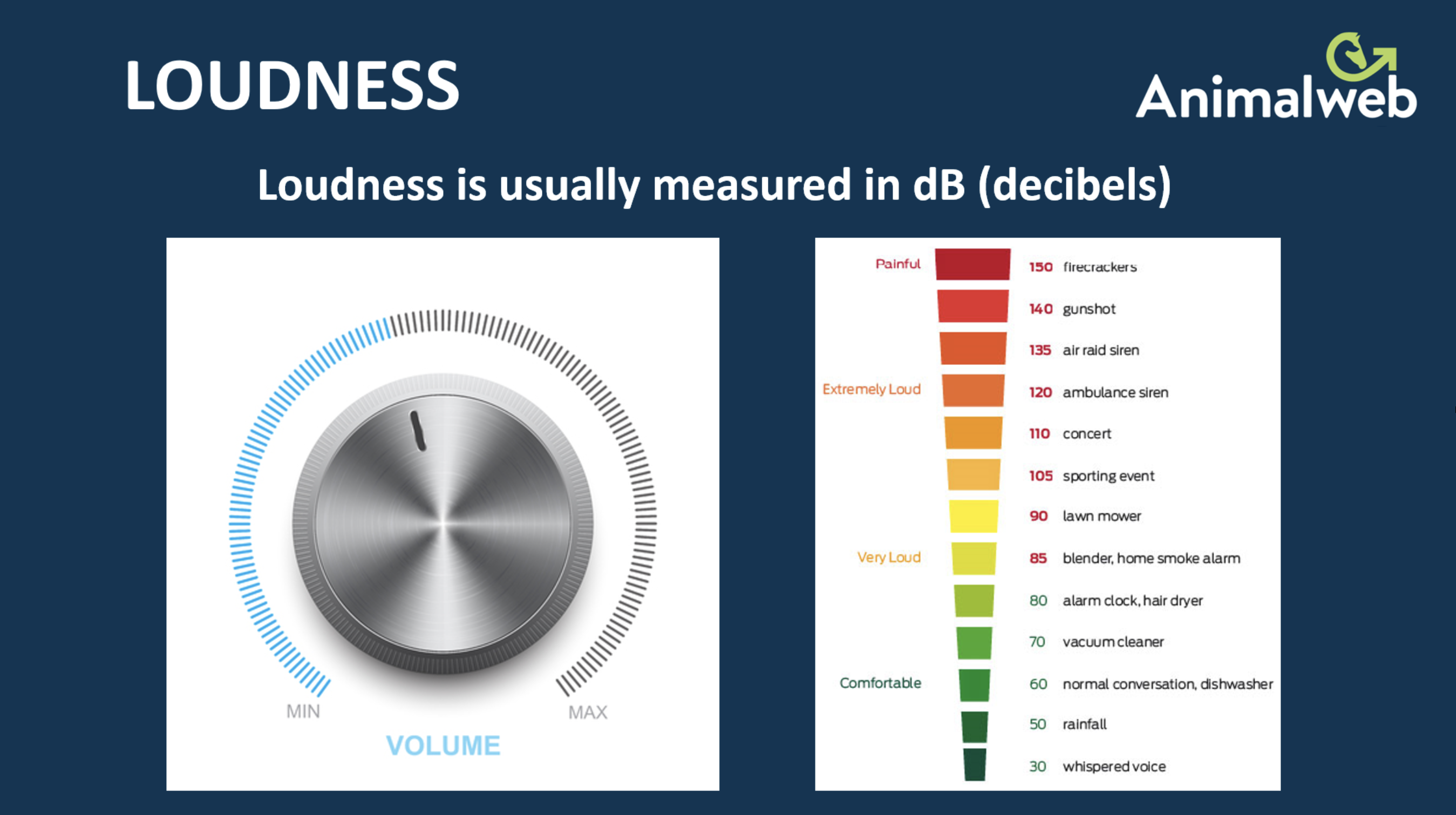

Although we don’t know exactly how much more sensitive horses hearing is compared with ours, they are probably at least 10x more sensitive, meaning that they can hear sounds way before we can OR that what we perceive as low-moderate volume a horse may experience as very loud.
Of course, hearing is not only about volume but also about frequency or “pitch”. A high frequency is a high pitch, e.g. soprano, and a low frequency is a low pitch e.g. bass. Below are examples of low, medium and high-frequency sounds and a representation of the sounds as “waves”.

We have a lower hearing range than our horse; from as low as 20Hz to 20,000Hz (or 20KHz). Whilst our horse can only hear sounds as low as 50Hz, they can hear sounds between 20,000Hz and as high as 33,000Hz which we can’t. Generally, larger animals hear lower frequencies and smaller animals hear much higher frequencies, and the horse is actually unusual in this respect in they have a limited ability to hear low frequencies. For example, elephants can hear frequencies as low as 12Hz. Horses are believed to be most sensitive to frequencies in the range of 1000 to 15,000Hz.

There are a number of common sources of sounds that are above our upper hearing range which our horse could hear but we can’t. This could include ultrasonic pest repellers, many species of bats and dog whistles.

So combined with much more sensitive hearing and the ability to hear sounds that we can never hear in the 20,000-33,000Hz range, it may not be surprising that horses and ponies often appear to be listening to or reacting to things we can’t hear. This increased hearing ability has a clear evolutionary advantage allowing the horse to hear potential danger from a very long way away. But sometimes, it may be a disadvantage when trying to ride horses. And of course there have been many products developed to try and block sound from horses ears. We tested most of the commercial products on the market LINK. None of the products tested blocked 100Hz (human speech is around 80 to 255Hz). Two products showed a reasonable ability to block sound at 1000Hz – this would be similar to mosquito buzzing and crowd cheering/whistling. The majority of the products tested blocked a reasonable amount of noise in the 10,000 to 20,000Hz range, but not the two products that blocked the lower frequencies. So the choice of “acoustic ears” should depend on what noise you think may be present. A tricky one.
What else do we know about how horses react to sound? Recently, Ruth Hole, daughter of Dr Rachel Murray (ex-AHT, Rossdales, Team GB), and I conducted some research on how horses react to different sounds. Eighteen horses and ponies were played 20s of one of 5 different sounds at 67dB at their ear in random order, and we recorded their behavioural and heart rate responses. The sound was horse whinny, the crowd clapping and cheering, horse trotting, music (We Are The Champions by Queen – often used during equestrian prize-giving ceremonies), and nuts being scooped into a bowl. All sounds produced a small but significant increase in heart rate of 10-15bpm compared with background noise/no sound (40bpm), with the exception of the trotting sound, which produced an average increase of over 40bpm to above 80bpm. The total number of behavioural responses was also greatest with trotting, but feed and whinny sounds also produced high numbers of responses. Acoustic ears did not produce a clear reduction in heart rate when the sound was replayed with them, but there were significant reductions in total behaviours for feed, trotting and applause, so it’s likely the product tested (Gerald Soundless Ears; Equiline, Veneto, Italy) did have some effect.
(Link – Webinar – Ear bonnets / acoustic ears tested by Dr David Marlin).
Summary
Horses have both sensitive hearing and can hear frequencies in the range 20,000 to 33,000Hz which we cannot. Bats, dog whistles and pest repellers emit frequencies in this range. So when your horse appears to be reacting to “nothing”, especially if there is a lot of ear movement, it may well be sounds you can’t hear. If your horse does seem to be quite “reactive” then it may well be worth trying a set of sound reducing “ears” (acoustic ears).
References
- Heffner H.E., Heffner R.S. Sound localization in large mammals: Localization of complex sounds by horses. Behav. Neurosci. 1984;98:541–555. doi: 10.1037/0735-7044.98.3.541.
- Heffner R.S., Heffner H.E. Hearing in large mammals: Horses (Equus caballus) and cattle (Bos taurus) Behav. Neurosci. 1983;97:299–309. doi: 10.1037/0735-7044.97.2.299.
- Heffner, Henry & Heffner, Rickye. Handbook of the Senses: Audition. https://www.researchgate.net/publication/220008867_Handbook_of_the_Senses_Audition
- Hole C, Murray R, Marlin D, Freeman P. Equine Behavioural and Physiological Responses to Auditory Stimuli in the Presence and Absence of Noise-Damping Ear Covers. Animals (Basel). 2023 May 8;13(9):1574. doi: 10.3390/ani13091574. PMID: 37174609; PMCID: PMC10177151. https://pubmed.ncbi.nlm.nih.gov/37174609/
- Mc Brearty A, Auckburally A, Pollock PJ, Penderis J. Evoked otoacoustic emissions: an alternative test of auditory function in horses. Equine Vet J. 2013 Jan;45(1):60-5. doi: 10.1111/j.2042-3306.2011.00542.x. Epub 2012 Feb 2. PMID: 22296459.
- Rørvang MV, Nielsen BL, McLean AN. Sensory Abilities of Horses and Their Importance for Equitation Science. Front Vet Sci. 2020 Sep 9;7:633. doi: 10.3389/fvets.2020.00633. PMID: 33033724; PMCID: PMC7509108.https://www.ncbi.nlm.nih.gov/pmc/articles/PMC7509108/
- Timney, B., & Macuda, T. (2001). Vision and hearing in horses. Journal of the American Veterinary Medical Association, 218(10), 1567-1574. Retrieved Apr 6, 2024, from https://doi.org/10.2460/javma.2001.218.1567
