


The aim of this article is to guide owners and carers through what to expect and how to prepare prior to their dog undergoing surgery to fix a cruciate tear and how to go about rehabilitating the dog.
What is the Cruciate ligament?
The cranial cruciate ligament, CCL (ACL in humans), connects the thigh bone and femur to the tibia or shin bone. Its job is to provide stability and prevent the tibia from sliding forward. There are several ways this can happen such as:
- Landing awkwardly when playing
- A fast deceleration
- Pivoting when chasing something.
Although a cruciate tear is a major injury, it is a fixable injury. It is the most common orthopaedic surgery carried out on canines. Your dog will recover with the help of your vet and a physiotherapist. The role of the vet is to surgically provide mechanical stability to the joint and manage any pain. A physiotherapist during rehabilitation will help improve mobility, when appropriate, as well as increase muscle mass. They will also help with pain.

Importance of Preparation and Rehabilitation
If you had surgery to repair their ACL, you would be in a physiotherapist clinic within 24 hours, so why should your dog’s be any different? Carrying out a structured rehabilitation programme for your dog following surgery with the help of a physiotherapist will reduce the risk of complications and speed up recovery. The physio will also be there to guide you through the programme and assure you that everything is going to plan!
Rehabilitation is important as, according to some studies, there is up to an 80% chance that the other leg will tear within a year of the first. Cruciate injury is also the leading cause of knee arthritis in dogs so it is important to get that leg as strong as we can, as quick as we can to reduce the likelihood of long-term issues.

How to Prepare
Before bringing your dog home, you need to know how you are going to confine them when you
are not around. A crate is a good option. However, if your dog is not used to being crated, gating
off a small room is also a great option.
Flooring
When you get home, the surgical leg will be painful. The dog will not be able to fully weight bear through it. Because if this it is important that your dog does not slip in the first few weeks of recovery. Slipping could cause the dog to use that leg and put strain through the repaired knee. Dogs can struggle to grip on laminate, tile or wooden floors. To offer some support, it is a good idea to put rugs or carpet down to reduce the risk of slipping.
Furniture
Your dog may be used to getting up on the sofas or beds. You will need to block these off or confine the dog in a different room when not supervised. The explosiveness needed to jump up on furniture will, again, but unnecessary stress through the leg.
Stairs
Ideally, your dog should not attempt to navigate stairs at all in the first few weeks. However, sometimes this is not possible. On stairs that your dog does have to negotiate, they will need belly support to reduce the weight going through their leg. You can use a purpose made sling or harness. A towel under the belly also works well.

Walks
For the first week, the only walking your dog should be doing is out to the toilet. This should all be done on lead. NO OFF LEAD TIME! When off lead the dog can jump and pivot, potentially harming the leg.
Do not use a flex lead as it will allow the dog too much freedom. Use a short lead to keep them under control.
Family Members
Ensure that all of your family knows the rules! It is no good having one person enforcing and keeping the dog under control if someone else is letting them do what they want!
Make sure everyone is on the same page and knows what the dog is allowed to do in the early stages of rehab.
You are going to be putting a lot of time and effort into rehabbing your dog, but you are not on your own. Your vet and physiotherapist will always be willing to help or answer any questions you have. If you feel something is not right, don’t hesitate to contact them, its their job!
How can Physio help?
Physiotherapists are trained to reduce pain, increase mobility and get dogs back on their feet. As cruciate surgeries are the most common orthopaedic surgery, they are also the most common cases that physios deal with!
There are many exercises/treatments that can still be done with your dog in the first few weeks of recovery, even when they are crated. The main aim of these is to reduce pain and stiffness without weight bearing.
We can use things such as massage, cold and heat therapy, laser and range of motion exercises to make the dog more comfortable and get them on the path to a strong and quick recovery. The physio will give you exercises to do at home also so that your dog has the best chance.
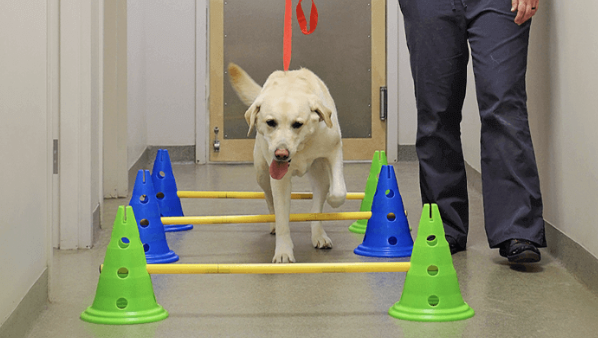
This can be a daunting time for any owner. Your animal physiotherapist is here to make the process easier and help your dog return to how they were before the injury occurred.
