


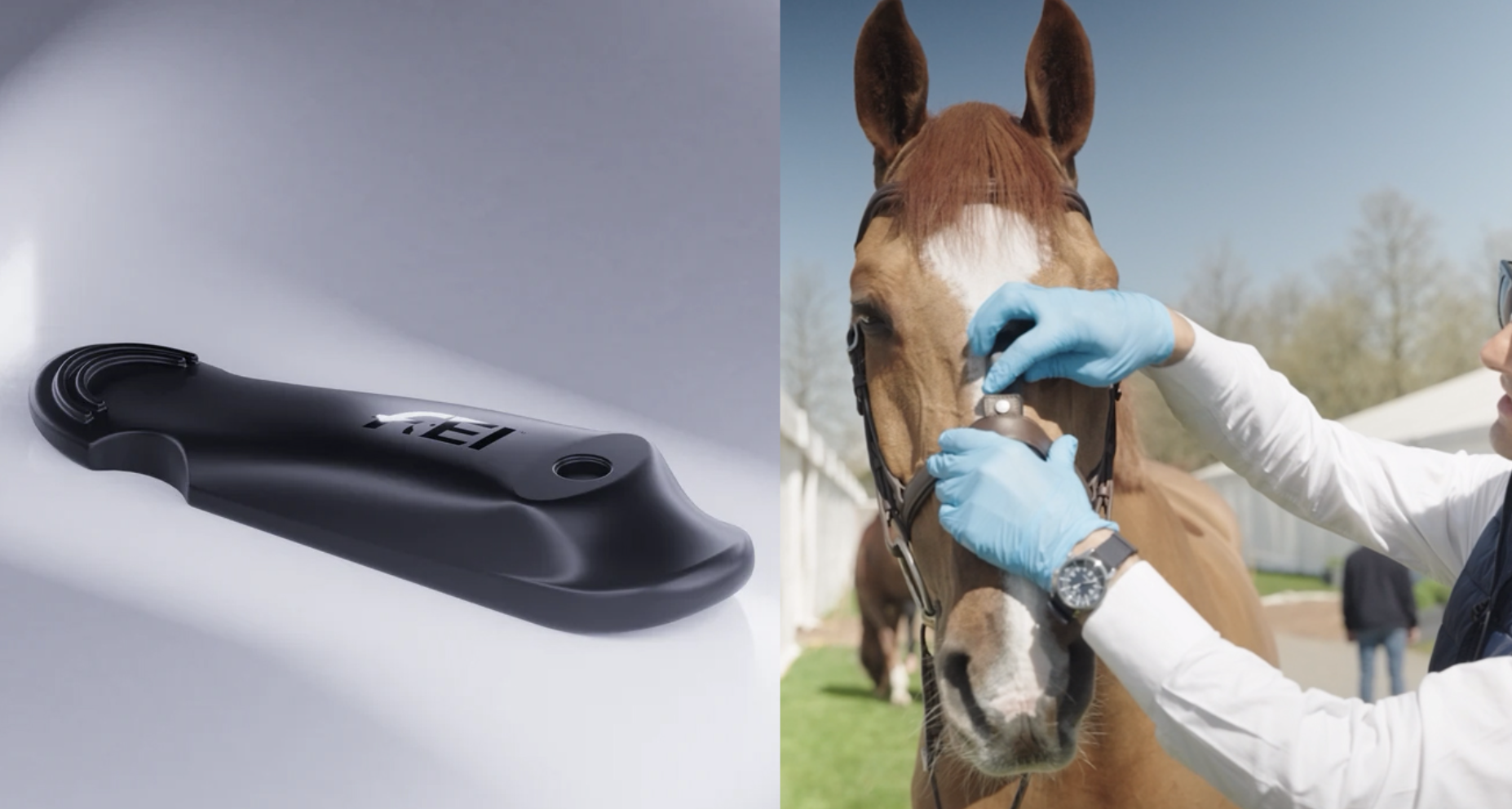
New research involving 523 horses competing at British Dressage championships has found that 95% passed noseband tightness checks using the Fédération Équestre Internationale (FEI) measuring device, suggesting a positive shift in noseband fitting practices and awareness of equine welfare.
The study, published in the Equine Veterinary Journal, involved several leading equine researchers, including Animalweb founder Dr David Marlin, Dr Russell MacKechnie-Guire, Professor Hilary Clayton, Professor Jane Williams, Dr Vicki Walker and Dr Rachel Murray.
Researchers observed mandatory tack and equipment checks at three major British Dressage competitions in 2025: the National Championships, Middle Tour Championships and Area Festival Championships.
Of the 523 horses assessed, 496 (95%) passed the noseband check, while just 27 (5%) initially failed because their nosebands were too tight to allow the FEI measuring device to pass beneath them. All 27 subsequently passed after their nosebands were adjusted.
A Positive Change for Horse Welfare
Noseband tightness has been a longstanding welfare concern within equestrian sport, with previous research identifying high levels of overtightened nosebands in competition horses.
A 2017 international study involving 750 horses found that 73% had nosebands adjusted tighter than the equivalent of 1.5 fingers, while in 44% of horses, the measuring gauge could not be inserted beneath the noseband.
The latest findings represent a substantial improvement compared with those earlier results, although differences in study populations and measurement methods mean a direct comparison should be treated with caution.
The researchers suggest that improved education about noseband pressure and the introduction of mandatory checks may be encouraging riders to adopt better fitting practices.
The FEI introduced its evidence-based noseband measuring device in May 2025, following scientific research into the pressures exerted on horses’ facial structures by nosebands adjusted to different levels of tightness.
The device is designed to provide an objective assessment of whether a noseband has sufficient looseness, replacing more subjective approaches such as estimating tightness using fingers.
Horses and Riders Respond Positively
One of the concerns surrounding the introduction of mandatory noseband checks was whether horses would tolerate the procedure.
However, the research found that 96% of horses were classified as compliant during testing, standing still without head movement that interfered with the assessment.
Only 2% were classified as satisfactory and a further 2% as non-compliant.
The researchers also interviewed 45 riders and six stewards to understand their experiences of the new checks.
Feedback was largely positive, with riders welcoming the clarity and consistency provided by the measuring device. Some reported that they had already loosened their horses’ nosebands or intended to use the device during everyday training.
Stewards also reported feeling confident and safe when carrying out the assessments, highlighting the benefits of a straightforward pass-or-fail system.
Does Noseband Type Make a Difference?
The study also recorded the different noseband designs used by competitors.
Swedish nosebands were the most common, accounting for 39% of horses, followed by flash nosebands (29%), cavessons (21%), drop nosebands (9%) and grackles (2%).
Of the 27 nosebands that initially failed, 15 were flash nosebands, 11 were Swedish nosebands and one was a drop noseband.
The researchers suggest that incorrect adjustment, rather than noseband design alone, is likely to be an important factor in failures.
They also emphasise that padding does not remove the need for adequate noseband looseness.
Research Supporting Better Welfare Standards
The findings provide encouraging evidence that scientific research, education and changes to competition regulations may be helping to improve noseband fitting practices.
However, the authors acknowledge that the study did not include a detailed behavioural assessment of the horses, meaning it cannot establish the wider welfare effects of the checks or noseband adjustments.
The researchers conclude that the high pass rate represents a positive change compared with previous findings and demonstrates the practical application of evidence-based approaches to equine welfare.
The study was supported by funding from the Worshipful Company of Saddlers.
Original research: Pass rates using the FEI noseband measurement device at British Dressage 2025 Championships
