


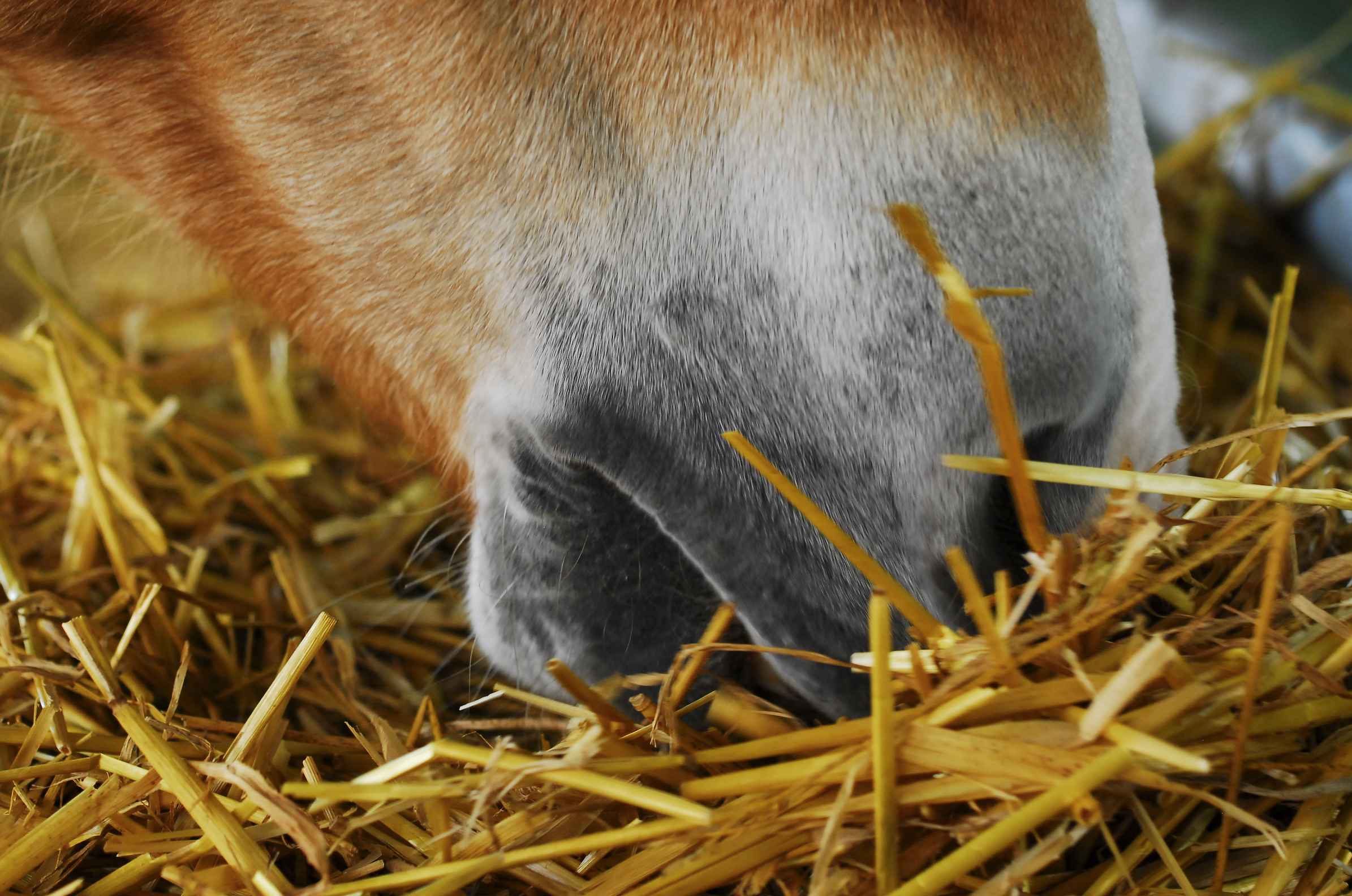
Before you get started, ask yourself these questions: Are they up to date with their dental checks, and is their dentition in good working order? Due to its coarse structure, good dental health is a pre-requisite to feeding straw!
Caution required (discuss with vet prior to introduction): Is your horse on box rest or limited movement/exercise?
While a horse is on box rest or limited movement. As straw can be harder to digest, it can sit in the digestive tract for longer periods. The motility (movement) of the gut is partially reliant upon physical movement to help keep the gut moving, and if the introduction of a harder-to-digest forage source coincides with box rest (or similar), this may increase the risk of impaction. This is not a concern isolated to straw, the same could be said for a later cut hay for example. As always, ensure ample supply of fresh, clean water.
Has your horse had recurrent colic or a recent diagnosis of ulcers? With these horses, we would need to consider introduction timing and protocol more carefully.
When to feed straw and why? You can introduce straw to the ration as part of the forage ration to reduce calorie intake or to provide as bedding with the dual purpose of acting as an alternative forage source for enrichment.
What straw to feed?
- Select a straw that is free of mould and of good quality (bright and clean).
- All straws (oat, wheat, and barley) tend to be lower in digestible energy (calories) and water-soluble carbohydrate (sugars) in comparison to hay and haylage in the UK.
- While there is some variation in nutrient composition across the three straw types, this will also vary with growing conditions and environmental conditions at point of harvest. It is for this reason, much like with hay or haylage, if possible, to analyse straw before feeding. This way you can check in on the nutrient provision and adapt the ration accordingly.
- Intact seed heads within straw should be avoided as this will increase the starch content of the forage and reduce the potential weight loss benefit of straw inclusion.
- Broadly speaking wheat straw tends to be coarser and contain more indigestible fibre compared to oat and barley straw which often makes it the least desirable – however it is the most widely available. Oat and Barley straw tend to be softer; oat straw tends to be slightly higher in digestible energy in comparison to barley and wheat, but this does vary.
- Just like hay or haylage, opt for the straw type that you can get a consistent supply of that is good quality (mould free, with minimal seedheads, bright in colour and clean) regardless of ‘cereal’ type –it is feasible for any straw type to be suitable in terms of nutritional content.
How to feed?
- Before Feeding: As straw is preserved through dehydration (like hay), its high dry matter content often reduces the hygienic quality which means that in an ideal world, straw should be steamed in a high temperature steamer or alternatively soaked for 10-20 minutes (as we would do with hay) prior to feeding. Steaming can also help to increase palatability which can be a challenge when introducing straw. Note that a long period of soaking is unnecessary for straw as we are typically not looking to leach calories (sugars), we are just looking to dampen the straw to reduce respirable particles.
- Soaking or steaming straw also serves the dual purpose of increasing moisture intake, which may help with motility (as mentioned before).
How much to feed and how to introduce?
- Initially aim for straw to contribute up to 25% of the forage ration. For example, for 2.5kg of a 10kg ration. Build up to this gradually over 2-3 weeks mixing it in with the rest of the forage (hay/haylage) ration.
- Mixing the straw in thoroughly with the current forage (hay/haylage) may help with palatability initially while also prolonging chew time and encouraging natural foraging behaviours.
- Research has shown that up to 50% of the forage ration can be fed as straw, but this should be done gradually and in conjunction with your vet and nutritionist where possible.
- As with all nutritional changes, only introduce one change at a time. This helps us to isolate cause and effect and monitor changes.
Things to monitor:
Manure
Knowing what is normal in terms of manure for your horse is just as essential as knowing normal vital signs such as temperature and respiration rate and can be a key indicator of digestive function and overall health. As there can be significant variation between individuals and day-to-day changes can be normal for some horses, ensure that you observe what is typical, prior to making any changes. Considering the following:
- Control – Time it takes to defecate (average is around 15 seconds)
- Frequency – how many droppings per day. Bear in mind that this can vary depending on several factors, one of which is diet and therefore may change throughout the year. On average mares and geldings defecate 6-12 times per day, but this frequency can double with foals and stallions.
- Consistency – ideally faecal balls should be moist but not too wet, with the formed faecal balls. However, for some horses this isn’t their ‘normal’. The material within droppings should be well broken down with no recognisable evidence of long fibre lengths or other feedstuffs. Consistency may change in the short term (for a few movements) post exercise/travel which is normal, however if this change in consistency occurs at an unusual time or is persistent, this may indicate digestive disruption.
- Manure colour is typically a shade of green. This can change depending on diet; a lighter green colour is seen with consumption of lush grass, turning a browner tone with lower quality hay. Any mucous covering may be an indication that food is spending longer than normal in the tract and may be an early warning sign of impaction.
- Changes in smell can coincide with dietary changes. Notably strong-smelling manure can result from rapid dietary changes or high parasitic burdens.
Weight and Body Condition
- With any change to the ration regular monitoring of weight and body condition is key to track the impact of the dietary changes. When moving to a less digestible forage like straw, it can be common for the gut to look more distended (what some might term a hay belly). This can happen where the fibre resides in the hindgut for longer periods to facilitate digestion.
Consumption
- Weigh the forage ration as part of the normal routine and ensure that a minimum of 1.5% bodyweight as dry matter per day is being provided. Be sure to account of haynets as part of the weight (a normal haynet weighs between 0.4-0.6kg but some brands can be significantly heavier).
- Weighing what is provided and what is left for a few days at set intervals can help to track how much forage is actually being consumed which allows you to ensure minimum fibre requirements are being met.
- Dental health should be checked regularly to ensure that straw can be consumed safely.
