


Dr Kirstie Pickles takes a look at the potential for a new test to enable more rational decision making when considering worming drugs.
Following on from her overview of the new CANTER Worming Initiative, Dr Kirstie Pickles, a European specialist in equine medicine, brings us a three-part series about worming in horses.
Here in Part 1, she evaluates the Small Redworm Blood Test, recently launched by science and technology company Austin Davis Biologics, which has shown excellent diagnostic performance in testing for its ability to detect cyathostomin infection in horses, including encysted larvae.
The test has the potential to enable more rational decision making over whether a horse requires worming drugs, which is particularly important given the developing widespread resistance to the traditional winter worming drug, cyathostomin.
By Dr Kirstie Pickles
A test has been launched by Austin Davis Biologics which can be used to detect the presence of cyathostomin (small strongyle, small redworm) infection using a blood sample.
Currently, faecal worm egg counts (FWEC) can be used to identify the presence of adult egg-laying cyathostomins but these give no indication of the presence of the immature larval stages.

These larvae burrow into the large colon wall (Fig. 1, see left) and form cysts where they can stay for variable lengths of time, sometimes for many months or possibly years.
Most deworming drugs have no action on early larval stages, allowing large numbers to build up in the gut wall. Eventually, the larvae continue developing before bursting back out of the wall into the gut to become adults.
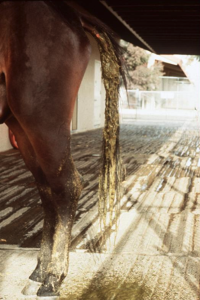
It is this re-emergence of larvae that is associated with clinical disease which can range from colic and lethargy to severe colitis (Fig. 2, see left) with profuse diarrhoea, dehydration and even death.
Once severe colitis has developed, the gut microbiome becomes very dysregulated; making it extremely challenging to treat, as well as expensive due to the intensive care and large amounts of fluids required to maintain adequate hydration. It is reported that 50% of horses with larval small redworm colitis do not survive.
Until now, there was no method of determining if a horse had these larvae in their gut wall but the new Small Redworm Blood Test (SBRT) diagnoses cyathostomin infection in horses, including these clinically important encysted larvae. The test detects antibodies in the horse’s blood to three different small redworm proteins and has shown excellent diagnostic performance in testing.
Traditionally, it has been recommended that horses receive an annual winter larvicidal anthelmintic to kill these larval redworm. However, due to widespread cyathostomin resistance to the worming drug fenbendazole (Panacur Guard®), there is now only one anthelmintic drug, called moxidectin (Equest®), available with larvicidal activity, and its use should be restricted to necessary use only to preserve efficacy.
The SRBT can therefore be used to allow more rational decision making of whether a horse requires a larvicidal anthelmintic dose (Table 1, see below).
Table 1: Use of risk management to determine if administration of larvicidal anthelmintic is necessary
LOW RISK | HIGH RISK | |
Management | Closed herd Poo picking 2-3 times/week Low stocking density No young stock (<5 | Open herd No/poor quarantine Poo removed ≤ once/week Higher stocking density |
Faecal worm egg counts | <200 EPG | ≥200 EPG |
Action in winter | SRBT negative – no treatment | Equest® |
Horses in low-risk environments with good pasture hygiene, including regular poo removal and recent low FWEC results (0-200 eggs per gram, EPG), should be considered for testing. If the test is negative, larvicidal treatment in unnecessary.
Conversely, there is limited value in testing horses to support anthelmintic treatment decisions when they are kept in high-risk environments, or if they or their co-grazers, have recent high FEC results (>200 EPG) as horses are likely to test positive in these circumstances.
The SRBT could also be used alongside history of the pasture management and current FWEC results when considering whether to treat a new horse on a premise with a larvicidal anthelmintic.
The test should not be used until four months after last anthelmintic treatment to reduce the risk of false positive results from the detection of antibodies to previous worm burdens.
Read Part 2 and Part 3 on Worming below:
Worming Part 2: Optimising Faecal Worm Egg Counts testing
Worming Part 3: The dos and don’ts of pasture management
Read more on worming:
