


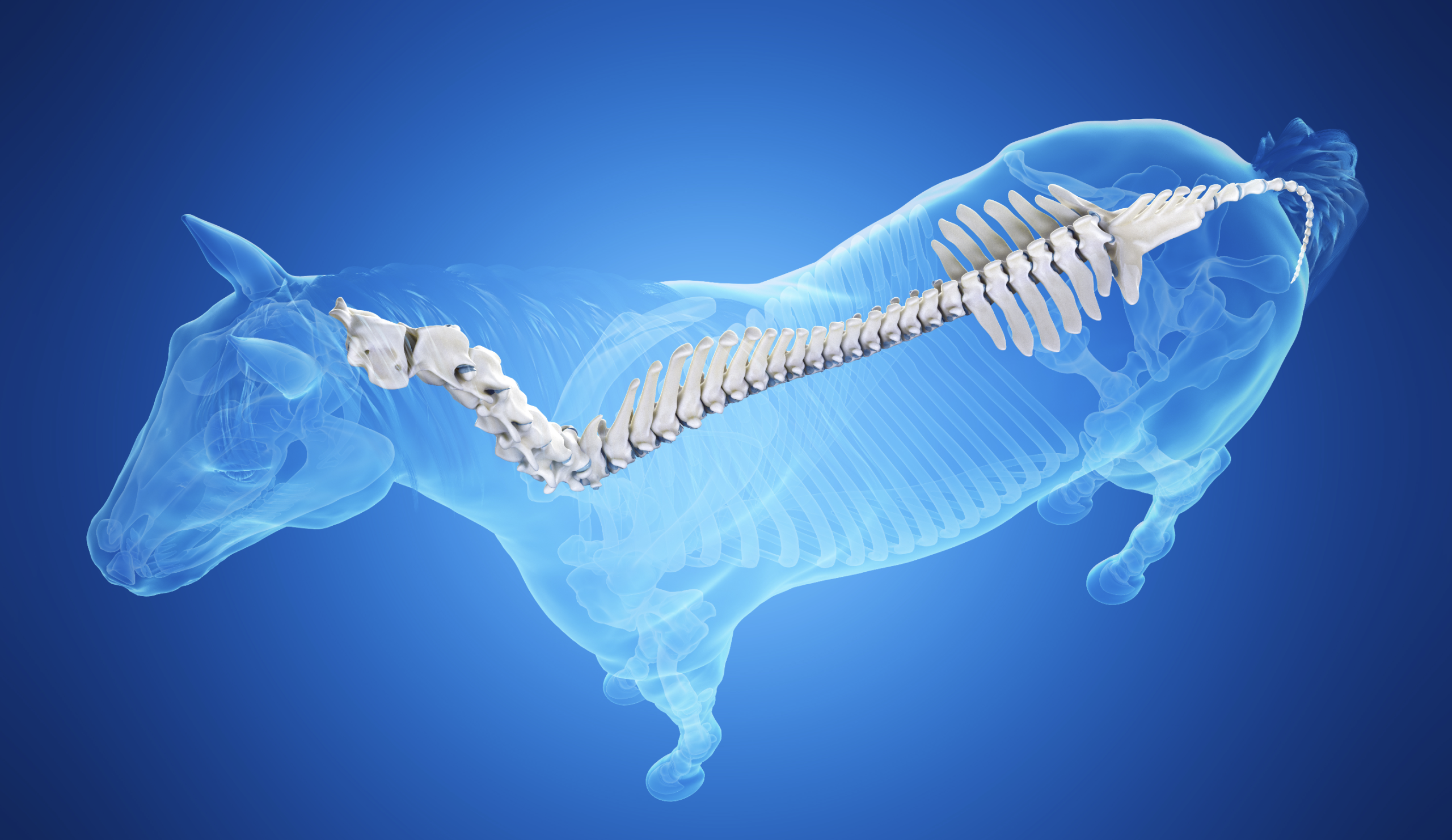
Mild Radiographic Changes & Kissing Spines
In this insightful session, Dr Gillian Tabor explores a recent study on kissing spines, challenging the assumption that radiographic abnormalities always correlate with poor performance or pain. Drawing on both clinical experience and scientific evidence, she discusses the complexity of diagnosing and managing back pain in horses, especially those with mild radiographic findings.
Key Topics Covered
- Understanding Kissing Spines
- What they are: impingement or fusion of the dorsal spinous processes.
- Why they matter: a common diagnosis in horses with back pain.
- Difference between clinical signs and radiographic findings.
- Pain vs Radiographic Evidence
- Horses may show behavioural signs of pain despite only mild or no X-ray changes.
- Conversely, some horses have severe radiographic changes but no outward symptoms.
- New Research Review
- Study of 100 actively competing warmblood showjumpers.
- Found no significant correlation between mild radiographic changes and reduced performance.
- Some mild changes (e.g. narrowing, sclerosis) were actually more common in higher-level competitors.
- Clinical and Management Implications
- Radiographs alone are not reliable indicators of current pain or future performance.
- Importance of behavioural observations and physical examination.
- Consideration for pre-purchase exams: mild changes shouldn’t automatically exclude a horse.
- The Role of Management
- Subtle factors (saddle fit, exercise, turnout, lameness) can trigger clinical pain in horses with existing mild abnormalities.
- Prevention is key: managing horses as if they could develop pain may reduce the risk of it developing.
- Key Message
- Radiographic evidence is just one piece of the puzzle.
- Horses with mild changes can perform well, proactive, consistent care is crucial to long-term soundness and welfare.
Reference Paper – LINK to Mild radiographic abnormalities of thoracolumbar spinous processes are not associated with decreased performance in 100 Warmblood jumping horses in active competition
Kerbert, M.P., le Jeune, S.S., Philips, K.L., Shaw, K.L., Erickson, C.A. and Espinosa-Mur, P., 2025. Mild radiographic abnormalities of thoracolumbar spinous processes are not associated with decreased performance in 100 Warmblood jumping horses in active competition. Journal of Equine Veterinary Science, p.105366.
MEMBERS CAN LOG IN TO WATCH

To read the rest and learn how this will help you, join us by clicking the banner below.

Already a member? Log in here
Join us now to view this article PLUS 1000s of
- tips
- articles
- videos
- money saving ideas
- reviews
- webinars
- podcasts
- news
And so much more!
Science backed horse care at your fingertips - dip in for information when you need science to help you care for your horse.
Transcription
Here is a transcription of the webinar. (Please note this is an automated transcription, so we apologise for any errors.)
Hello and welcome to this webinar on kissing spines. In this webinar, I’m going to cover a recent paper that has been published on this commonly discussed topic. And we’re gonna talk about the research that was conducted, a little bit of a background on kissing spines, and then really trying to apply what the conclusions are from the study into our work with our own horses.
So my name is Gillian Table. I’m a physiotherapist and my job is about the management of performance and the rehab of horses that have unfortunately been diagnosed with kissing spines or perhaps thinking more about the prevention of kissing spines. So this area is something that I’m particularly interested in. So let’s just have a bit of a recap and a review to start with. Let’s think about, you know, what is kissing spines and what do we need to know about it?
So there are a lot of horses that have back pain. Unfortunately, it is a very common presentation. Sometimes it is to do with a primary pathology in the back, i.e. there is a problem local to either the spine, the bony structures of the spine, the ligaments or the soft tissues around the back, or it can be secondary because of lameness.
So when we look at this paper, the study was looking at horses that had a mild signs of kissing spines. So the rationale basically was because we know that osteosoboni lesions that cause back pain can be because of the impingement of the dorsal spinous processes. And impingement of dorsal spinous processes are also known as overriding spinous processes or kissing spines.
but also back pain can be because of osteoarthritis of the articular process joints. And we know that unfortunately it’s the most common pathology in the equine thoracolumbar vertebrae. So this impingement idea is where the spines are either close together or they can be overlapping or actually they can be fused. And there are varying levels of pain with this. So one of the points I’d like to just to discuss to start with
is to think about whether we’ve got clinical signs or we don’t have clinical signs because that is relevant to the paper that I’m going to discuss. So on post-mortem, we’ve seen that there are really high instances of changes to those dorsal spinous processes. Some are stating, you know, sort of over 90 % and they’re saying that these changes potentially are a cause of pain. However,
We’ve also got some studies that say that horses have these changes when you look at them on radiography, so on X-ray, but there are no clinical signs. So one thing I just like to suggest to people is that you can’t go on what the X-ray tells you. That’s not just me saying that, obviously it comes from very experienced veterinary surgeons who have actually…
conducted studies where they have used nerve blocking, so sort of regional, local anaesthetic to see whether or not the behaviour changes in the horses that were presumed to come from that area that they nerve blocked were actually from there. So if you’ve got pain from kissing spines and you block out that area with anaesthetic, then you’ll find that the horse’s behaviour will change quite quickly.
One of things I’d also like to think about is how quickly those behaviors can change. Now, I always thought that because of learned behavior and adaptation, postural changes, compensation, it would take quite a long time for us to see a change in behavior. But when we’ve looked at, I’ve looked into some of the videos that Dr. Sue Dyson has presented when she’s covering her Ridden Horse Pain Ethogram.
You can see that there’s dramatic changes in behaviour in a very short time frame. So the horses have been videoed before having the local anaesthesia and then they have videoed after it. And a lot of those behavioural signs have been changed. So it’s a little bit complex because we’ve got horses that have no clinical signs, yet they have quite dramatic changes on x-ray. And then we’ve got horses with very severe clinical
severe clinical science from a behaviour point of view, they’ve only got mild radiographic changes. So we have to be aware that this is a very complex topic. And there’s a paper that’s referenced in the research study that I’m presenting today. And they showed that in a large population of warm blooded horses, the distribution of radiographic lesions was similar in horses with and without back pain.
The graphs in front of you are completely made up based on that sort of fabule of the 80-20 rule, but basically to reinforce the point that you can have significant changes on x-ray with no or mild clinical signs, or you can have horses with minor changes, but major behavioral signs of pain. So we need to be very careful when we are only looking at radiographic changes that they are the cause of the problem that we are interested in.
So it’s important for me to just to talk about behaviour and pain because the only way the horse can express pain is via facial and body language changes. So knowledge of that response is really, really important. And just to reinforce, it’s not the horse being grumpy or naughty. There is usually a reason for the pain. So we need to be on the lookout for signs of pain, however subtle they are.
Now, I’ll point you to a podcast that has recently been shared on the Animal Web podcast, Stable Science Network. And I’ve talked about whether we can tell whether the behavior of the horse indicates the pain is coming from either kissing spines or from equine gastric ulcer syndrome, or perhaps from lameness. And just to shortcut that, unfortunately, there isn’t any clear link to specific behaviors for specific
pathologies is a huge overlap between the behaviours that are demonstrated by the horse. So what sort of signs should be on the lookout for? Well, the signs can be subtle as, you know, just a lack of propulsion or perhaps, you know, canter changes or the quality of the work overall isn’t going so well or poor performance such as, you know, occasionally knocking a pole or not being able to make a distance between fences.
So, you know, those are subtle signs that could be misconstrued as sort of training behaviors or fitness or something like that. But then we’ve got the complete other end of the range where we’ve got the complete inability for the horse to be ridden. And we have to remember that there’s a learning effect for pain. It’s called associative learning, also known as classical conditioning, where we think that the horse has the ability to sort of back chain or link the experience of pain when ridden.
to other behaviors such as when they are mounted or even further back to when they’re being tacked up. And again, this is supported by a study by Dr. Dyson, who looked at the behaviors observed when tacking up. And their paper showed that there was a significant relationship between back pain, so apaxial muscle pain, lameness and saddle fit such as tight tree points. And this was associated with the behavior scores of the horses observed during tacking up.
So Dr. Dyson suggests that these behaviors are an anticipation of pain, so it could be either caused directly by the tack or it could reflect musculoskeletal pain during ridden exercise. So you could have a horse that is perceived as grumpy when you approach them with a saddle, which isn’t actually creating any actual harm at that particular point, but it is a perception of harm that might be linked to when that horse is ridden, then there is discomfort because of lameness.
So I just wanted to include these points because it’s important to remember that pain is exceptionally complex and it relates very well to the study that I’m just about to talk to you about. So this is a study, mild radiographic abnormalities of thoracolumbus spinus processes are not associated with decreased performance in 100 warm blood jumping horses in active competition. So almost our conclusion is the title.
But it was published this year in the Journal of Equine Veterinary Science. The lead author is from the School of Veterinary Medicine in the University of California. And if you have a look at the list of names in the author list, there are some familiar ones that have been associated with studies relating to back pain in the past. So Lejeune, I believe, is the same author that studied the behaviors during tacking up, so girthiness behavior when
the horses were sort of considered to have equine gastric ulcers. And then we’ve got Shaw, so Ellis and Shaw, a group of authors that have published on rehab and Erickson as well has published on diagnoses of back pain in the past. So just to draw out the objectives of this study.
They wanted to report on osseous radiographic findings of dorsal spinous processes in a population of actively competing warm blooded showjumpers. And they wanted to compare these with the severity of the radiographic abnormalities to performance measures, clinical observation and horse’s age. So as in the title, they had 100 warm blooded horses and they were jumping at various levels, but ranging from 90 centimetres to 1.6 metres.
with a median height of those competing at a 1.35. So these horses were and they had a history of being able to compete at that level. So I think they had to compete at sort of over 10 events and they looked back at their records. So they were ensuring that the horses actually were doing what they said they were doing. So with these 100 horses, they were examined by the
by one of the authors who is a board certified veterinary surgeon. So they were observed on a hard ground surface, walk and trot on a straight line and then on a circle in both directions. And a clinical examination is important because we know that the signs of pain can be, as I said before, compensation or secondary effects. So we need to ensure that we’re sort of trying to limit that potential range of clinical signs.
So in this study, horses with a lameness grade higher than one out of five on the AAEP lameness scale. that’s a very mild observable sort of inconsistent lameness. Anything with that or above was excluded. And horses that had received corticosteroids within 14 days prior to the data collection were also excluded. Now it’s interesting that they had the 14 days prior.
(11:30.48)
I’d like to have a chat with veterinary surgeons whether they think 14 days was enough as a sort of exclusion period. But apart from the lameness exam, each horse was also graded for muscle atrophy, so wastage of those back muscles and back pain, but it was only on a binary scale of zero being not present and one being present. They also assessed range of motion of the neck with flexion of to the left and to the right.
and flexion of the back as well via induced reflexes. So they looked at lateral flexion, thoracolumbar lateral flexion, lumbar lateral flexion and thoracic flexion extension and thoracolumbar flexion extension. And range of motion was graded as either normal or decreased on a scale, three point scale of zero being normal, one mildly decreased and two moderately or severely decreased. And just as a note at the moment, we don’t have any validated
outcome measures with regards to these induced ranges of motion. So this sort of categorical scale is quite visually subjective. But, you know, to give the authors their credit, they have tried to gather a group of horses that only have a single variable of osseous changes on X-ray. To be honest, I suspect that there were horses with subtle gate asymmetries included in the group, even though they use that scale of 0 to 1 on the AEP scale.
because the gait assessment was only conducted via visual assessment. So these horses were perhaps what we could call functionally sound with no overt lameness. And it’d be interesting to repeat gait assessments with objective measurement tools. We’ve got these sort of currently validated IMUs, inertial motion sensors, and also video systems using markers, or now we’ve got AI markerless methods.
The issue with the relationship between lameness and back pain or potential for pathologies is that we know that in studies where we’ve induced lameness, we’ve got changes in the back movement. And also we’ve got studies where we’ve looked at the instance of back pain when we’ve got lameness and lameness when we’ve got back pain and there is a very strong relationship between those two. However, going back to this study, there were sort of no apparent signs of lameness.
And then each of these horses had back radiographs. So they went lateral, lateral all the way from the withers through to the Thoracolumbar region. Then what they did is they had these X-rays graded. And the good thing that they did at this point was they were graded by four raters and they looked at the sort of agreement between these raters, which was quite strong, which is good.
But just to explain the gradings and how they gave them, because they were for different aspects of the images. So they looked for bone sclerosis, and that is where you’ve got an increase in density of the bone matrix. So it can either be focal, multifocal or diffuse. So it can be sort of local or broader. So when you look at X-ray, the bone sclerosis is that whitening around the edges of the bones, and it’s sort of quite commonly seen in the ends of the spinous processes.
They looked for bony lucencies and that is where you’ve got an area of the image where there are a larger amount of the X-ray beam. It can actually sort of pass through unimpeded and then it sort of shows as a sort of darker or less dense area through the bone. So that’s something that they were measuring for as well. They were looking for an anesopathy and that’s where anesia…
the actual pathology of the attachment of the soft tissue, so the ligament or the tendon onto the bone. And that area is called an enthesis. So if you look at an x-ray, you can see there’s either erosions or there can be some new bone formation, anetophytes, but also you can look for other signs of damage to these attachment sites. And we’ve got some quite a collection of research papers that
look at these grading scales. And then the other point, of course, is to look for narrowing. So how close those spinous processes were. So here’s an example taken from the paper. So this is a 13 year old girl in competing at 140. And then each of those spaces between the dorsal spinous process was graded. And SP is for the interspinous space, so the narrowing.
on a zero, one or three scale. Sclerosis is SC, lucency is LU and then anisopathy is EN. So you can see that the numbers are quite low between T16 and T17, but when we get to T18 and L1 in this image, you can see that actually we’ve got a narrowing or there’s no interspinal space, so it’s given a grade of two. There’s sclerosis, so again, a grade of two. There’s lucency, so you can see that difference in the density of the bone.
where the X-ray can pass through, but there’s no zero score for an esiopathy. So each of the horses for every level was scored. So imagine there’s quite a lot of data that’s coming out of it. So what did they find? So they looked at correlation. So correlations are the statistical associations between, in this case, two factors. So it doesn’t tell you about causation. It doesn’t tell you which came first or which drove which.
but it tells you about the relationship. So if we look at the correlation between radiographic abnormalities and the level of performance, there was no significant correlation between the individual radiographic findings and the current level of performance. When they looked at the sort of individual agreements or the correlations between them, they did find that there was some related to the highest career level and narrowed into spinous spaces.
also between highest career level and sclerosis and the total radiographic score was positively correlated with the current level of performance and higher career level. So what that is telling us is that there is a sort of a conflicting picture here. Those with a higher radiographic score had a higher performance level, although I would say that the agreement levels are 0.2 or 0.21.
We’re not looking at the higher level of agreements, you know, up in the 0.8 or the 0.9 here. It’s just saying that there was a sort of a mildly positive association. So if we look at the correlation between the radiographic abnormalities, age and years of competition, there was no significant correlation between these. And if we look at the correlation between the clinical presentation and radiographic findings, they say that 35 % of the horses showed signs of back pain on palpation.
and 33 % showed thoracolumbar muscle atrophy. However, there was no significant correlation between the absence or presence of back pain and the radiographic findings or between the range of motion and the back and radiographic findings. So what do they conclude? They conclude that the study shows that mild radiographic abnormalities of spinous processes and actively competed warm blooded jumpers
are common and they do not necessarily negatively affect athletic performance. So there was a sign of narrowed interspinal spaces and sclerosis in the horses that were competing at higher jumping level and potentially that is because when they go over higher jumps you need more extension of the back. So is there a relationship between that repetitive extension under load
and narrowing of the interspinous processes. Well, we don’t know because we don’t know what caused what. It could be actually we have higher performance in horses with narrowed interspinous spaces. Now, I’m not saying that’s the case, but just pointing out that that statistical association doesn’t drive our understanding at the moment, which came first. They talk about some of the limitations that the radiographs are taken at shows and the horses weren’t sedated.
And although they tried to keep the head and neck position difference, we do know that when the head is high, those interspinous processes narrow, and when the head is low, then that changes the gaps between the spinous processes as well. However, that wouldn’t change the presence of sclerosis and the actual narrowing of spinous processes and sclerosis was strongly correlated in the study.
that potentially shows that relationship between the gap between the dorsal spinous processes and the presence of sclerosis. Now, that makes sense because as you go up the grades. So obviously we’re looking at mild changes here. But if you’ve got major radiographic abnormalities of the spinous processes, then what you will have is no interspinous space and you will have
almost like overlapping or some cases you can have fusion between those spinous processes. So I think the conclusion then, sorry, the discussion then takes us onto a little bit of a sort of extrapolation of the data to link with pre-purchase examinations. Now, I’m not a veterinary surgeon, but I sort of understand the pre-purchase examination purpose, which is to sort of…
give the potential purchaser an idea of the current state of the horse. You don’t have a crystal ball. You can’t also judge performance on that clinical examination. That is also sort of an additional part to it. But they’re saying that if you routinely perform radiographs during your pre-press examination, you could actually fail horses, which they could go on to have potentially so unaffected careers.
And they’re suggesting that actually it might limit the number of horses that are imported to the United States. So should they be included? And also if they are included, should the interpretation of these radiographs be sort of taken with caution based on this study? But for me, it raises a few questions. The question that I…
would like to think about when we’re talking about pain in particular is that if a horse is performing, does it mean that they are pain free? And I want to raise that because we know that horses will jump with lameness so effectively they are performing, but from a sort of welfare point of view or even from sort of optimizing their performance, should we have concerns about that?
These horses were not observed actually performing. So what we don’t know is whether the horses were with mild radiographic changes were actually demonstrating some evidence of pain when they were being ridden. So for that, they could be scored with a ridden horse pain ethogram.
So if you’re not familiar with that, then have a look at that by Dr. Sue Dyson. There’s plenty of free resources on that on the website, including a ridden horse pain checklist. So you could actually go and score your own horse or you can watch videos and score. As I said, know, x-rays, they don’t come with a crystal ball. So what we don’t know is with these horses, if we react rate them in a year’s time, five years time.
Would there be further changes? These x-rays were taken at one moment at a time, so we don’t actually know whether the horses were going to be able to go on and compete and progress through the jumping levels or not. So remember that this research is a snapshot of time. And then the other thing from a physio point of view, I did wonder whether these horses were having any other treatment. So what about any physiotherapy or other musculoskeletal
practitioner interventions, know, chiro or the like body work, because I was just wondering whether when the vets actually did the clinical exam and they’re examining for apaxial pain or reduced range of motion, could there be other treatments that weren’t discussed other than injection with cortical steroids that weren’t actually considered as part of this study?
And then the final question is, what do do with this research? the point about the pre-purchase exams in this study makes me consider the occasions where I’ve had clients in a situation where kissing spines have been found fairly soon after the horses being bought. So, you know, what is it that triggers the supposed non-clinical mild radiographic changes to becoming painful?
I don’t know the answer to that. It’s a $64 million question. Certainly with the horses that have changed home and they haven’t had radiographs as their pre-purchase examination, I think it is a combination of factors such as a change of management, the change of turnout, perhaps the riding style, perhaps they’ve had a new saddle, perhaps they’ve got a sort of a different trainer. know, there’s lots of different reasons as to why.
non-clinical, kiss and spines become clinical, but that sort of onset of pain behaviour isn’t when the changes happen on x-ray, basically. We know that the x-ray changes have been there for a long time, but the pain potentially can sort of be a recent onset. And actually, it’s much easier assuming a horse has kissing spines and managing them exactly the right way to prevent that onset of pain, even if
horse isn’t showing any signs, so let’s assume all horses have the potential to have pain from overriding dorsal spinous processes. But when we cross that horizontal line on the x-axis here as time goes on and we’ve got pain behaviour and we’ve got signs of pain, it’s so much harder to reverse our way back down that line to no signs of pain. So we sort of want to prevent the onset of pain. So if we
know our horses have got these mild signs, then perhaps we would be more likely to do something about it. But just to reiterate the point that I sort of made during that discussion, if we assume that all horses have the potential to suffer pain from overriding dorsal spinous processes and we manage them, we train them, we keep them up to date with things like having their saddle fitted.
their feet comfortable being assessed for lameness or their teeth managed, then hopefully we can prevent us crossing that line which is very hard to come back from. So that paper, well, a link in the notes to this webinar and obviously have a read yourself and if you want to carry on the conversation, then please do get in touch because I think there’s so much that
we could still learn about kissing spines and also about the prevention of the onset of pain from them. So thank you very much for listening.
