


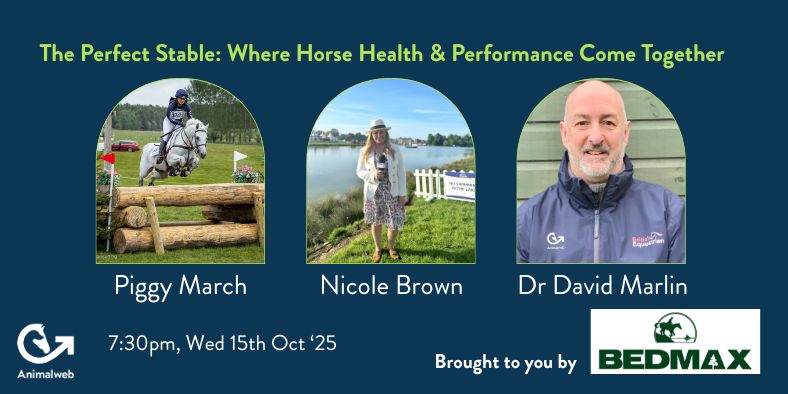
The Perfect Stable: Where Horse Health and Performance Come Together
What really makes the perfect stable? How much does your choice of bedding and stable management impact your horse’s health, hygiene, welfare, and performance?
In this exclusive webinar, international animal scientist Dr David Marlin joins World Gold Medallist and international event rider Piggy March to explore how the stable environment can influence equine wellbeing and performance. From choosing the right bedding to understanding how everyday decisions affect respiratory health, recovery, and results, this is essential viewing for every horse owner, rider, and yard manager.
Brought to you by Bedmax, this session blends science and real-world experience to help you create a healthier, hygienic and more performance-focused stable environment for your horse.

To read the rest and learn how this will help you, join us by clicking the banner below.

Already a member? Log in here
Join us now to view this article PLUS 1000s of
- tips
- articles
- videos
- money saving ideas
- reviews
- webinars
- podcasts
- news
And so much more!
Science backed horse care at your fingertips - dip in for information when you need science to help you care for your horse.
Transcription
Here is a transcription of the webinar. (Please note this is an automated transcription, so we apologise for any errors.)
Host (Nicole):
Okay, we’re all set for what’s hopefully a thoroughly informative and entertaining evening. A very warm welcome to A Perfect Stable, where horse health and performance come together — and where Bedmax and Animal Web have teamed up to bring you an insightful session you can take back to your own horses.
We’ve got two brilliant guests. First, Dr David Marlin, one of the world’s leading equine scientists with over 30 years’ experience at top-level events — passionate about keeping horses as healthy as possible. David, lovely to have you with us.
Dr David Marlin:
Thanks, Nicole. I love doing these because even if you think you’ve heard it all, someone always asks a question that makes you think again. The key is education — good healthcare comes from good knowledge — and we can never be reminded often enough how important it is to look after our horses.
Host (Nicole):
Absolutely. We’re all learning every day, so please send in questions via the chat — no question is too silly. We’ll tackle as many as we can. Our second guest is a team world championship gold medallist, a dual five-star winner — eventing legend Piggy March.
Piggy March:
Good evening, Nicole. Thank you for having me.
Host (Nicole):
Let’s start with the theme of the night: the perfect stable. David, give us the big-picture overview?
Dr David Marlin:
We all come from different backgrounds, with different horses and constraints — financial, time, or yard rules — but many horses spend a lot of time in stables. We want that environment to be the best it can be: opportunities for social interaction, as dust-free as possible, enough time and space to lie down. Managing the stable well is a fundamental part of horse ownership. Some horses never have issues; others do. Fortunately, we hear less about horses getting cast than we used to — I’m not sure why, and I’d be interested if anyone here still encounters it. Ultimately, a well-managed, healthy horse is more likely to perform better.
Host (Nicole):
Piggy, we’ll come to your practical insight on performance shortly. Let’s begin with the basic stable environment — materials, ventilation, size.
Dr David Marlin:
Type of stable matters. Brick or breeze-block can be cooler in summer than wood, which can get very hot; sometimes a horse is better off outside on really hot days. Size and ventilation are crucial, and I’d pick brick or breeze-block for temperature regulation if I had the choice. Horses being able to see each other is important; there’s ongoing work on social interaction in stables.
Piggy March:
Our barn is breeze-block with large, airy stables under one roof — 24 stables, lots of light and windows, and good airflow. (Apologies if my sound dips — sorting tech!)
Host (Nicole):
While Piggy settles the tech, a comment from Kate: her horse gets cast when his equine asthma is bad.
Dr David Marlin:
That’s interesting — I wouldn’t have immediately linked those. It could be stress or more rolling when asthma flares. It’s a reminder how intertwined respiratory health and stable management are.
Host (Nicole):
Is there such a thing as the perfect stable if you could start from scratch?
Dr David Marlin:
I’ve helped design yards, vet hospitals, and teaching stables around the world. They all end up different due to regulations, climate, and use. For example, horses used under a Home Office licence for certain research must have stables of a specified minimum size — they’re big. While some event stables can feel too small for big horses (think nearly 18hh), the universal principles are: adequate size, ventilation, temperature-stable materials (brick/breeze-block), and visual contact with other horses.
Host (Nicole):
Let’s talk airflow. We want good ventilation without a draft. What’s “enough”?
Dr David Marlin:
Air changes should prevent CO₂ buildup and, in stables, clear dust from bedding, forage, and from the horse itself. Grooming in the stable adds dust to the air. If you muck out, airborne dust can take ~45 minutes to settle — you often only see it when the sun slants in just right. So: take the horse out for a proper muck-out, and avoid grooming in the stable where possible.
Host (Nicole):
That answers a pre-submitted question: take the horse out to muck out — and leave the stable about 45 minutes before bringing them back?
Dr David Marlin:
Yes, that’s ideal. And again, groom outside if you can. People say, “My horse doesn’t cough; does it matter?” In an untrained horse, muscles/heart are the limit; in a trained horse, the respiratory system limits performance — and lungs don’t “get fitter” with training. So air quality is critical. You don’t need much respiratory disease to knock performance. A horse that coughs regularly, even just at warm-up or in the stable, likely has some degree of respiratory disease. The absence of coughing doesn’t guarantee health; it often takes a lot to make a horse cough. We sometimes scope horses as part of health checks and find moderate respiratory disease even in high performers.
Piggy March:
Am I sounding better now?
Dr David Marlin:
Much better!
Piggy March:
Great — thank you, Tom. David, on scoping: I don’t routinely scope eventers unless they’re obviously unwell, coughing a lot, or underperforming. Is scoping invasive? Should it be part of regular top-level checks?
Dr David Marlin:
In some racing yards, scoping was very frequent. The risk is small in experienced hands; it is technically invasive as the scope enters the airway. There are two common levels: a quick unsedated tracheal scope, sometimes with a tracheal wash (saline squirted and recovered) to assess cells, bacteria, and mucus — helpful to distinguish infection vs allergy. I’d scope horses prone to respiratory issues more readily than those without problems.
Shipping fever concerns me on long journeys (8–10+ hours) by lorry/plane: head-up posture, stress, and dehydration can let normal airway bacteria multiply and cause infection. Some horses arrive with a slightly raised temp that settles in 24–48 hours; a few develop pneumonia. If a horse is prone, I’d scope around four weeks before travel so there’s time to treat anything found.
Piggy March:
That resonates. I’ve one who’s run below par after long trips; bloods later showed white cell changes. No coughing, good appetite, clean stable management — but travel could be the underlying factor we’ve missed.
Dr David Marlin:
It can be travel-related, and bedding/forage changes at events don’t always help. What’s your travel routine?
Piggy March:
We keep everything the same when away: Bedmax in the lorry, same feed, same hay/haylage. Even if events supply free bedding, we stick with ours — consistency matters.
Host (Nicole):
Travelling shifts you into temporary set-ups. How do you manage that?
Piggy March:
At home, no stable swapping — it’s their home. At events, you use what you’re given, but in eventing we’re often in airy field stables, which suits horses that are used to turnout and ventilation. We hand-graze several times daily, keep routines consistent, and aim for heads-down feeding to clear airways. Haynets if we must, but floor-feeding is my preference — especially straight off the lorry.
Water matters hugely. I don’t use automatic drinkers — I want to know exactly how much they drink and keep buckets spotless. You can learn a lot from what’s left in a bucket. A top hydration tip I picked up from the Hong Kong team: “nut water” for travel — a shallow bucket with a scoop of nuts so it smells/tastes enticing. They drink more, which helps on long trips.
Host (Nicole):
If you see a bit of gunk after heads-down, is that a red flag?
Dr David Marlin:
Context is everything. A high temperature is a red flag on its own. A bit of white mucus with a bright, eating, exercising horse isn’t panic. If mucus increases/changes colour or is paired with coughing/dullness, investigate. Also, studies show some horses drink less from automatic waterers than buckets — often much less with the small, noisy bowl types. Bigger, quieter waterers are better, but I’d take buckets to events and stick with what the horse knows.
Travel is tiring — horses constantly adjust balance, and an hour in a horsebox can use energy akin to walking/trotting. Routines change at shows; stables can be busy all day so horses don’t lie down. In Tokyo, with stables closed for hot hours, around three-quarters of horses were lying down — dark, quiet, fewer people. That matters because horses only get REM sleep when lying flat (lateral recumbency). REM is vital for recovery.
Host (Nicole):
How much REM is enough?
Dr David Marlin:
They get it in short bouts — think 20–30 minutes when flat out — spread through their sleep cycles. Seeing them truly zonked out is a good sign they’re getting that restorative sleep.
Piggy March:
Ours turned out at night often have a morning siesta when they come in. I ride those later so they can lie down. We also keep a quiet hour after lunch — staff break, yard silent — and most horses snooze. It’s lovely and important for their minds and bodies. We do a late check around eight, then leave them undisturbed till morning. Routine and quiet time keep them calm.
Host (Nicole):
We had a question about stable cameras overnight. Overprotective, or helpful?
Piggy March:
We’ve got security cameras around the yard, but not in each stable, as we live on site and hear things quickly. If I had cameras in every box, I’d watch all night like Horse TV! But if you don’t live on site, cameras can be great to check if/when they lie down without disturbing them.
Host (Nicole):
On environmental enrichment — toys, mirrors, music?
Piggy March:
I want horses to see each other, but I’m not keen on bars between stables — they encourage face-pulling and squabbling, especially at feed time. Our competition horses are worked, turned out, and in a routine, so they’re rarely bored. For box rest, a lick or trickle ball can give them something to do.
Dr David Marlin:
Enrichment can help, but it’s horse-dependent. Some nudge a toy; some demolish it in five minutes. Music is interesting: horses seem to prefer gentle classical or country; they don’t like Radio 1, jazz, or heavy rock. Calm rhythms = calmer horses. Quiet music can also mask sudden noises, making them less reactive.
Host (Nicole):
Speaking of sudden noises — bonfire season. Advice?
Dr David Marlin:
Two approaches. Desensitisation: play fireworks recordings very quietly and gradually increase; if they react, step back. And background sound: play gentle music so bangs don’t jump out from silence. Start now, especially in the evening, to get them used to it before fireworks kick off. If a horse is at real risk, discuss options with your vet; sedation sometimes helps, sometimes doesn’t.
Host (Nicole):
Great. And it’s not just one night — it’s a week of fireworks. Start the routine early.
Dr David Marlin:
Exactly.
Host (Nicole):
Piggy, your yard runs like clockwork despite different owner preferences and horses coming from varied backgrounds. How do you keep it calm and consistent?
Piggy March:
By being honest and consistent. I’ve developed systems I trust — how the yard runs, how stables are set, and the horses’ routine. Visitors often say it’s quiet even with 30 horses. Everyone knows the rhythm of the day. I want horses comfortable, with good beds and proper rest. Older horses might have deeper beds with banks (not too high — we have rubber mats). We refresh bedding regularly so nothing gets stale or dusty.
Piggy March (continued):
That rotation keeps stables fresh and low-dust. I’ll remove a bank and replace it with a fresh bale to mix new material in. Messy youngsters or those out a lot might just have a smaller square bed — practical and cost-effective. The aim is a clean, calm, lived-in look: swept fronts, spotless buckets, no old hay. It should feel peaceful — somewhere you’d happily curl up for a nap!
It’s a business, but it’s also a lifestyle. Horses aren’t nine-to-five; they’re part of the family, along with the people and owners. There’ll be bad days — illness, lameness, off-performances — but we communicate. We don’t hide. We’re all trying to do the best for the horses. I want to go to bed knowing I did everything I could for happy, healthy horses and people.
Host (Nicole):
I’ve been to Piggy’s yard — immaculate but calm. I genuinely considered closing the door and having a nap in one of those empty stables!
Right, bedding. It’s a deep topic (pun intended). There are so many choices. Bedmax are supporting tonight’s webinar and have Bedmax, Littlemax, Strawmax, among others. David, what should people look for — for their setup and their horse?
Dr David Marlin:
I’m not a fan of deep littering. If you can smell ammonia, it’s already irritating airways (yours and the horse’s). You don’t need fancy kit; if you can smell it, it’s too much. There’s no truly dust-free bedding — only low-dust. Lab tests confirm it. Choose bedding that’s low dust, absorbent, easy to work with, and one the horse will lie on.
If a horse never lies down, consider orthopaedic pain. A top dressage rider once insisted something was wrong; a sensor showed the horse never lay down. Vet treated its back, and it slept for eight hours. She was right.
Don’t skimp on bedding: the “cheaper” option can cost more in respiratory issues and lost performance. Pair good bedding with soaked hay or haylage, ventilation, and good routines. Skip out with the horse in, but for a proper muck-out, take them out. Groom outside if you can. Horses are elite athletes; any compromise — respiration, colic, lameness — has big consequences, emotionally and financially. Even pleasure horses stabled for hours need a low-dust environment.
Host (Nicole):
What about depth of bed?
Dr David Marlin:
There’s individual variation, but with rubber mats, 3–4 inches of good bedding is usually fine. Bedding’s main roles: absorb urine and keep droppings contained. The difference between six inches and a foot likely doesn’t matter to the horse. Clean, dry, consistent matters more.
Host (Nicole):
A question from Dawn: clay floors with wood pellets and shavings; horses sleep on the clay and use the shavings as a toilet. She worries they’re not resting enough. Should the bed be deeper, or are they fine?
Dr David Marlin:
If they’re choosing that surface, they’re probably comfortable. Measuring actual rest is hard without monitoring, but there are now AI camera systems (many evolved from foaling alarms) that can track time spent lying, moving, eating — and flag behaviour changes (like early signs of colic). Some systems even alert at a moderate risk, prompting early intervention. Data suggests lower colic rates where owners act on those alerts. Accuracy still matters — no one wants false alarms at 2 a.m. — but this tech will likely become commonplace as it improves.
Host (Nicole):
Brilliant. That wraps a huge amount of ground: ventilation, dust, travel, hydration, sleep, enrichment, fireworks, and bedding. Keep your questions coming — we’ll dive into more specifics next.
