


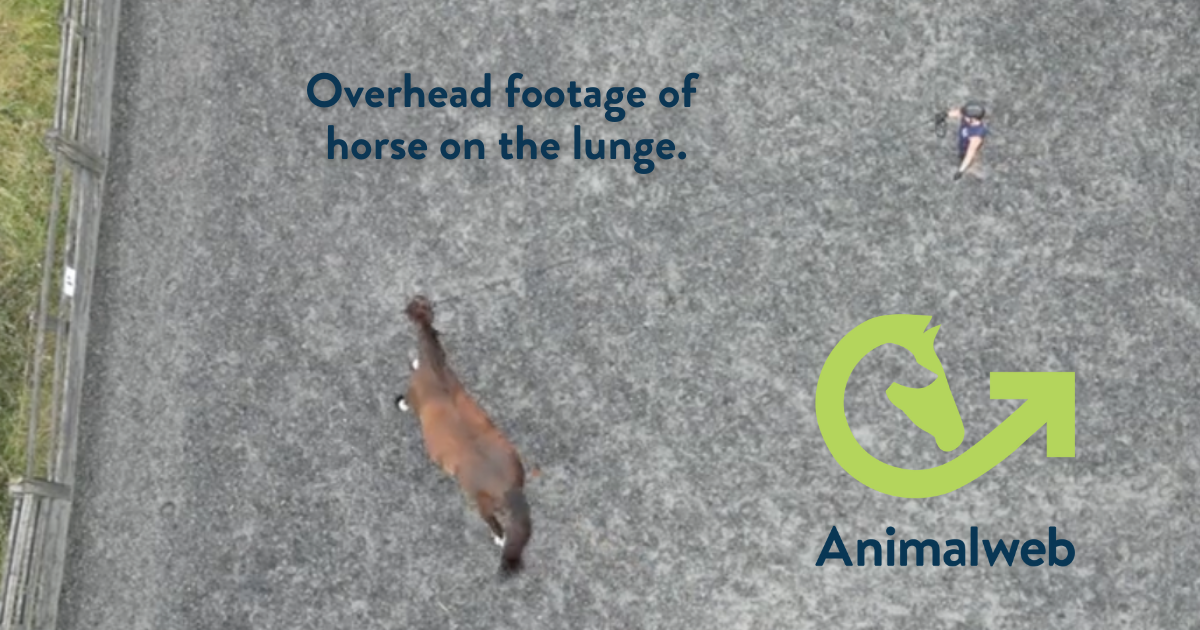
Recently, during a filming session at one of our expert’s yards, we had the opportunity, with a very chilled horse, to obtain some overhead video using a drone. The drone operator is very experienced and the handler knew that we were filming from above. We wanted to see a relaxed horse being lunged. The overhead view provides us with an unusual angle and a very different perspective than we normally see from the ground. We were intrigued by what we saw. So, we shared the footage with a few of our experts and below we share with you their thoughts, questions and musings.

Dr David Marlin
We are very used to observing horses from the ground, from in front or behind or from the side, or from a variety of angles with a rider on. I’ve been fortunate enough to be able to record horses moving at walk, trot, canter, and gallop from above on a treadmill without a rider or saddle and to be able to observe just how much spinal motion and soft-tissue motion takes place, which really makes me focus on how much saddles and riders must restrict or impair normal back function.

Russell MacKechnie-Guire – Equine Biomechanics
Nice video that gives you an appreciation for how horses adjust their body position during circular locomotion, i.e. body lean/head and neck position. From this angle, you can visualise the rotational movement of the horse’s back, particularly in the area where the saddle (and rider) is positioned due to the horse’s coat colouring. Specifically, on the right rein, from this angle, the axial alignment is indicative of horses when travelling on a circle (i.e bending), at times you can get an appreciation for how a horse’s “shoulder falls out”, and how when the handler applies tension to the lunge line, the horses head and neck tilts/twist with the nose coming towards the inside of the circle, causing the shoulders to fall more to the left. This can be applied to riding when horses fall out and the rider does not turn the horse from their outside leg, instead relying on the inside rein. On the right rein, the circle size remains fairly consistent vs. the left rein, where the horse has a more chaotic locomotor strategy. On the left rein, the lateral bending, body positioning, suppleness, that was seen on the right rein, is not as established. The horse’s head and neck Is positioned towards the outside of the circle, coupled with a consistent twist/tilt of the head. The horse’s rhythm and balance is more variable on the left rein compared with the right.
Mark Lucey – Vet
Interesting video. Looks like more neck and head alternate in or out of the circle on the right rein. Seems to find the left rein a bit easier to go around. No side reins, so allows more head and neck movement. Is the head a bit more tipped when on the left rein. You can see the muzzle area more on the left rein, so head slightly more on the side rather than perpendicular to the ground. Does it move the head and neck to the outside a bit more to counteract the slight loss of balance on that rein so needs the head and neck to keep balance? How old or how trained is the horse? Looks a bit novicy rather than an experienced well-trained horse.
Dr Gillian Tabor – Equine Physiotherapist
On the right rein, there is a very clear demonstration of the body leaning to the inside with the faster trot and canter, as you can see the outside pair of boots more than the inside. This is expected with speed, but seeing it from above is fascinating. There are marked differences in the bend throughout the horse’s body on either rein. To the right the whole spine is straighter and at times is not following the shape of the circle. To the left there is increased cervical lateral bend but also rotation and ‘falling out’ through the shoulder. We know that there is not equal lateral flexion through each region of the spine despite it being assumed but the left right differences seen from above really highlight how biomechanically true this is.
Nicola Bell – Rider Biomechanics Coach (AND Yard Owner of where this was filmed!)
Oh my goodness, how incredible to see a horse moving at this angle. It is so good to see his natural movement patterns at this angle without the help of lunging equipment or a rider. It also shows how hard our bodies have to work to maintain stability and yet still offer mobility in our joints to absorb the movement of the horse. I would love to see Glamourdale or another world-class dressage horse from this angle.
I noted that one of my colleagues commented that the horse looked more novice, and I agree. It just shows me that this horse, when left to his own devices, really struggles to hold himself alone. This is true to character, and despite the many hours of groundwork I have put in, he still drops his core at any available opportunity and returns to his natural body shape/position. It makes you then think about what the skeletal system would look like without muscle, fascia, etc and however hard you work to improve a horse’s symmetry, you could be permanently in a losing battle if the bone structure is not allowing it. A bit like you can help a human to a point with a naturally deeper lordosis or kyphosis but at the end of the day you get to the point where limitation is reached.
All so fascinating. And it would be good to watch a horse jump from this angle, too!
