



Thunder is common. It’s also a natural phenomenon. For some horses, dogs and cats, they barely register any reaction at all and may even sleep through it. For others, it causes extreme distress. And then there are reactions from mild to moderate through to severe. Perhaps a similar analogy to fireworks.
Of course, if you have a reactive horse and you are riding, a thunderstorm could present a serious problem. I’ve had horses I have had to get off and walk or turn and head for home asap. The same with dogs – a thunderstorm approaching whilst your dog is off the lead could cause your dog to panic and run off.
If we add to this the fact that horses, dogs and cats have more sensitive hearing than we do, they are likely able to hear thunder way before we do.
How common is thunder in the UK? Across the UK, there are typically 10-15 days with thunder each year. But some regions experience more than others, with Scotland and Wales towards the lower end, at less than ? days per year, and most of the rest of the UK at 5-15 thunder days per year. The highest number of thunder days is in the Southeast and East Midlands, with typically 15-20 per year. And in terms of time of year, it’s June, July and August when most thunder days occur. Thunder and lightning are much more common in mainland Europe than in the UK. And just a note, although we call it “thunder and lightning”, really we should be saying “lightning and thunder” because it’s the lightning that comes first!
Lightning is an enormous electrical discharge. It superheats the air around it to ~30,000°C (54,000°F) in a fraction of a second. The air expands explosively, which creates a shock wave, and that shock wave is what we hear as thunder.
There are a number of different websites that show live lightning, and if you have lightning, then you will have thunder. If you see lightning but don’t hear thunder, then it’s simply because you are too far away.
There are also a variety of apps for IOS and Android phones.
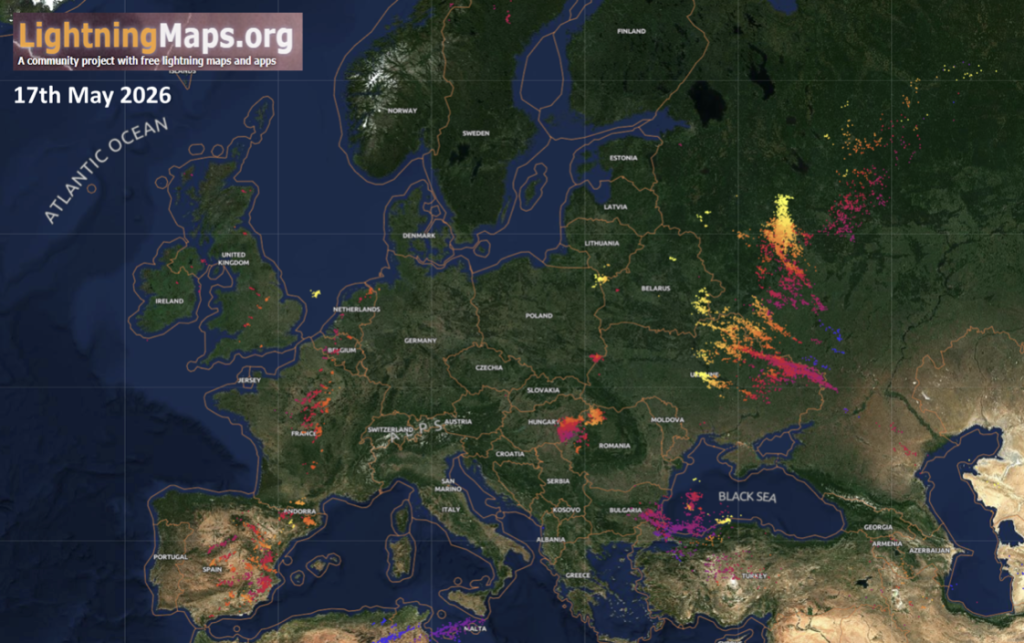
The image below shows the map for the UK on the 17th May 2026 and you can see there were some areas of lightning and thunder.
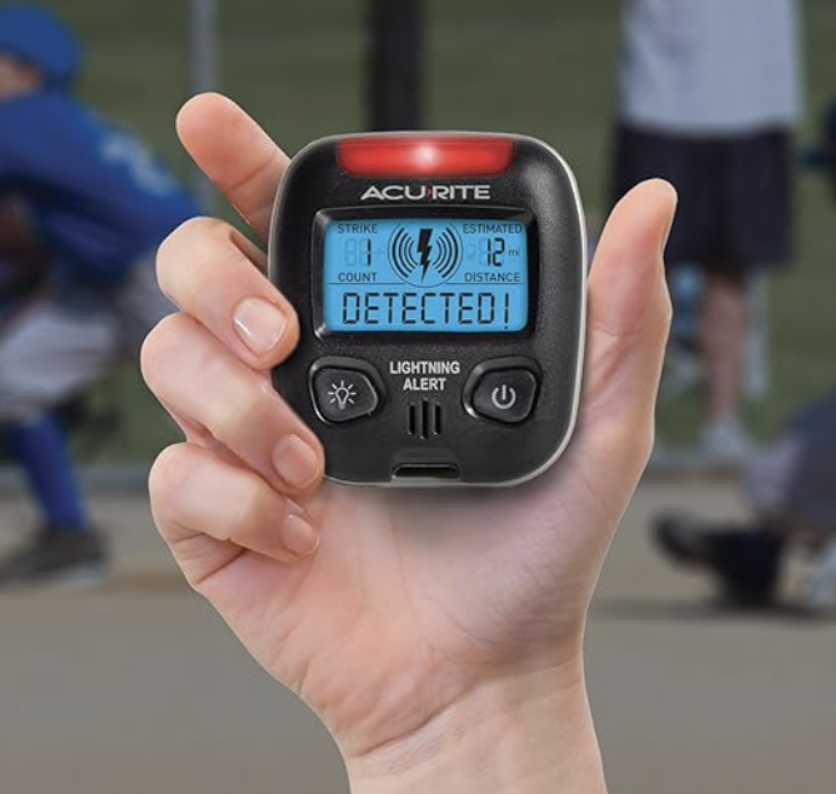
So having these programmes open on a browser or app on your phone might be ok if you are at home but one other device I cam across recently is a simple sensor that continuously monitors for lightning strikes called AcuRite which detects the electromagnetic pulses produced by lightning.
AcuRite Lightning Detector
The AcuRite uses a built-in radio receiver tuned to 500 kHz (a specific low-frequency band). Lightning creates a unique “spark” pattern of radio signals when it discharges (cloud-to-ground, cloud-to-cloud, or intra-cloud). The device listens continuously for this distinctive radio signature. Filters help reduce false alarms, but it can still pick up similar electromagnetic “sparks” from man-made sources (e.g., electric motors, light switches, garage doors, power lines, cars). But it can detect lightning up to 25 miles (40km) away; a long time before you can hear the thunder. When lightning is detected it shows an estimated distance to the storm front (based on signal strength — stronger signal = closer strike), displays a running strike counter and triggers audible alarms (beeps), flashing red LED, and on-screen messages like “STRIKES DETECTED!”. Alerts continue every 5 seconds until 30 minutes pass without new strikes.
Its small, runs on two AAA batteries and comes with a clip that you can wear on a belt or in your pocket. It weighs around 60g (2oz) and is 2.5 x 6.4 x 7.1cm. So this got me thinking, would this be useful for owners with pets who react badly to thunder? So for £35 I thought I would invest in one.
So we would like to know
- Do you have a horse, dog or cat that reacts badly to thunder?
- Have you had an animal injured as a result of panicking due to thunder?
- If you are riding and thunder occurs, do you have to get off or turn for home?
- Could you imagine this might be useful as an early warning device?
If you do have a horse that is very sensitive to thunder, we will be looking for someone to try this device out and report back to the community about its practical use and reliability.
Desensitisation
One of the techniques some use to help their animals deal with thunder is desensitisation. We have a fantastic article on the website, aimed at helping animal owners with fireworks, but the same principles can be used to help with coping with thunder – click here to read – Fireworks and Pets and Desensitisation.
