


Researchers at the Royal Veterinary College (RVC) have identified a potential new approach to treating osteoarthritis, raising the possibility of future therapies that could slow or potentially reverse the progression of the disease rather than simply managing its symptoms.
The findings could ultimately have implications for both human and veterinary medicine, including the treatment of osteoarthritis in horses and dogs.
Osteoarthritis (OA) is a progressive joint disease involving changes to cartilage and underlying bone, as well as inflammation within the joint. It is particularly common in older animals, with the RVC reporting that it affects around 50% of horses over the age of 15, rising to 90% of horses over 30, and up to 80% of older dogs.
Despite its prevalence, there are currently no approved treatments capable of reversing or stopping the progression of osteoarthritis.
Researchers identify potential drug target
The new study, published in the scientific journal Bone Research, was led by Dr Scott Roberts, Reader in Translational Skeletal Research within the RVC’s Skeletal Biology Group.
Researchers from the RVC, University of Oxford, Middlesex University and the Institute of Cancer Research investigated two closely related proteins known as Cyclin-Dependent Kinase 8 and 19 (CDK8/19).
The team identified CDK8/19 as involved in disease processes associated with osteoarthritis and investigated whether blocking their activity could alter disease progression.
Researchers tested a CDK8/19 inhibitor using STR/Ort mice, which spontaneously develop osteoarthritis and are therefore used as a model for studying the disease.
Mice receiving the treatment showed improvements in several measures, including their gait and ability to complete treadmill exercise tests. Researchers also recorded lower levels of osteoarthritis biomarkers in the blood and improvements in the composition of cartilage within the knee joints.
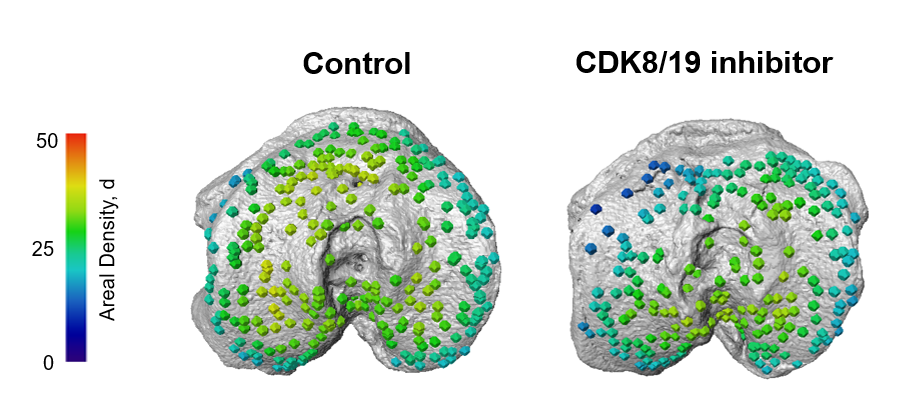
Detailed 3D imaging of the joints also found differences in changes occurring between bone and cartilage.
Untreated osteoarthritic mice developed small bridges of mineralised tissue within the growth plate region of the bone, a process associated with worsening joint damage. Animals receiving the inhibitor developed fewer of these bridges, and those that did form were less dense.
Could osteoarthritis eventually be treated differently?
The results are significant because most current approaches to osteoarthritis concentrate on reducing pain, inflammation and maintaining mobility rather than modifying the underlying disease.
Dr Scott Roberts said the research had helped the team better understand the mechanisms through which cells become disease-causing in osteoarthritis, while also identifying a potential pharmaceutical approach to reversing those changes.
He described the findings as particularly exciting given the current absence of disease-modifying osteoarthritis drugs.
The next stage will be to move the research beyond these preclinical findings and into proof-of-concept studies to establish whether the approach can demonstrate disease-modifying effects in patients.
The compounds themselves also have an interesting history. They were originally developed through work by the Institute of Cancer Research, Merck Healthcare KGaA and Cardiff University as potential cancer treatments.
Although they proved unsuitable for that purpose, researchers have since investigated whether the compounds could be repurposed for osteoarthritis.
Important early-stage research
While the findings are promising, the treatment has so far been studied in a mouse model and is not currently an available treatment for horses, dogs or people.
Further research will be needed to establish its safety and effectiveness in other species and determine whether the results can be translated into clinical treatments.
However, the prospect of a therapy capable of modifying the underlying osteoarthritis disease process, rather than solely managing its symptoms, could be particularly important for veterinary medicine given the high prevalence of OA in older horses and dogs.
The project was funded by the RVC’s Mellon Fund for Equine Research and Higher Education Innovation Funding (HEIF).
