


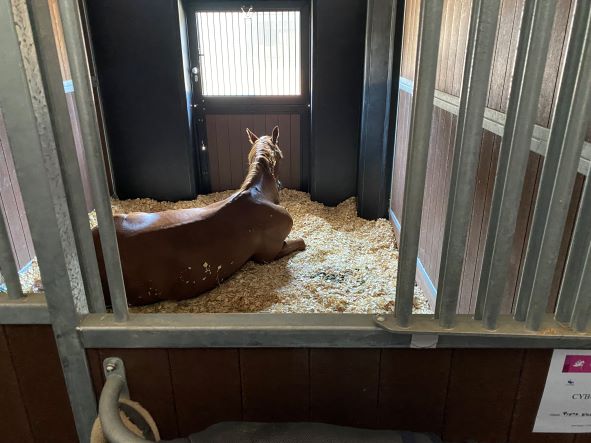
Colic is an umbrella term for abdominal discomfort and there are many different reasons why it might occur. Impactions or blockages can occur throughout the digestive tract and usually require veterinary intervention. The gut is a muscular tube and so muscle spasms in the gut are referred to as spasmodic colic and can be triggered by things like an accumulation of gas, dehydration or stress.
The level of discomfort the horse experiences varies considerably, which is often reflected in the clinical signs shown by the horse. Some mild conditions may mean a horse just seems a little lethargic or quieter than normal, whereas serious colic issues may result in horses literally throwing themselves on the floor, rolling and careering around their stable. It can be very distressing to witness a horse with colic. Serious conditions often start with milder signs though and the general rule of thumb is that the sooner your vet can intervene, the greater the chance of recovery and survival and so it is imperative not to delay calling a vet. As soon as you notice something isn’t right,gastric ulcer you should contact your vet for advice.
Recurrent colic
If your horse has repeated incidents of colic, it may indicate there is an underlying issue. The high prevalence of gastric ulcers means this is an area worth discussing with your vet. A gastroscopy will help determine whether gastric ulcers could explain why your horse is showing repeated signs of discomfort.
Older horses are also vulnerable to colic for a number of reasons. Poor dentition may result in them not being able to eat enough fibre resulting in an accumulation of gas; just as for humans, fibre helps to promote bowel movements and so if a horse doesn’t consume enough fibre it can have an effect on the motility of the gut.
Older horses may have compromised dentition and so may be swallowing larger particles of fibre which can result in impactions. Quidding is a sign that your horse is struggling to chew forage. This is where the horse drops partially chewed up balls of forage from his mouth when eating. Ensuring fibre is offered in a form a horse can manage such as short chops or mashes will help to reduce the risk of issues.
Risk factors for colic
Colic is a particularly frustrating problem to deal with as, in many cases, what causes colic in horses is never confirmed. In fact, studies have shown that as many as ¾ of colic cases are undiagnosed. For this reason, several studies have sought to identify the risk factors associated with colic – known as epidemiological studies – and these often involve collecting lots of data about how horses with colic are fed and managed and comparing it with data from horses that haven’t had colic. This can then be analysed statistically to show trends or factors that are associated with an increased risk of colic. Knowing these factors should help us to feed and manage our horses in ways that reduce the risk of colic.
One of the first studies to determine risk factors for colic was carried out in the USA. Some of the key factors that increased the risk of colic were found to be:
- Changing the type of concentrate fed
- Feeding concentrates at between 2.5-5kgs per day
- Feeding concentrates at more than 5kgs per day increased the risk even more
- Changing the type of hay fed more than once a year
The obvious take-home message from this study was that feeding concentrates and changing diet were two significant factors that increase the risk of colic. So what can we do to mitigate these factors? Well, if you know the basic ‘rules of feeding’, you can start to appreciate why they were developed. The key rules to consider in relation to colic are:
Make changes to the diet gradually – this allows the population of bugs that live in the horse’s digestive system time to adjust to the change of feed. The horse relies on the microbial population in the gut to digest fibrous material and changing suddenly from a high fibre to a high starch (cereal) diet or vice versa doesn’t give the bugs time to adjust. It is recommended to change the diet over 7 to 10 days. It may also be beneficial to use a prebiotic or live yeast supplement when making a significant change to the diet. Fungi such as yeast are part of the fibre digestion process and help to keep a stable environment in the gut, whereas FOS prebiotics provide a food source exclusively for beneficial bacteria. Both would be beneficial to feed when the gut is being disrupted by a change of diet.
Feed little and often – although this study didn’t look specifically at meal size, just the total amount fed per day, it is recommended that a maximum of around 1.5kgs of concentrates is fed per meal, but if less can be fed then so much the better. It is preferable to feed 4 meals a day of 0.75kgs than two meals of 1.5kgs for example. By feeding more small meals the horse may be able to get more out of the feed he is consuming and so may require less feed in total – a win-win situation!
The other thing to consider is whether you actually need to use a cereal-based feed at all? There are lots of ways to provide the energy your horse requires without having to resort to feeding cereals. High-quality fibres such as alfalfa and sugar beet provide as much energy as a cool mix – an alfalfa-based fibre feed with a light molasses coating contains 10MJ/kg DE, for example. When oil is added, the energy value increases to 12.5MJ/kg DE, which is comparable to a competition or conditioning mix. Even if you don’t want to convert to a fibre and oil diet completely, reducing the amount of cereal-based feed will reduce the risk of colic.
Findings from other studies
In a study by Scantlebury and colleagues published in 2014, more risk factors were identified. In this study, 59 recurrent colic episodes and 177 controls were included. One of the interesting findings was that a linear relationship exists between the amount of time a horse was turned out and the risk of colic. For example, a horse that is always stabled had twice the risk of recurrent colic compared to a horse with 12 h of turnout per day. It goes without saying that turning horses out tends to be beneficial, but if this isn’t possible or it doesn’t suit your horse, as not all prefer to be turned out, then ensuring plenty of forage is available when they’re stabled is of paramount importance. Horse owners often assume that ‘ad lib’ means feeding lots of forage, but what it actually means is that the horse is never without access to forage. There aren’t many horses that haven’t eaten all of the forage available to them overnight by the next morning, which technically means they haven’t been fed ad lib.
Are there recommended diets for horses with recurrent colic?
A study presented at BEVA Congress in 2021 shared details of a feeding strategy used by a veterinary group managing a range of horses with recurrent colic. The horses were fed a combination of short-chopped alfalfa, unmolassed sugar beet pulp and grass pellets with additional vegetable oil if more energy for weight gain was needed. The authors concluded it was a safe diet to use and reported a 79% one year survival rate – keep in mind these were horses referred to an equine hospital and so were experiencing more severe or recurrent issues. The principle of using a mix of highly digestible fibres with oil if needed is advocated for general health and this study provides further support for this approach. It is important to note, however, that no feeding strategy can prevent or treat colic; it is about trying to reduce the risk!
References:
- Prospective study of equine colic risk factors – M K Tinker 1, N A White, P Lessard, C D Thatcher, K D Pelzer, B Davis, D K Carmel – LINK to study
- Management and horse-level risk factors for recurrent colic in the UK general equine practice population – C E Scantlebury 1, D C Archer, C J Proudman, G L Pinchbeck – LINK to study
- Use of Short Fibre (Low Residue) Diets for the Management of Recurrent Colic and Weight Loss in Horses 2021 – 1Hallowell G.D., 2Bates C., 3Peal E., 3Bullard C. and 1Bowen I.M. First published: 25 August 2021 LINK to study
