


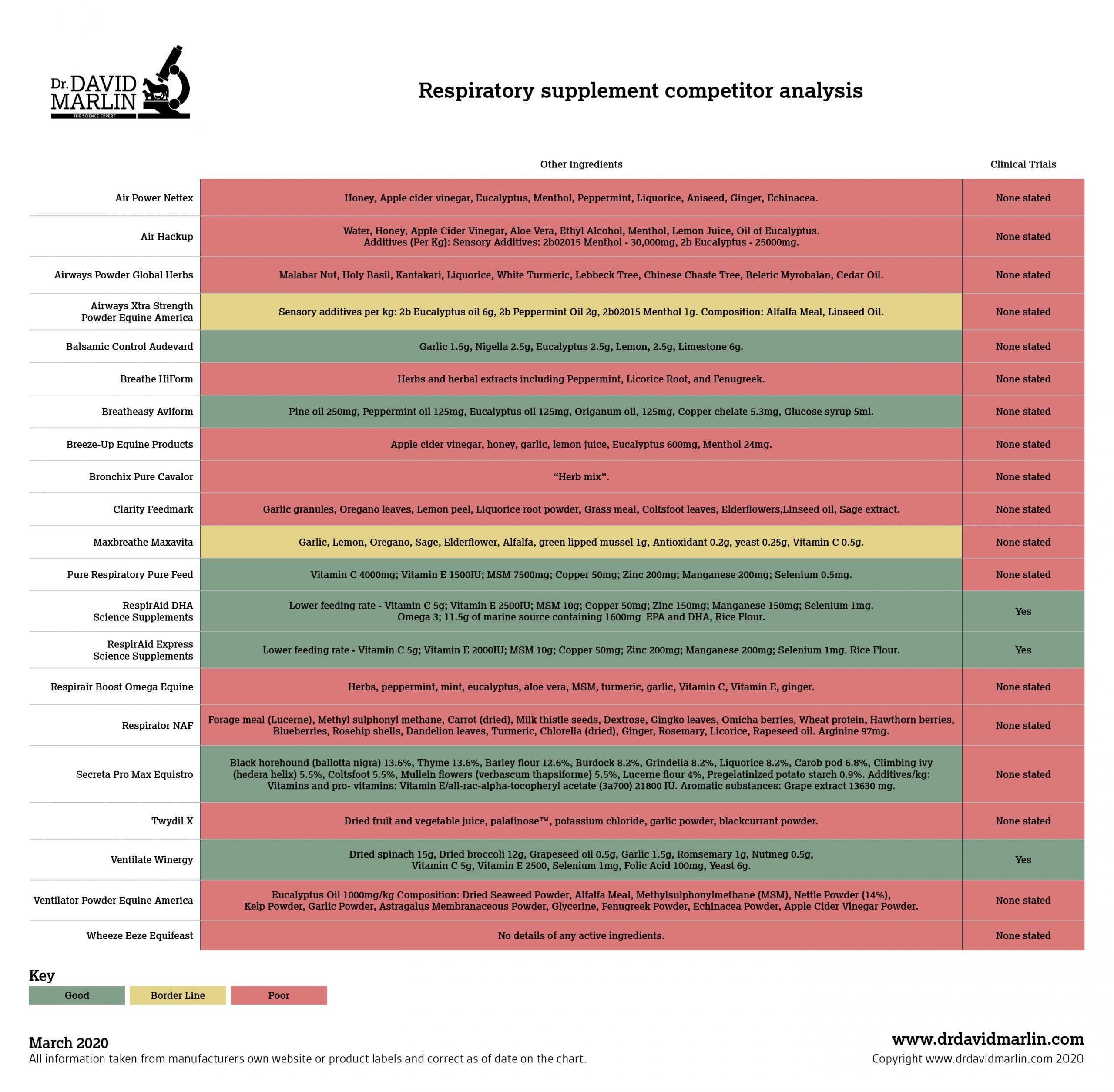
A common type of supplement fed by owners to horses is a respiratory or “breathing” or “airway” supplement. As with other supplements, such as those for joint, behaviour, gastric ulcers, etc, very few have clinical trials in horses. Most do not rely on evidence for which compounds/ingredients have been shown to have efficacy in horses but instead rely on “natural” or traditional respiratory “treatments” for which there is rarely any evidence for efficacy in horses or other species, such as eucalyptus, pine oil, peppermint oil, honey, cider vinegar, lemon, menthol, oregano, aniseed, omicha, gingko, hawthorn, turmeric and rosemary.
Few studies have been carried out on “herbal” supplements. One such study found no evidence of any benefit of a supplement called “Breathe” (Selected Bioproducts, Guelph, Ontario, Canada) containing garlic, white horehound, boneset, aniseed, fennel, liquorice, thyme, and hyssop to reduce the clinical signs of horses affected by equine asthma (Pearson et al. 2007). The exact composition of the product is not given and it is only reported that horses were fed ½ cup twice a day. However, horses did develop Heinz Body Anaemia which took 5 weeks to resolve following cessation of feeding garlic.
Dried garlic supplementation at 32mg/kg per day (equivalent to 16g in a 500kg horse) was concluded to possibly have a small positive effect on respiratory health but a negative effect on haematology (Saastamoinen et al. 2019).
A further concern is that the majority of companies selling equine respiratory supplements do not declare the amount of all active ingredients.
A small number of supplements do contain Vitamin C which has been shown in published peer-reviewed research in horses to have efficacy, but either at too low a dose and/or using the natural form, L-Ascorbic acid, which has poor stability and low bioavailability (Löscher et al. 1984). Together this means the vitamin C in these supplements will be ineffective.
Ingredients that have been shown to have efficacy in managing respiratory disease in horses include EPA and DHA from omega 3 oil (marine not plant), Vitamin C, Vitamin E, MSM, selenium, copper, zinc and manganese.
Therefore caution should be exercised when choosing respiratory supplements and it is advisable to choose supplements containing ingredients shown to have efficacy as opposed to herb and plant-based supplements for which currently there is no evidence of efficacy or safety.

References
Cuff, T., Williams, R., Deaton, C., Smith, N., Davies, B., Davies-Morel, M., Harris, P. (2005). Changes in plasma cortisol and ascorbic acid in horses with and without recurrent airway obstruction upon exercise and ascorbic acid supplementation. Equine and Comparative Exercise Physiology, 2(2), 105-112.
Deaton CM, Marlin DJ, Smith NC, Roberts CA, Harris PA, Kelly FJ, Schroter RC. Pulmonary bioavailability of ascorbic acid in an ascorbate-synthesising species, the horse. Free Radic Res. 2003 Apr;37(4):461-7.
Deaton CM, Marlin DJ, Smith NC, Harris PA, Dagleish MP, Schroter RC, Kelly FJ. Effect of acute airway inflammation on the pulmonary antioxidant status. Exp Lung Res. 2005 Sep;31(7):653-70.
Deaton, CM., David J. Marlin, Nicola C. Smith, Patricia A. Harris, Robert C. Schroter, Frank J. Kelly, Antioxidant Supplementation in Horses Affected by Recurrent Airway Obstruction, The Journal of Nutrition, Volume 134, Issue 8, August 2004, Pages 2065S–2067S.
Deaton CM, Marlin DJ, Deaton L, Smith NC, Harris PA, Schroter RC, Kelly FJ. Comparison of the antioxidant status in tracheal and bronchoalveolar epithelial lining fluids in recurrent airway obstruction. Equine Vet J. 2006 Sep;38(5):417-22.
Deaton CM, Marlin DJ, Roberts CA, Smith N, Harris PA, Kelly FJ, Schroter RC. Antioxidant supplementation and pulmonary function at rest and exercise. Equine Vet J Suppl. 2002 Sep;(34):58-65.
Dedar, R. & Legha, R.A. & Bala, Prokash & Sk, Ravi & Pal, Yash & Gupta, Ashok. (2014). Effect of Oral Supplementation of Vitamin C and Exercise on Plasma Vitamin C Status in Marwari Horses. Journal of Veterinary Science & Technology. 5.
Kirschvink N, Fiévez L, Bougnet V, Art T, Degand G, Smith N, Marlin D, Roberts C, Harris P, Lekeux P. Effect of nutritional antioxidant supplementation on systemic and pulmonary antioxidant status, airway inflammation and lung function in heaves-affected horses. Equine Vet J. 2002 Nov;34(7):705-12.
Löscher W, Jaeschke G, Keller H. Pharmacokinetics of ascorbic acid in horses. Equine Vet J. 1984 Jan;16(1):59-65.
Marañón G, Muñoz-Escassi B, Manley W, García C, Cayado P, de la Muela MS, Olábarri B, León R, Vara E. The effect of methyl sulphonyl methane supplementation on biomarkers of oxidative stress in sport horses following jumping exercise. Acta Vet Scand. 2008 Nov 7;50(1):45.
Pearson W, Charch A, Brewer D, Clarke AF. Pilot study investigating the ability of an herbal composite to alleviate clinical signs of respiratory dysfunction in horses with recurrent airway obstruction. Can J Vet Res. 2007 Apr;71(2):145-51. PMID: 17479778; PMCID: PMC1829186.
Ralston S, Stives M. Supplementation of Ascorbic Acid in Weanling Horses Following Prolonged Transportation. Animals (Basel). 2012 Apr 16;2(2):184-94.
Saastamoinen M, Särkijärvi S, Hyyppä S. Garlic (Allium Sativum) Supplementation Improves Respiratory Health but Has Increased Risk of Lower Hematologic Values in Horses. Animals (Basel). 2019 Jan 2;9(1):13.
Snow DH, Gash SP, Cornelius J. Oral administration of ascorbic acid to horses. Equine Vet J. 1987 Nov;19(6):520-3.
Snow DH, Frigg M. Bioavailability of ascorbic acid in horses. J Vet Pharmacol Ther. 1990 Dec;13(4):393-403.
Youssef MA, El-khodery SA, Ibrahim HM. Effect of selenium and vitamin C on clinical outcomes, trace element status, and antioxidant enzyme activity in horses with acute and chronic lower airway disease. A randomized clinical trial. Biol Trace Elem Res. 2013 Jun;152(3):333-42.
Youssef MA, El-Khodery SA, Ibrahim HM. Antioxidant trace elements in serum of draft horses with acute and chronic lower airway disease. Biol Trace Elem Res. 2012 Dec;150(1-3):123-9.
