


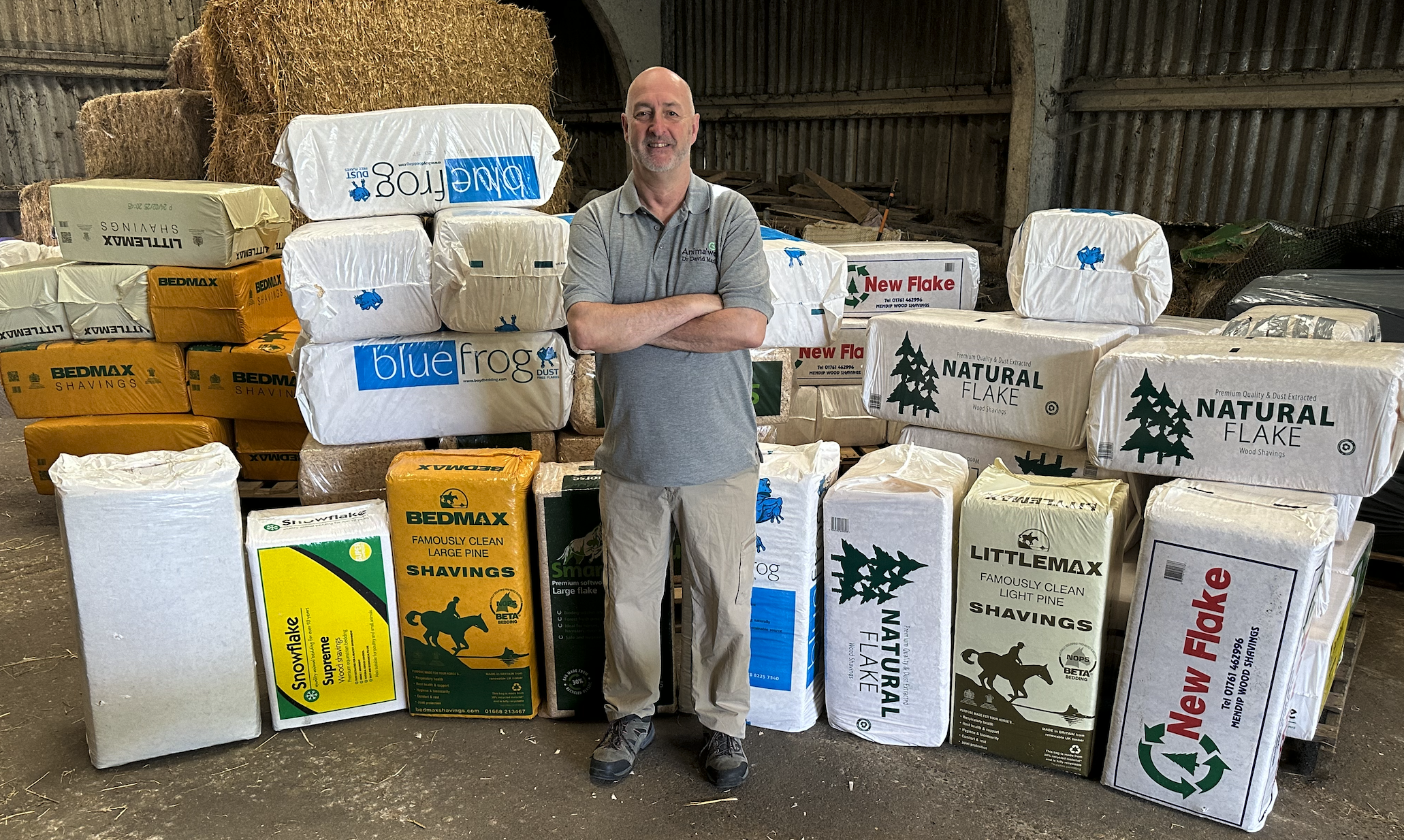
In this episode of the Animalweb podcast, Dr David Marlin takes a deep dive into something every horse owner uses, but few truly scrutinise, bedding.
Drawing on extensive independent testing, owner surveys and even calibrated weight checks, David unpacks the science behind bedding quality, respiratory health, value for money and UK Trading Standards compliance.
This is not a brand-bashing discussion; it is evidence-based information designed to help you make informed decisions for your horse and your wallet.
Why You Should Listen
Many brands claim to be “dust free”. David explains why, in laboratory testing, no bedding has ever been completely dust-free.
- What dust actually contains, including bacteria, mould spores, pollen and mites
- Why this matters for equine respiratory health
- Which products tested as genuinely low dust, and which performed poorly
If your horse spends up to 23 hours in the stable, air quality matters.
Beyond Dust – What Really Makes Good Bedding?
The podcast explains how Animalweb tests bedding scientifically, including:
- Absorbency
- Hygienic quality, measured through bacterial and fungal colony growth
- Ammonia control
- Resistance to scattering
- Ease of mucking out
David also discusses why lab testing is only part of the picture, and how real-world owner experience adds valuable insight.
The Bale Weight Investigation
One of the most eye-opening sections of the episode looks at bale weights.
David explains how 10 bales of selected shavings brands were weighed on calibrated scales, and what they found:
- Some products contained slightly more than stated
- Four contained less than their advertised or widely sold weight
- Two did not comply with UK Trading Standards labelling requirements
When you calculate the true price per kilogram based on actual weight, some “cheap” options do not look so economical after all.
The Bottom Line
This episode is about empowering owners with independent data.
It covers:
- Respiratory risk
- Hygiene and bacterial load
- Real value for money
- Lab testing versus marketing claims
- How to interpret bedding choices intelligently
If you stable your horse, this is essential listening.
Whether you are concerned about dust, looking to reduce costs, or simply want to make evidence-based decisions, this podcast gives you the tools to do exactly that.
CLICK HERE to see the test, survey and investigation results for yourself! Animalweb Bedding
Transcription
Here is a transcription of the podcast. (Please note this is an automated transcription, so we apologise for any errors from the original podcast.)
Hi, and welcome to this Animal Web podcast with me, Dr. David Marlin. So bedding is something that probably most of us use on a fairly frequent basis, obviously more so perhaps in winter if our horses are in. And of course there’s lots of different options in terms of brands and materials that are out there.
So this is something we’ve had an interest in for a long time. We’ve undertaken surveys to ask owners what they’re using and what they like, what they don’t like. We’ve also undertaken testing of different bedding products. And more recently, we’ve been looking at whether you’re getting value for money in terms of whether what it says on the bag or on the bale, the weight, whether that actually is matched with what those actually weigh. So if we start with thinking about the testing that we’ve done, we look at a number of really probably important variables. Obviously when it comes to respiratory health, the amount of dust within the product is really important. And what’s interesting is so many of the brands claim that their beddings are dust free.
Now, to date, we’ve never found a single bedding that is completely dust free. We have found some that are really, really low dust, for example, Bed Max, and we’ve found some that are really, really dirty. And if you have a look on our website, see the link below this podcast, then you’ll be able to have a look and see which are the really dirty brands, ones that really you should avoid, because they’re probably going to cause your horse some degree of respiratory disease. So dust is one and of course it’s not just your horse. I mean your horse could be breathing really poor air quality for 23 hours if it’s stabled on a really dusty bedding. But also for people, many people are actually sensitive to the dust that is in bedding and this dust can be a variety of different things. It can be inorganic, sort of like tiny particles of say sand or dirt, bacteria, pollen, forage mites. There can be lots of stuff that’s in there that would be irritating not just your horse’s airways, but your airways as well. So that’s one thing. Absorbency is really important, certainly for a lot of people.
Now, what we’ve also seen is a trend towards people using a combination of different beddings. So they might have a bedding which is really low dust that they use as the top layer. And then they use something that is really absorbent on the bottom layer like some form of pellet. So that’s another important thing. We also measure what we call the hygienic quality of the bedding. So if we take the bedding and we put a known amount of bedding in a known amount of water and then we put that onto agar plates we can grow and see how many what we call colony forming units there are and this is basically what we’re growing are bacteria and fungi and again you really want a bedding that is low in these because bacteria and fungi are going to be two of the key things that irritate your horse’s airways and potentially can also cause infection, but that’s probably less common. So that’s the sort of things that we measure to compare beddings. And we’ve now compared quite a few different beddings.
So the brands we’ve tested now include Wooburn, Silver, Bedmax, Concord, Platinum Plus, Little Max, Sorbio, Ethos Original, Hunters Straw, Max New Flake, Snowflake, Sundown, Sunny Bed, Dodds, Blue Frog, Bed Kind, Smart Horse, Probed, Natural Flake, Championship, Easy Bed, Mega Spread, All B.O.’s, MegaSorb, Caviar, Cavianthus, Caviar Raviara and Swish. So and yeah that’s a lot of beddings. Of course there’s still brands out there that we haven’t yet tested but these cover wood shavings, other wood based ones such as wood fibre, wood pulp, wood pellets, cardboard, hemp, rape straw, straw pellets, miscanthus, elephant grass which is a type of straw. So all different types of beddings and different brands and as I say you can’t really go on what the manufacturers claim their beddings are. If you want to make an informed choice have a look at our website to see which beddings are the least dusty, the most hygienic and the most absorbent. And then you can make an informed choice on what to choose. As I say we’re not here to tell you what to buy. We’re here to give you the information and then you can make your choice based on that information.
Now of course when it comes to what we test in the lab this doesn’t necessarily cover all the aspects of how a bedding might perform when you’re using it yourself. So for example how easy is it to muck out? How consistent is each product? How likely is it that you’re going to find some sort of foreign object in there, you know a big piece of wood or a piece of metal? How easy is it to get rid of and maybe the customer service of the company? So what we did in order to try and get a little better handle on these aspects of different beddings was we put out a survey and we had over 1800 owners who rated almost 3000 beddings. And what we found from this is that most people these days are using wood shavings, about 30 percent. The next most common, most popular was wood pellets at about 17 percent. Then wheat straw, still popular, about 15 percent. Rape straw, about 9 percent. And then sort of things like hemp, miscanthus, straw pellets, cardboard, flax, sawdust, all pretty low, less than sort of 5 percent.
Now most people, not surprisingly, were over 95 percent were using these beddings in the stable. About 18 percent said they were using them during travelling. And then about 5 percent said they were using them in field shelters. So not really any surprise there. When it came to the overall score, so these rated by the people voting, there were some surprises. Some of the products rated as low as sort of 70 percent but that’s still not bad and some of them were rated up around 90 percent and again if you look on our website you can see which beddings rated and how they rated. We also looked at customer service. The lowest was about 55 percent, that wasn’t so good but that was only one product and most of them rated between about 70 and 95 percent. So that’s quite encouraging. And what we also looked at and what we present overall is which products rated best and worst in each of the following categories. So that was dustiness, ease of mucking out, absorbency, ammonia smell, consistency of product, presence of foreign objects, floor coverage, resistance to scattering, comfort, ease of disposal and customer service. So as I say, I’m trying to think how many products there are. There’s probably about 30 products that were included in the final surveys. Now some of the products weren’t included and that would be if they got less than 20 votes. So below 20 votes we don’t really consider that to be particularly representative. So we actually didn’t include products that only had say five or 10 votes.
So the most recent testing we did was around the weight of different products compared to the actual weight compared to what it stated on the bag. And this came about because when we were doing some of the other testing we felt that some of the bags didn’t seem to be what we expected. So we bought a range of different products. These we decided to just look at shavings and see how much they varied. So we looked at Bed Max, Blue Frog, Dodds, EDS, Little Max, Natural Flake, New Flake, Smart Horse and Snowflake Supreme. And these vary in terms of what’s stated on them from sort of 15 kilograms to 20 kilograms. Now interestingly two of the products that are sort of 20 kilograms, they’re not, they don’t explicitly state on the bale that they are 20 kilograms but they’re widely sold as 20 kilograms. And these were Blue Frog and Natural Flake.
Now what’s interesting is that in the UK under Trading Standards Law there must be a net weight on the product. So it’s surprising that two of these quite widely available products don’t actually have a weight on them. Now what we found was that for example for Bedmax Original the advertised weight and the actual weight were pretty close. In fact there was a little bit more in them than it said on the bag. And that was the same for both Original Bedmax, Little Max, Snowflake Supreme, again pretty similar. But there were four of the products that we tested that had less in them in weight than what was stated or that they were commonly sold as and that’s going to have a big implication on what the actual price you’re paying is.
So what we looked at is the weight per kilogram as sold and the actual weight per kilogram according to the actual amount that was in the product. Now what that means is that some of the ones that look pretty good when you actually calculate the actual price per kilogram based on how much is in the bale they’re not as cheap as they initially appear. Now when you also take into account some of these products that again appear to be quite cheap when you take into account the dust and the hygiene quality and the absorbency of them again they’re even worse value for money because not only are they not that cheap they’re also not very good quality either which perhaps we should expect.
So the bottom line is that the two of the beddings we weighed and we took 10 bales of each of the products and we weighed them on a calibrated scale. We actually did this with Redwings Ada Cole Centre and we gave them the beddings afterwards to use. So thanks very much to Ada Cole Centre for helping us out with that. But as I say two of the beddings we measured didn’t comply with UK Trading Standards Law as regards their labelling. Four of the beddings we measured were under the implied or widely advertised or stated weight. And when you take into account the real price per kilogram based on our actual weights the two cheapest beddings really don’t look so good, especially when you check out the bedding test results and read that they scored very poorly for dust.
So if you want to learn more about this, if you want to look at our bedding testing, if you want to look at our bedding survey, if you want to look at our weight of the shavings beddings then have a look in the link. Some of this is open access. Some of this is only available to members. And of course membership is a little more than the cost of two cups of coffee a month so it’s very reasonable. And that membership gives you access not just to those articles but to everything for a period of 30 days. Plus you can join our Members Only Facebook group where you can get to ask your questions and interact with an enormous range of different experts, leading people in their fields. So have a look and consider joining. Thanks very much.
