


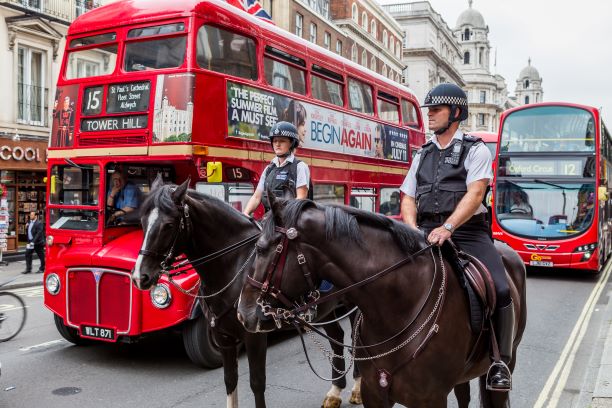
A new international study has shown that equine personality traits are central to the successful selection of mounted police horses, helping to shape safer, more effective partnerships between horses, officers and the communities they serve.
The research, led by Kiana McDole and Katrina Merkies, surveyed mounted police officers and volunteers to identify which personality traits are most desirable, and which are considered unacceptable, in police horse candidates. The findings provide important evidence to support more structured, welfare-led selection protocols for police horses worldwide.
What makes a good police horse?
Across 129 survey responses from mounted units in nine countries, respondents consistently identified five key personality traits as essential for police work:
- Calm
- Confident
- Trusting
- Willing
- Reliable
These traits align with personality dimensions associated with positive agreeableness, sociability and low neuroticism, all of which are vital when horses are expected to work in unpredictable, high-pressure environments such as crowd control, urban patrol and public events.
Importantly, the study found that most current police horses already possess these preferred traits, suggesting that many mounted units are making good selection decisions, even where formal testing protocols are not yet in place.
Dealbreaker traits clearly identified
Just as clearly defined were the traits that mounted officers consider dealbreakers for police horses. The five most problematic traits were:
- Aggressive
- Fearful
- Uncooperative
- Nervous
- Unreliable
Encouragingly, the vast majority of current police horses were reported not to show these traits, reinforcing the value of careful selection and training.
However, the study also found that fearfulness was considered especially unacceptable for horses working in neighbourhood patrols and park or wilderness patrol roles, where exposure to unpredictable stimuli is more common.
Calmness not always as common as expected
One interesting finding was that although calmness was ranked as the most important trait overall, it appeared less frequently in current mounts than anticipated. The authors suggest this may be linked to the use of personally owned horses within some mounted units, where horses may not have been originally sourced specifically for police work.
This highlights the potential benefit of early personality assessment, particularly when identifying young horses suitable for demanding working careers.
Do breed and sex matter?
The study found very limited influence of breed or sex on personality traits in current police horses. The only notable differences were:
- Draft crosses were reported as less approachable than other breeds
- Geldings were more often described as bold than mares
Overall, the findings suggest that individual personality matters far more than breed or sex when selecting police horses.
Supporting better welfare and safer selection
The authors conclude that personality-based assessment could help mounted units make earlier, evidence-based decisions, reducing the risk of unsuitable horses entering demanding roles and improving welfare outcomes for both horses and riders.
As police horse testing protocols continue to develop, this research provides a strong foundation for creating standardised, science-led selection tools that prioritise safety, performance and equine wellbeing.
The full open-access study, The influence of equine personality on police horse selection, is published in Applied Animal Behaviour Science and is available under a Creative Commons licence.
