


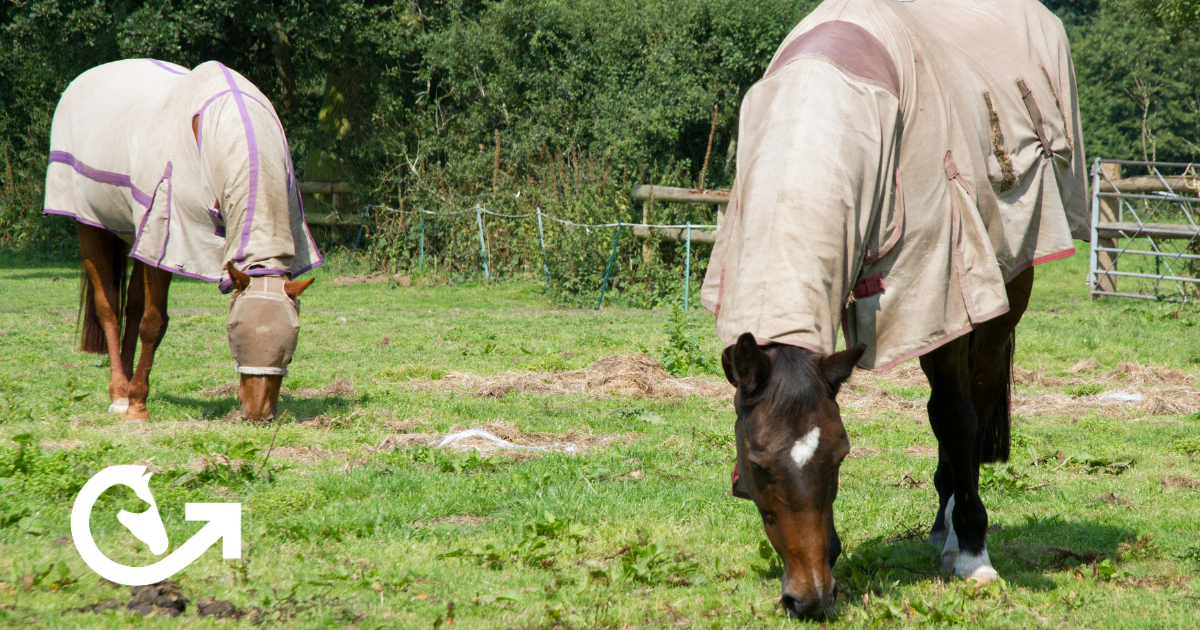
New research by Meggan Graves, Xiaocun Sun and Kellie Fecteau has provided the first scientific evidence that fly sheets can significantly reduce the irritation caused by biting insects, but the researchers say owners should remain aware of the potential effects on horses during hot weather.
The study, published this week in the Equine Veterinary Journal, found that horses wearing fly sheets displayed fewer fly avoidance behaviours, including head tossing and tail swishing, suggesting a clear improvement in comfort during peak fly season.
However, the researchers also found changes in some physiological measures, with horses wearing fly sheets showing a slightly higher heart rate and mixed responses in body temperature, highlighting the importance of choosing the right fly sheet and managing horses carefully during periods of high heat.
What did the researchers find?
Graves, Sun and Fecteau followed five healthy horses over a 10-week crossover trial, with horses alternating between wearing and not wearing fly sheets. They monitored behaviour, heart rate, body temperature and cortisol levels throughout the study.
The results showed that when horses wore fly sheets:
- Head tossing reduced by more than 80%.
- Tail swishing also fell by more than 75%.
- Fly sheets had little effect on stomping, likely because the lower limbs remained exposed to biting insects.
- No rubbing or skin lesions caused by the fly sheets were observed.
These findings support what many owners have observed for years, that fly sheets can make horses considerably more comfortable during periods of heavy insect activity.
A balance between comfort and heat
The researchers also measured several indicators of physiological stress.
While horses wearing fly sheets generally had slightly higher heart rates, the effects on body temperature were less straightforward. Some horses became marginally warmer, while others were actually cooler when wearing a fly sheet, suggesting that individual horses respond differently depending on factors such as the fly sheet itself, environmental conditions and the horse’s own ability to regulate body temperature.
The authors conclude that fly sheets are effective but should not be regarded as having no physiological cost, particularly in hot, humid weather.
Instead, they recommend owners make individual decisions based on each horse, considering factors such as:
- The horse’s workload.
- Air temperature and humidity.
- Access to shade.
- The fit and breathability of the fly sheet.
- Signs that the horse may be becoming too warm.
What does this mean for horse owners?
For many horses, particularly those prone to fly irritation or sweet itch, the welfare benefits of reducing constant insect harassment are likely to outweigh any small physiological effects, provided sensible management is used.
During periods of extreme heat, however, owners should avoid assuming that simply because a fly sheet is labelled as “cooling” or “breathable” it cannot contribute to heat load.
Dr David Marlin has previously advised owners to choose light-coloured or white fly sheets wherever possible, as darker colours can be prone to heating. He also recommends regularly wetting suitable fly sheets during periods of extreme heat – around every two hours where practical – to enhance evaporative cooling, while continuing to monitor horses closely for signs of heat stress.
Animalweb’s own independent fly sheet testing has also demonstrated that not all fly sheets perform equally. Factors such as fabric type, colour, construction and airflow can make a significant difference to how much heat builds up beneath the sheet.
Further reading
For more evidence-based advice on managing horses during hot weather:
- Helping you protect your animals in hot weather
- Independent fly sheet testing and performance comparisons:
By combining the latest scientific research with practical advice, horse owners can make informed decisions that help keep horses both comfortable and safe throughout the summer.
