



In our recent poll we asked which of the following systems were considered to be the limiting factor to performance in (healthy) unfit and fit horses. Of course in a lame horse pain would almost certainly be a limiting factor or if a horse had an infection such as influenza that would be the main factor, but this question is based around some of the exercise physiology studies from 20-30 years ago.

The Answers
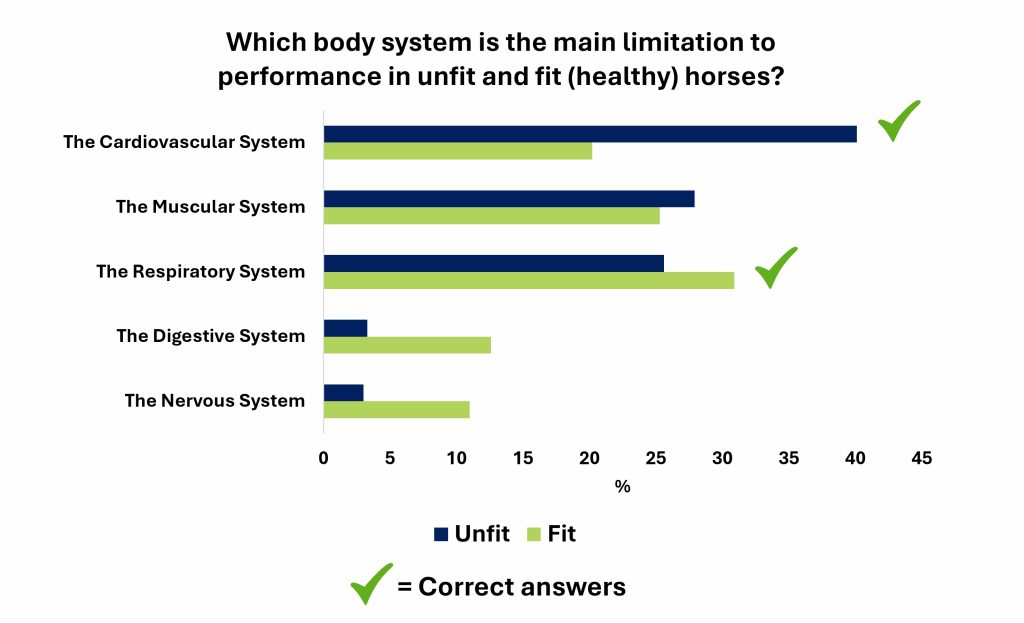
So the answers were that it is the CARDIOVASCULAR system (heart, blood vessels, blood) that limits performance in UNFIT horses BUT it is the RESPIRATORY system (lungs and airways) that limits performance in the fit horse. But why?
In the unfit horse, exercise performance is limited by delivery of oxygen to the working muscles (the locomotory muscles – the muscles that generate movement). We know this because if we improve oxygen delivery, for example by giving horses air to breathe that has 30% oxygen instead of 21%, we know that the muscles can use this and the performance is improved. We also know this from studies where the blood volume has been increased so more oxygen can be delivered to the muscles.
With training, the ability of the muscles to use oxygen increases and the ability of the cardiovascular system to deliver oxygen also increases. Muscle has a significant capacity to adapt to training, and the heart is, of course, a muscle. So the heart after training is often larger in response to aerobic-type training, and the blood volume is increased. However, the respiratory system does NOT change with training. You will see some textbooks still saying it does, but several studies have shown this is definitely not the case. So whilst the heart and muscles are now able to function at a higher level the respiratory system is now the limitation. How do we know? Again, if we give the horse more oxygen to breathe or we make breathing easier for the horse by providing oxygen in helium (Heliox as used by divers which is less dense and requires less energy to move in and out) we see significant improvements in exercise performance.
Further Information
- Top 10 Tips For Fitness And Soundness
- Webinar – Heart Rate, Fitness and Training – David Marlin
- Research Paper PrePrint – Heart Rates Of Horses During Competitive Dressage
- Your horse’s ECG and heart rate on your mobile phone!
- How and Why You Should Care for the Respiratory Health of Your Horse
References
- Physick-Sheard PW. Cardiovascular response to exercise and training in the horse. Vet Clin North Am Equine Pract. 1985 Aug;1(2):383-417. doi: 10.1016/s0749-0739(17)30762-9.
- Poole, D. Erickson, H. Heart and vessels: function during exercise and training adaptations. Kenneth, W. ∙ Hinchcliff, K.W. ∙ Kaneps, A.J. (Editors) Equine sports medicine and surgery; Elsevier Saunders, St Louis (MO), 2014; 667-694
- Marlin, D., & Nankervis, K. (2002). Equine Exercise Physiology. Wiley-Blackwell.
- Roberts, C. A., Marlin, D. J., & Lekeux, P. (1999). The effects of training on ventilation and blood gases in exercising thoroughbreds. Equine Veterinary Journal, 31(S30), 57-61.
- Art, T., & Lekeux, P. (1993). Training‐induced modifications in cardiorespiratory and ventilatory measurements in Thoroughbred horses. Equine Veterinary Journal, 25(6), 532-536.
