


Following Dr Kieran O’Brien’s excellent webinar: Willy or Won’t He? Equine Sheath and Other Problems, we bring you this simple how-to guide about sheath cleaning for your male horse.
What is sheath cleaning?
Most equine vets would only see horses with sheath problems occasionally. However, in last couple of years there’s been a proliferation of organisations offering sheath cleaning and cleaning products. Why?
A normal male horse’s sheath contains the penis, and is shrouded in multiple skin folds, which fold inside each other like a telescope. Glands line the sheath to lubricate it. The secretion from these glands is yellow, grey or black in colour, and odourless. It combines with dead skin cells, dirt, and oils, which aggregate and dry out, forming lumps, scales, or flakes.
Normally, these lumps/scales/flakes are shed when the horse is urinating or mating. But depending on how far they protrude their penis when urinating, and considering that most male horses are geldings in the UK and don’t develop an erect penis, this material can accumulate. Hence sheath cleaning.
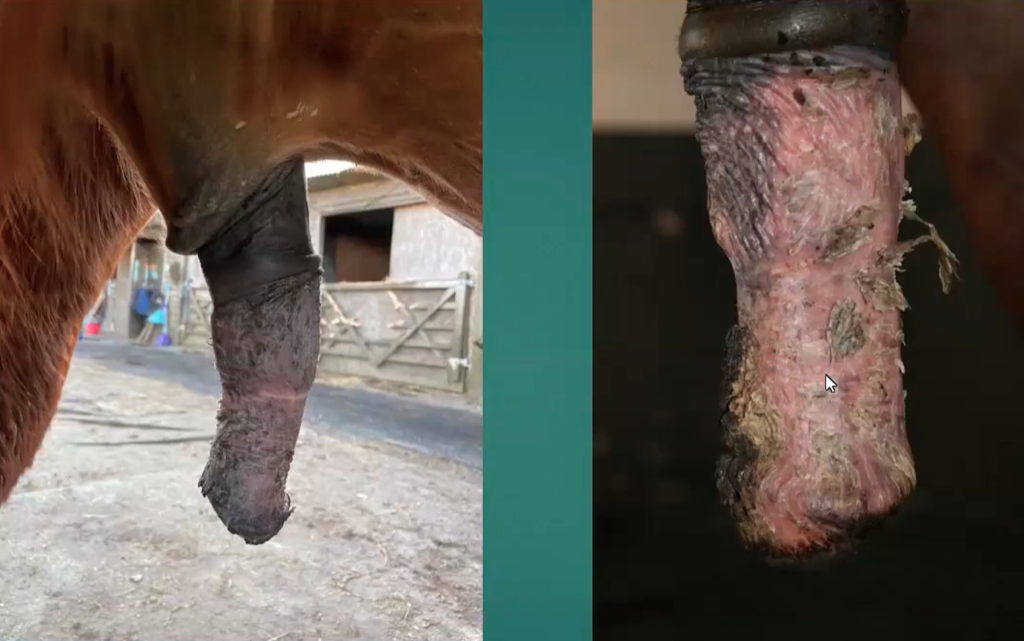
Is sheath cleaning necessary?
Of the 800,000 horses in Britain, only a fraction will have their sheaths cleaned during their lifetime. Clearly, it is not a major priority. And the symptoms listed on some sheath cleaning promotional websites can be dubious. Certainly, these issues can occur in relation to lots of other conditions, not just sheath problems.
In fact, vets would argue that there are more problems associated with over-cleaning than failure to clean, particularly when antibacterial products are used because these destroy the normal microbiome inside the sheath, for example, Hibiscrub or antiseptic washes.
When might cleaning be necessary?
There is an argument to carry out preventative cleaning every so often. But the key is not too often. You may wish to consider sheath cleaning if your horse has:
- Excess crusty discharge
- Obvious irritation/discomfort
- Tail rubbing
The disadvantage is that whatever you use to clean the sheath will disrupt the region’s normal microbiome.
Research from 1982 concluded that systematic washing with antiseptics (once a week for a few weeks) will cause the normal flora in the sheath to be replaced with pathogens and potential pathogens.
Infections can be caused by over-zealous cleaning with antiseptics, which kill the normal microbiome.
You must be careful about what you use AND how you do it.

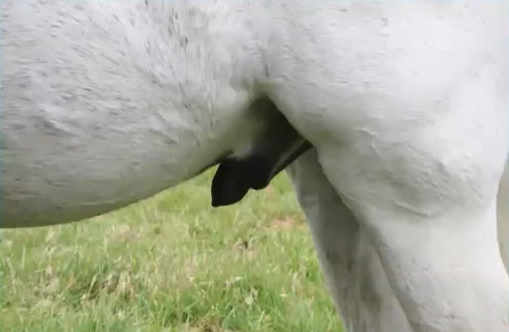
How should I approach cleaning?
Before cleaning your horse’s sheath, it’s important to be aware of the following:
- Compliance (varies enormously among horses)
- Danger to the cleaner (wear a helmet at all times)
- Penile retraction (horse might refuse to relax his penis without sedation)
- Too frequent cleaning (removes normal microbes)
- Use of antibacterial substances (must be avoided)
Which product is best?
There are numerous sheath cleaning products on the market.
It’s important to AVOID any products that contain antibacterial or anti-fungal properties to carry out normal cleaning in order to prevent killing the sheath’s normal microbiome.
Dr Kieran recommends a veterinary lubricant called Vet-Lubigel which is a very bland, very mild substance containing no antibacterial compounds that is water soluble.
Alternatively, you can use KY Jelly, although several tubes will be required. The veterinary version is much cheaper, and it comes with a long applicator pipe which is useful.

How do I clean the sheath?
Wear long gloves (rectal gloves) – ask your vet for a pair. Put disposable gloves on top for added dexterity.
- Insert the lubricant’s applicator pipe into your horse’s sheath, then squirt the liquid into the region.
- Apply as much lubricant as you can, working from both sides of your horse.
- Next, massage externally to work in the lubricant. Hopefully, this will remove any waxy, greasy lumps.
- Then, put some lubricant onto your hand and arm. Insert your hand fully to remove any loose lumps/scales/flakes.

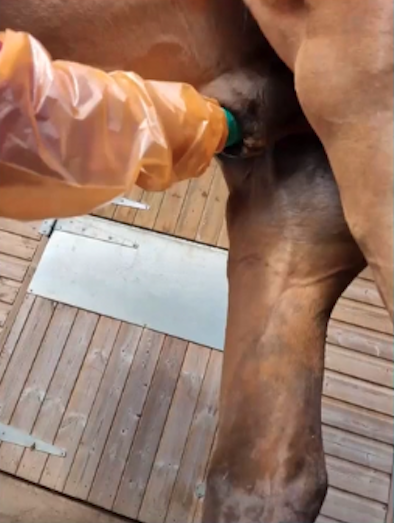

Be aware: If your horse does not relax his penis and retracts it right back inside the sheath, it will be difficult to access the skin folds either side of the penis, and therefore difficult to clean the area thoroughly.
Top Tip: Some horses will allow you to gently pull down their penis to extend the telescope of skin. Or running hot or warm water through a hose pipe inserted into the sheath may encourage the horse to relax and extend his penis.
What’s next?
- Wait one hour.
- Massage the sheath again from the outside to allow the lumps to loosen up.
- Insert your hand again to remove more.
- Then insert a hose pipe rubbed with a little bit of Vet-Lubigel into the sheath. Have someone ready at the tap to turn it on very gently until reaching full flow in order to flush out more lumps/scales/flakes.

Top Tip: Warm water is ideal for flushing with a hose pipe but cold water works fine. Alternatively, use the pipe that comes with the lubricant/commercial sheath cleaning product.
Be careful: Some horses will allow you to do this for longer than others. Watch out for kicking if the horse is anxious.
What about beans?
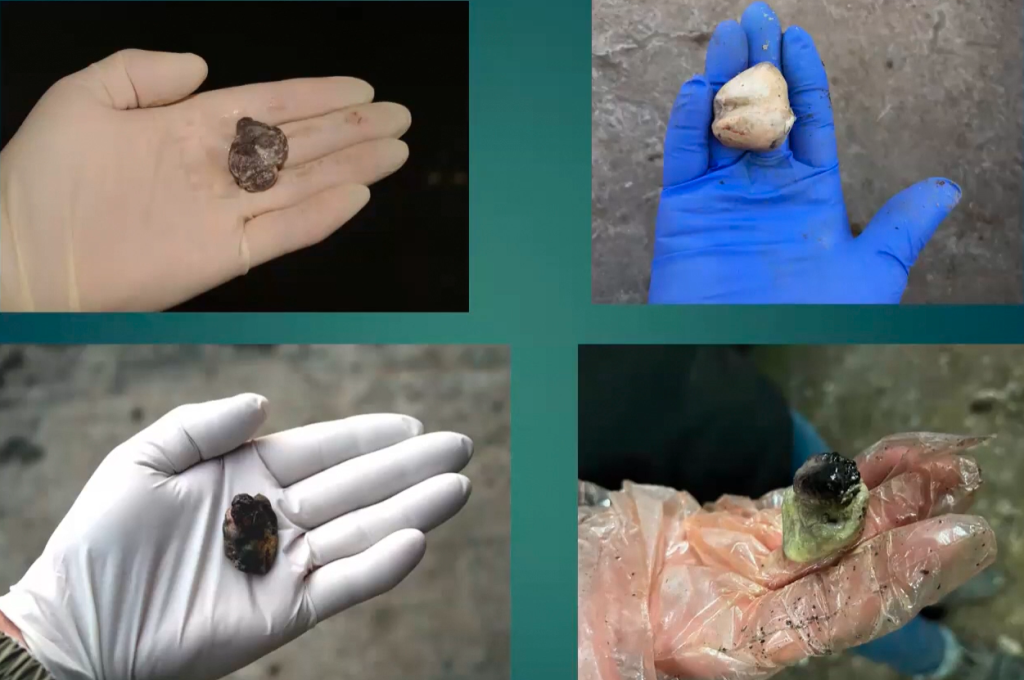
At the tip of a horse’s penis is a small ‘cave’ called the urethral diverticulum. This commonly fills with secretion which then hardens to a wax-like consistency, forming what is commonly called a bean.
The majority of older geldings likely have these, and they only rarely cause a problem. But there have been rare occasions when they are so large that they cause urinary obstruction, so it is common to remove them when sheath cleaning.
To do so, a sufficient length of the penis must be exposed so that it can be grasped with one hand, while the other hand removes the bean from the tip.
Things to remember!
Sheath cleaning should not be undertaken lightly. You must avoid cleaning the sheath too often, and you must use the correct solution.
- Only clean your horse’s sheath 1-2 times per YEAR!
- Use the correct cleaning solution – containing no antibacterial compounds
- Flush out the area afterwards with water
- Be vigilant for any changes in the sheath or penis – check closely when your horse is urinating, especially if his penis has pink skin
- Don’t hesitate to ask for veterinary advice!
Watch Dr Kieran’s webinar for more guidance on the following sheath-related issues: cancer, sarcoids, parasites, plus smeg, smegma, and beans, as well as castration, and the anatomy of a horse’s penis and sheath.
Read our other handy guide on How to Spot Sheath Problems here:
And, as always, please speak with your vet for further guidance.
