


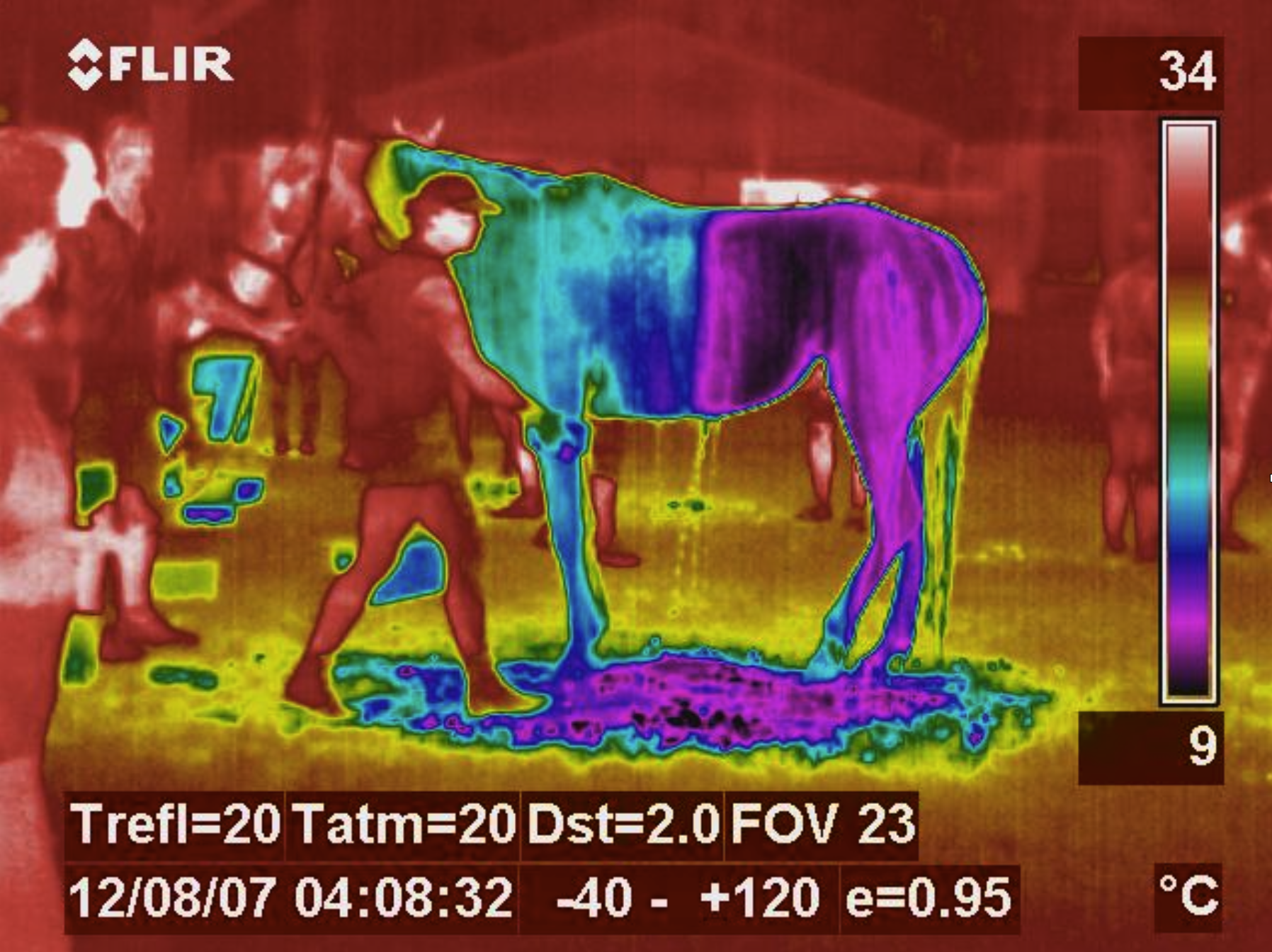
Our paper on the use of thermal imaging to assess how hot horses are during training, warm-up, during and after competition has just been published in Comparative Exercise Physiology….
Marlin, D.J., Reynolds, H., Mukai, K., Neil, K., & Akerstrom, G. (2023). Estimating rectal temperature in exercising horses in a competition environment using infrared thermal imaging. Comparative Exercise Physiology (published online ahead of print 2023). https://doi.org/10.1163/17552559-20230026
Sadly this is not open access but I can share the contents with you and you can read the abstract below or see the original at the link above.
Background
First a little background. In 1992 many horses got into trouble during the cross-country (then long format) at the Barcelona Olympic Games. The cross-country was held in the middle of the day with air temperatures in the low-mid 30°C’s, the hottest time, and the wisdom at the time was to prepare horses by AVOIDING the heat. So no acclimatisation. Many horses finished the cross-country with rectal temperatures exceeding 42°C. No one actually knows how hot these horses got as the rectal thermometers were human ones and only measured up to 42°C. Whilst fortunately no horses died, a fair few suffered irreversible heat injury and never came back to compete at that level again. And horses competing in dressage and jumping were also badly affected!
Atlanta Olympic Project
In 1993, with the Atlanta 1996 Olympics looming and not only heat but high humidity, the FEI launched a research initiative. I was nominated by the Animal Health Trust to write a proposal for FEI grant funding for a programme of work to inform how horses should be managed at the Atlanta 1996 Olympic Games. My proposal covered research into transport, acclimatisation, competition structure, thermal environmental monitoring and post-exercise cooling techniques. My proposal was selected against international competition and we started to put together the working plan. This represented a huge collaborative effort with AHT colleagues including Dr Pat Harris (now of Spillers/WALTHAM), Dr Roger Harris, Dr Paul Mills, Phd student Caroline Scott, Dr Colin Roberts (now of Cambridge Vet School), Sue Dyson (then of the AHT equine clinical unit at Balaton Lodge), Catherine Orme (PhD student), Ignasi Casas (Visiting researcher and vet student and latter Chef D’Equipe of the Spanish Endurance Team),
Collaborators
Prof Bob Schroter (Imperial College, London), Dr Bob Michell (Royal Vet College), Fred Barrelet (Rossdales, Newmarket), Celia Marr (Cambridge Vet School), Jan Bright (Cambridge vet school), Leo Jeffcott (Cambridge vet school), Dr Susie White (University of Georgia, Atlanta), Rachel Williams (PhD student Hartpury), Dr Mina Davies Morel (University of Wales), Dr Pat Maykuth (Atlanta), Dr Natalie Waran (University https://youtu.be/Br3KkvgMAZY?si=fPfBMcZoeX7qebPV of Edinburgh), Geoff Holah and Dr Gerit Matthesen (Private practice, Germany).
Dr Med Vet Gerit Matthesen
Gerit Matthesen was based near Frankfurt which is a large hub for equine flights and was to be the point of departure for horses flown to Atlanta for the test event in 1995. Gerit organised stables near the airport for horses from the UK, Germany, Belgium and Italy to congregate and be assessed for 5 days prior to the flight. Sadly, Gerit passed away during the Tokyo 2020(1) Olympic Games but I was able to share with him the work in the paper we have just published – 26 years on from our first work together.
First use of thermal imaging at the AHT and in Atlanta
I was aware of thermal imaging as it was a technique clinical colleagues often discussed. At the time relatively few people were using it although Chris Colles, clinical director at the AHT was using it occasionally. So early on in the project I got in touch with Geoff Holah, a thermal imaging specialist, who came along and collected images for us of horses on the treadmill and then also travelled with us to collect images during the Atlanta test event in 1995. However, all I kept hearing from everyone was, “you can’t use thermal imaging outside because of the sun”. And this did make sense to some degree as the sun directly heats the surface of horses and was considered to be a confounding factor. We then used thermal imaging to understand the potential for using ice cold water for rapid cooling. Again, at the time, it was considered that ice-cold water would be counter-productive as it would “shut down skin blood flow and make the horse even hotter”. Of course we have known for almost 25 years that this is not the case and that ice-cold water and lots of it is probably the most important method for protecting horses in hot climates.
Revisiting thermal imaging at the 2019 Tokyo Test Event
I rarely used thermal imaging post the Atlanta project and thermal imaging wasn’t used during the Games themselves; just good old rectal thermometers that went up to 45°C. Fortunately no horses got anywhere near that due to a combination of acclimatisation, an early morning start, shortened cross-country and a mandatory cooling stop after the steeplechase. And in the meantime a number of thermally challenging events took place with which I was involved on the climate mitigation side, particularly Athens 2004, Beijing 2008, Rio 2016 and Tokyo 2020(1). Not to mention major championships such as Tryon 2018 and a number of Asian Games including the most recent in Hangzhou, China in 2022. It was in planning meetings for Tokyo 2020 that I was asked to advise on any technology that could be used to provide an “early warning” of horses that were hotter than normal and at risk of potential heat illness. And so thermal imaging was my first thought.
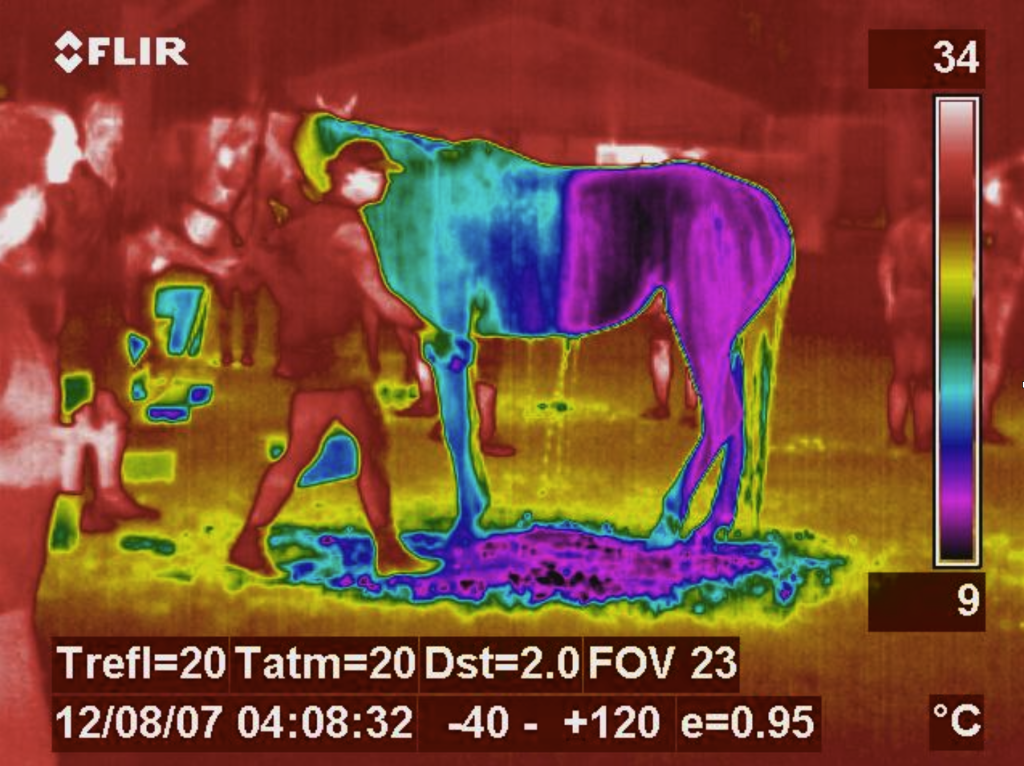
So for the 2019 Tokyo Test Event (Ready Steady Tokyo) I teamed up with thermographer Helen Reynolds of Equionics to collect paired thermal images and rectal temperatures of horses during training, warm-up and post-competition. And to our surprise there was a very good correlation between a thermal image of the hindquarters and rectal temperature with the thermal imaging underestimating rectal temperature by around 0.5°C, so very easy to adjust for. An example image is shown below.
Further validation work
After the Tokyo 2019 Test Event we collected more data from other events in different thermal environmental conditions. What we found and what is reported in our paper is not surprising – the cooler the environment the less reliable thermal imaging becomes. But a horse that shows up as hotter than other will be….hotter than others.
Use of thermal Imaging at Tokyo 2020(1)
On the basis of the research from 2019 and 2020 and early 2021, protocols were developed for the use of thermal imaging at Tokyo 2020(1). This involved 3 thermographers (Helen Reynolds, Kaz Mukai and Kirsten Neil) imaging horses during training, warm-up and post-competition. Horses that had a hindquarter lateral temperature above 39°C were flagged to the Steward and or Vet Commission as appropriate. This was then relayed to Chef d’Equipe, Team Vet or rider if neither of the former were available. This was briefed to all stewards, veterinary team and National teams prior to the start of the Games. In addition, thermal imaging was also used on cross-country day in the warm-up area and horses that were above the 39°C threshold were flagged and riders were requested to cool their horses sufficiently before being allowed to start the cross-country. Fourteen of the 62 starters were flagged to Stewards/Vets and required to cool their horses before being allowed to start. This was done as early as possible so as to avoid horses missing their allocated start time, which only happened with one horse.
Overall the use of thermal imaging was very well received by all involved in Tokyo; riders, vets, team management, officials. What was also particularly encouraging was that most teams began to request thermal imaging of their horses during training and/or competition warm-up and used this to make decisions on whether to interrupt training or warm-up to undertake cooling.
Limitations of using thermal imaging
Is this something that you can do with a £200 thermal imaging camera? Sadly not. We investigated low, medium and high cost cameras and the minimum spec was cameras around £5000. The ones used in Tokyo were £15,000. The more expensive cameras have higher resolution which means they can work at distances of up to 20m or even slightly further. This is essential for discrete monitoring of horses and riders.
What next?
The use of thermal imaging in this way at Tokyo 2020(1) helped us identify some horses being worked too hard for the conditions in training and helped us prevent hot horses starting the cross-country which should have reduced fatigue and fall risk. Whether it will be used in Paris 2024 is an open question. But for the record, the climate analysis shows that on the basis of the past 10 years there is a 1 in 3 chance of a substantial heatwave during the Paris 2024 Olympics.
If you find this interesting and have questions or would like to explore the use of thermal imaging in equestrian competition further, then please do get in touch via hello@drdavidmarlin.co.uk
