


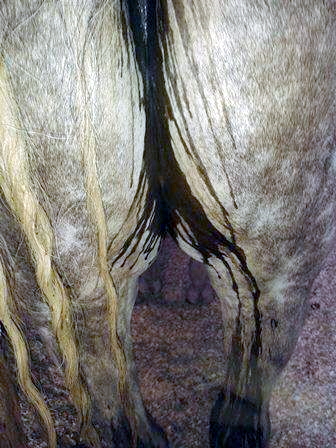
Faecal Water Syndrome (FWS) or Free Faecal Water Syndrome (FFWS) is a relatively common condition in horses, but perhaps surprisingly, there is relatively little scientific information about its causes and treatment. It is a condition recognised by vets. FWS differs from diarrhoea, where the droppings (faeces) are abnormally loose or soft. In FWS the droppings are often normal, but water is passed before, with or after the droppings. One study compared the composition and physical properties of faeces from normal horses and those with FWS and found they were essentially the same.
The severity of FWS can vary from mild to severe. Some horses may experience persistent FWS, whilst others may experience it sporadically or seasonally and other may have varying severity on a week by week basis.
FWS may be inconvenient for many owners who need to frequently wash the horse’s hindquarters. But this may also lead to skin irritation and inflammation. This can sometimes be managed by the use of a suitable barrier cream. Whilst there is not a strong link between FWS and the risk of colic, some studies have suggested there may be a link.
Some of the risk factors for FWS include sudden changes in the type or amount of forage. This suggests that the gut microbiome may be involved in FWS. In a study where faecal microbial transplantation was given to 10 horses with FWS, there was an improvement in FWS symptoms for 14 days after treatment and up to 168 days (Lautsen et al. 2021). This is particularly interesting, as there was no evidence of abnormal hindgut microbiome in these horses before faecal transplantation. The same group of authors also found that horses with FWS tended to be fed less forage and higher amounts of concentrates than non-affected horses (Lindroth et al. 2021). It has also been suggested that horses lower in the pecking order with a herd may be more at risk of FWS. Furthermore, coloured horses and geldings appear to be more at risk. Finally, stress, such as hard training, travelling or other illness appears to be a trigger for FWS.
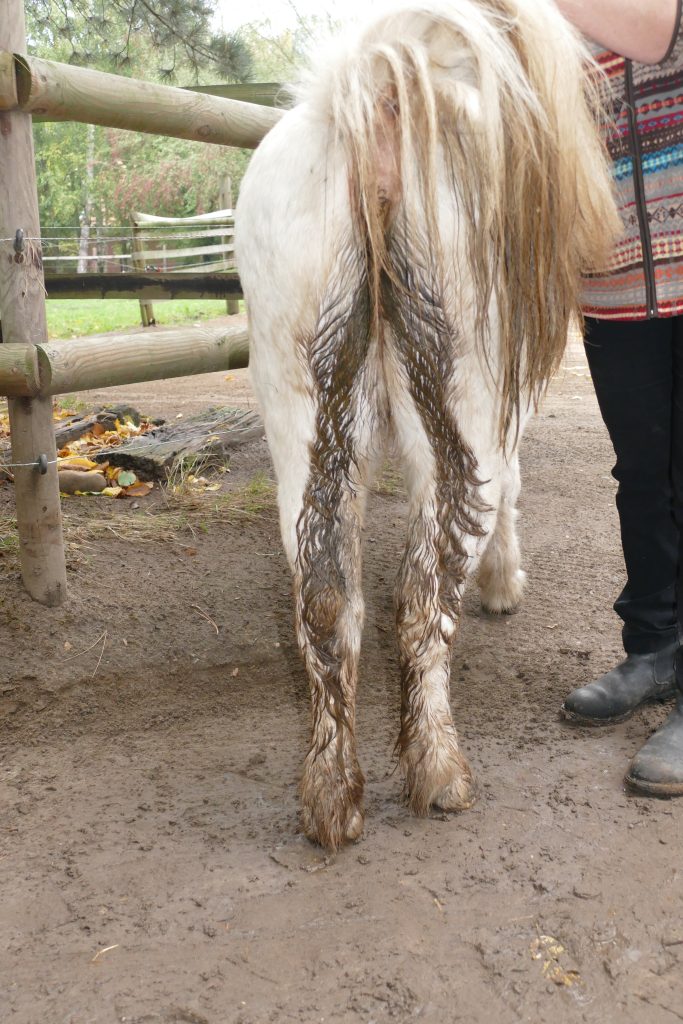
Whilst relatively little is known about what causes FWS, hindgut imbalance, inflammation of the gut lining, parasites and poor dental health are all possibilities.
The procedure for investigating a horse with FWS by your vet may include a detailed history of the horse, including their age, breed, and any gastrointestinal issues, a physical examination with a focus on the digestive system, questions about the horse’s feeding and management regimen, including their daily schedule, turnout times and herd status.
Diagnostic tests to rule out other causes may include blood samples to rule out infectious causes, tests to rule out parasites, a Cushing’s disease test to rule out an endocrine disease, rectal examination and/or ultrasound to check for intestinal inflammation or cancer or gastroscopy to check for stomach ulcers.
Some things to try for a horse or pony with FWS as well as obviously consulting your vet include:
- ad lib forage and small meal sizes with low starch content
- adding in a high-quality pre and probiotic supplement
- ensuring that your horse is not being bullied in a herd
- increasing turn-out time
- ensuring there is no other illness/pain that could be causing chronic stress
- avoiding any sudden change in diet, especially forage
References
Ertelt A., Gehlen H. Free fecal water in the horse—An unsolved problem. Pferdeheilkunde Equine Med. 2015;31:261–268. doi: 10.21836/PEM20150308.
Kienzle E., Zehnder C., Pfister K., Gerhards H., Sauter-Louis C., Harris P. Field Study on Risk Factors for Free Fecal Water in Pleasure Horses. J. Equine Vet. Sci. 2016;44:32–36. doi: 10.1016/j.jevs.2016.04.098.
Laustsen L, Edwards JE, Hermes GDA, Lúthersson N, van Doorn DA, Okrathok S, Kujawa TJ, Smidt H. Free Faecal Water: Analysis of Horse Faecal Microbiota and the Impact of Faecal Microbial Transplantation on Symptom Severity. Animals (Basel). 2021 Sep 23;11(10):2776. doi: 10.3390/ani11102776.
Lindroth KM, Johansen A, Båverud V, Dicksved J, Lindberg JE, Müller CE. Differential Defecation of Solid and Liquid Phases in Horses-A Descriptive Survey. Animals (Basel). 2020 Jan 1;10(1):76. doi: 10.3390/ani10010076.
Lindroth KM, Dicksved J, Vervuert I, Müller CE. Chemical composition and physical characteristics of faeces in horses with and without free faecal liquid – two case-control studies. BMC Vet Res. 2022 Jan 3;18(1):2. doi: 10.1186/s12917-021-03096-1.
Lindroth KM, Lindberg JE, Johansen A, Müller CE. Feeding and Management of Horses with and without Free Faecal Liquid: A Case-Control Study. Animals (Basel). 2021 Aug 30;11(9):2552. doi: 10.3390/ani11092552. PMID: 34573518; PMCID: PMC8465618.
Molina-Torres G., Rodriguez-Arrastia M., Roman P., Sanchez-Labraca N., Cardona D. Stress and the gut microbiota-brain axis. Behav. Pharmacol. 2019;30:187–200. doi: 10.1097/FBP.0000000000000478.
Schoster A., Weese J.S., Gerber V., Nicole Graubner C. Dysbiosis is not present in horses with fecal water syndrome when compared to controls in spring and autumn. J. Vet. Intern. Med. 2020;34:1614–1621. doi: 10.1111/jvim.15778.
