


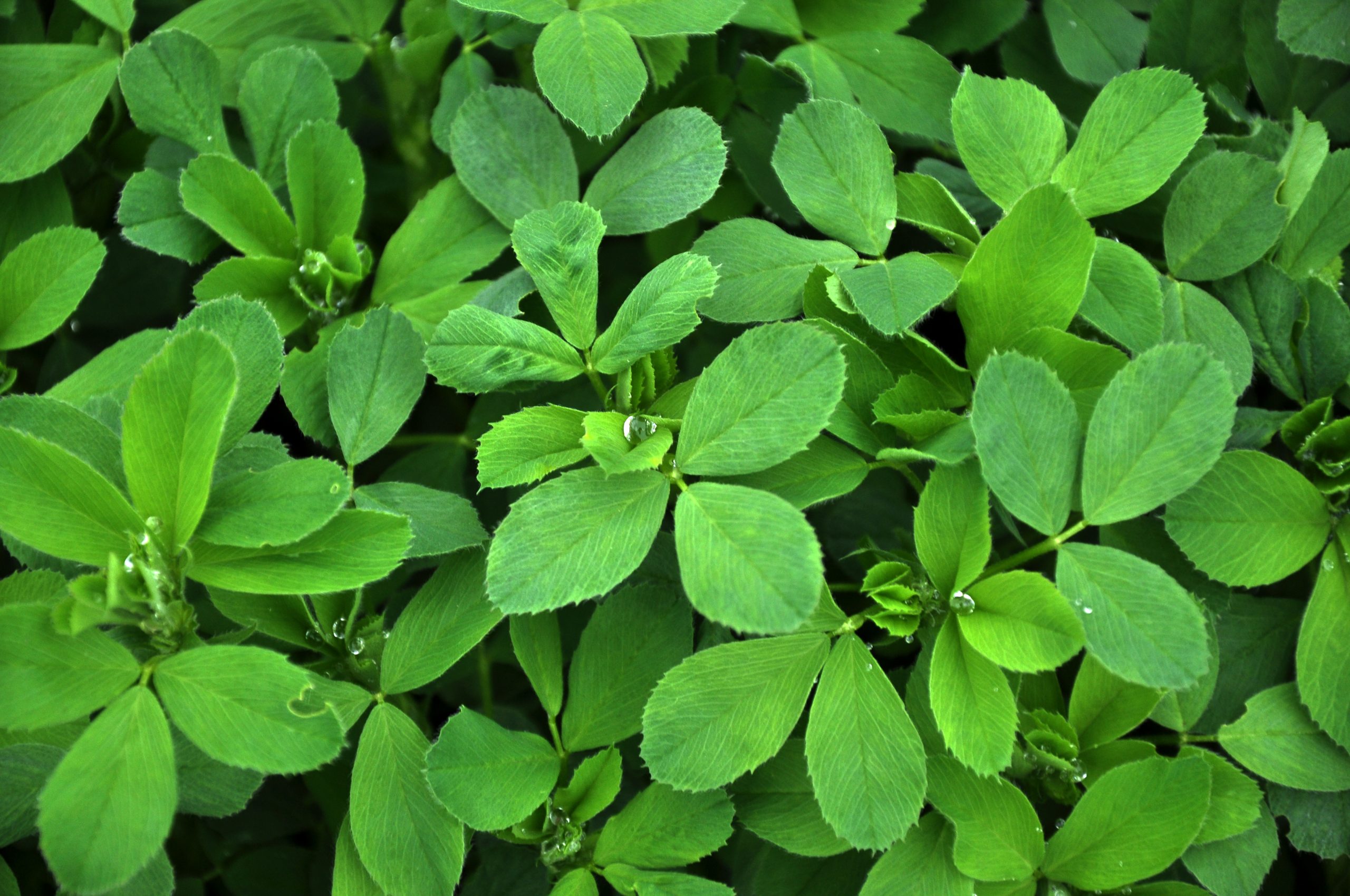
There are always lots of questions surrounding the best feeds or supplements for horses with or prone to gastric ulcers, and alfalfa or lucerne is always being discussed, whether its fresh alfalfa, alfalfa hay, alfalfa chaff or alfalfa pellets. The reason alfalfa always comes up is that due to its high protein and calcium content (Woodward et al. 2011), alfalfa has the potential to buffer some of the stomach acid produced. Before discussing alfalfa any further, it’s important to point out that three of the best ways to reduce the risk of gastric ulcers are to provide ad lib good quality forage, to feed 3-4 small meals a day if they are starch-based and to provide some forage prior to exercise.
What research do we have on alfalfa and ulcers in horses? Nadeau et al. (2000) fed 6, seven-year-old horses a diet of either bromegrass hay or an alfalfa hay and grain diet. Interestingly the stomach pH was higher for the first 6h after feeding alfalfa hay and grain compared with the bromegrass hay only. Not only that, the number and severity of nonglandular squamous gastric lesions were significantly lower in horses fed the alfalfa hay-grain diet, and the authors suggested that “An alfalfa hay-grain diet may buffer stomach acid in horses.”
In 2007, Lybbert et al. fed 24 Quarter Horse yearlings either coastal Bermuda grass hay or alfalfa hay. The ulcer severity scores were significantly lower when horses were fed alfalfa hay compared to coastal Bermuda hay. When horses who had been on coastal Bermuda hay were swapped to alfalfa hay, their ulcer scores reduced.
The next study to look at is by Vondran et al. (2016). They studied 70 Warmblood foals at weaning and fed one group 3kg of alfalfa chaff and ad-lib hay and the other 3kg of alfalfa pellets and ad-lib hay. After weaning, all foals showed gastric ulcers, mainly in the glandular region (compared with 84% before weaning). What was interesting in this study was that where the food exits the stomach at the pylorus, foals fed alfalfa chaff had more severe ulcers than those fed alfalfa pellets. The reason for this was thought to be due to mechanical damage or “scratching” by the stiff, dry and sharp chaff used. In a second study (Vondran et al, 2017), the same authors studied 6 mature horses. All horses were stabled for 24/7, but half were fed alfalfa chaff only, whilst the others were fed grass hay only. The groups were then swapped. The glandular ulcer scores were not significantly different between the alfalfa chaff-only or the grass hay-only diets. But 6 horses is a small number and a larger number may have produced different results.
Another study on bromegrass versus alfalfa hay found that the faecal pH of alfalfa-fed horses was greater when compared to caecal pH in alfalfa-fed horses and faecal pH of bromegrass-fed horses (Lesh et al. 2019). Acetate, propionate, butyrate, and total VFA concentrations were also greater in the caecum and rectum of alfalfa-fed horses compared to the caecum and rectum of bromegrass-fed horses.
A recent study by Bäuerlein et al. (2020) found that in adult Warmblood horses fed either meadow hay or alfalfa hay, feeding alfalfa hay seems to have no detrimental effects on the mucosal integrity at the squamous gastric region in healthy adult horses nor any detrimental effects on the glandular mucosa.
It’s difficult to discuss alfalfa without addressing “alfalfa allergy” or “alfalfa intolerance”. This seems to be more imagined than common. In the USA and other regions where large amounts of alfalfa are fed, allergy or intolerance are rarely mentioned. It’s also not uncommon to hear reports that a horse cannot have a specific product “because it contains alfalfa” but then to find that it being fed another product which is also high in alfalfa.
The bottom line
Alfalfa may be beneficial to horses with, recovering from or prone to gastric ulcers. Young foals may be sensitive to gastric damage from sharp chaff. It may be prudent to avoid feeding sharp, dry chaff of any kind to horses prone to gastric ulcers.
References
Bäuerlein V, Sabban C, Venner M, Vervuert I (2020) Effects of feeding alfalfa hay in comparison to meadow hay on the gastric mucosa in adult Warmblood horses. 36 (1), 29–36. DOI: 10.21836/PEM20200105
Lesh, JR., Sorensen, RJ., Drouillard, James S., Douthit, TL. and Lattimer, JM. (2019) Effect of forage type on cecal and fecal fermentation parameters in the horse https://krex.k-state.edu/handle/2097/40004
Lybbert, T., P. Gibbs, N. Cohen, B. Scott and D. Sigler. 2007. Feeding alfalfa hay to exercising horses reduces the severity of gastric squamous mucosal ulceration. AAEP Proceedings. 53:525-526
Nadeau JA, Andrews FM, Mathew AG, Argenzio RA, Blackford JT, Sohtell M, Saxton AM. Evaluation of diet as a cause of gastric ulcers in horses. Am J Vet Res. 2000 Jul;61(7):784-90. doi: 10.2460/ajvr.2000.61.784.
Vondran S., Venner M., Vervuert I. (2016) Effects of two alfalfa preparations with different particle sizes on the gastric mucosa in weanlings: alfalfa chaff vs. alfalfa pellets. BMC Veterinary Research 12:110; DOI 10.1186/ s12917-016-0733-5
Vondran S., Venner M., Coenen M., Vervuert I. (2017) Effects of alfalfa chaff on the gastric mucosa in adult horses. Pferdeheilkunde 33, 66-71; DOI 10.21836/PEM20170109
Woodward, A.D., Nielsen, B.D. Liesman, J et al. 2011. Protein quality and utilisation of timothy, oat-supplemented timothy and alfalfa at differing harvest maturities in exercised Arabian horses. J. Anim. Sci. 89:4081-4092
