


These supplements are sold as preventatives against sand colic, but all evidence confirms they should be considered SECONDARY to management changes to avoid sand ingestion.
The recommended dose of psyllium from studies is 1g/kg – i.e. 500g per day for a 500kg (1100lb) horse. NONE of these supplements get anywhere near this. Even the pure psyllium supplements only indicate 100g per day! This is because, first, 500g per day would be expensive, and second, because psyllium on its own is not palatable.
Some products are pelleted and include other ingredients to improve palatability (Sandout, SandXpell, Sand-Ex), but only Equine America declares the % psyllium in their product. These products should NOT BE FED CONTINUOUSLY. They should be fed as a 7-10 day course each month.
The cheapest way to provide psyllium is as a pure product. At £1.27 per 100g, a 7-day course of 500g per day would cost £44.45 in total. Some products could cost £30-40 for a 7-day course with a limited chance of benefit due to the low amount of psyllium.
Palatability can be improved by feeding in multiple small feeds (e.g. 4-5 per day with ~125-100g per feed. Feeding in linseed, with oil or with herbs and/or molasses and dampened is also helpful. It should be fed immediately after wetting. Do not let it sit around after wetting, as it quickly becomes “gummy” and harder to eat or clean from buckets. Introduce slowly when feeding for the first time. Always ensure unrestricted access to water as restricted intake after feeding psyllium could increase the risk of IMPACTION COLIC!
We would not recommend products that are not fully transparent in the % psyllium.
Bottom Line
- Management to limit sand ingestion is the most effective and reliable way to reduce the risk of sand colic.
- If you are going to feed a psyllium product, aim for 1g/kg bodyweight (eg 500g/500kg horse) for 7 days, once a month
- Introduce slowly for the first time, split between multiple feeds, try to improve palatability
- Ensure water is always available
- Pure psyllium is the best. It’s the most cost-effective. No commercial products deliver the recommended amount of psyllium.
- Commercial supplements are expensive and almost certainly ineffective.
Sandy Soil Supplements: Animalweb Comparison Table
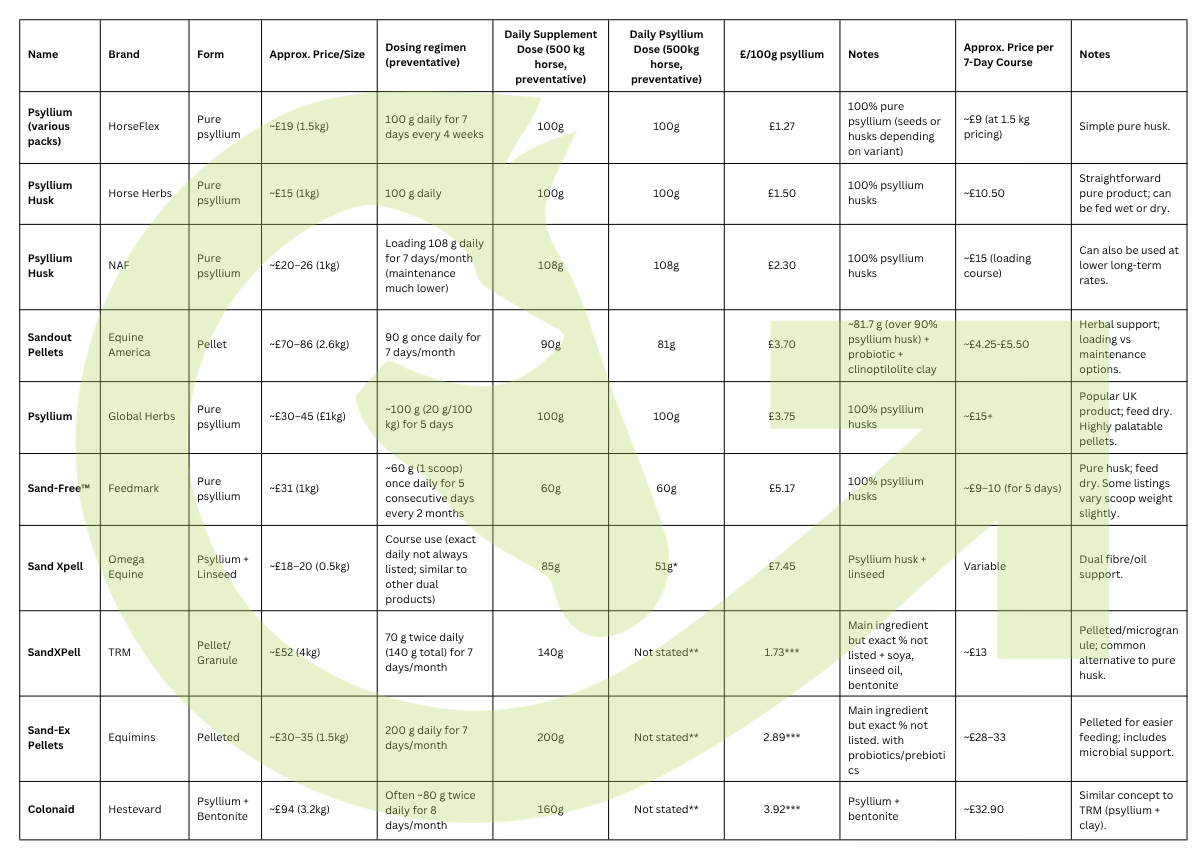
NB.
- * Omega Equine do not give the amount of psyllium in their product but did supply the information when requested by email
- ** TRM/Equine Products, Equimins and Hestevard did not supply information on psyllium content when requested by email
- *** Estimated based on psyllium being 75% of the product
