


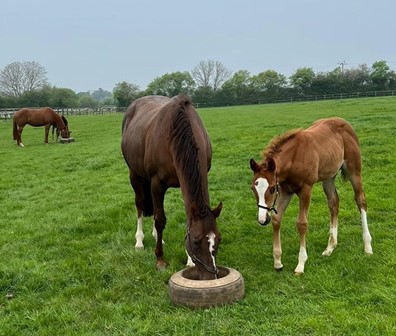
A new study from the Royal Veterinary College (RVC) has shown that the early-life management of Thoroughbred foals can have a significant impact on their future racing careers.
Researchers found that foals given extensive turnout in large pastures during their first six months of life, and those weaned at a later age, were more likely to race, take part in more starts, and earn higher levels of prize money.
This is the first time in a UK field setting that the relationship between early-life experiences and later-life performance in Thoroughbreds has been studied in such detail. The results, published in Equine Veterinary Journal, suggest practical changes that stud farms can adopt to improve both welfare and performance outcomes, key goals of the Horse Welfare Board’s strategy for the racing industry.
How the study was conducted
The research team, led by Dr Rebecca Mouncey, Veterinary Surgeon and Post-Doctoral Research Fellow at the RVC, followed 129 flat-bred Thoroughbred foals born in 2019 and 2020 across six stud farms in the UK. Foals were monitored from birth through to entry into training, with detailed records kept of their health, management, and early environments. Racing performance data was then collected up to the end of the horses’ fourth year of life.
By using statistical modelling, the team were able to identify clear links between management practices in the foals’ first six months and their later racing achievements.
Key findings
- Foals with greater turnout in their first six months, and those weaned later, were more likely to race at least once by age four.
- Older age at weaning was associated with a higher number of race starts.
- Larger paddock turnout during early life was linked to greater prize money earnings.
Why it matters
Dr Mouncey explained:
“This study is the first of its type to evaluate the effect of early-life experiences on later-life performance in Thoroughbred racehorses. Our findings highlight that the first six months of life are a critical period of development, during which management practices must provide sufficient opportunity for positive tissue adaptation and optimal growth.”
The results underline the importance of maximising turnout and delaying weaning where possible, both for welfare and performance benefits.
Funding and publication
The study was funded by the Horserace Betting Levy Board, the Racing Foundation and the RVC’s Mellon Fund for Equine Research.
Reference:
Mouncey R, de Mestre AM, Arango-Sabogal JC, Verheyen KL. Born to run? Associations between gestational and early-life exposures and later-life performance outcomes in Thoroughbreds. Equine Vet J. 2025. Read the paper here.
