


Research Paper: Comparison of Transverse Thoracolumbar Angles in Dressage and Endurance Horses Using 3D Light Scanning and Comparison with Commercial Saddle Gullet Angles
David J. Marlin – Ergon Equine Ltd
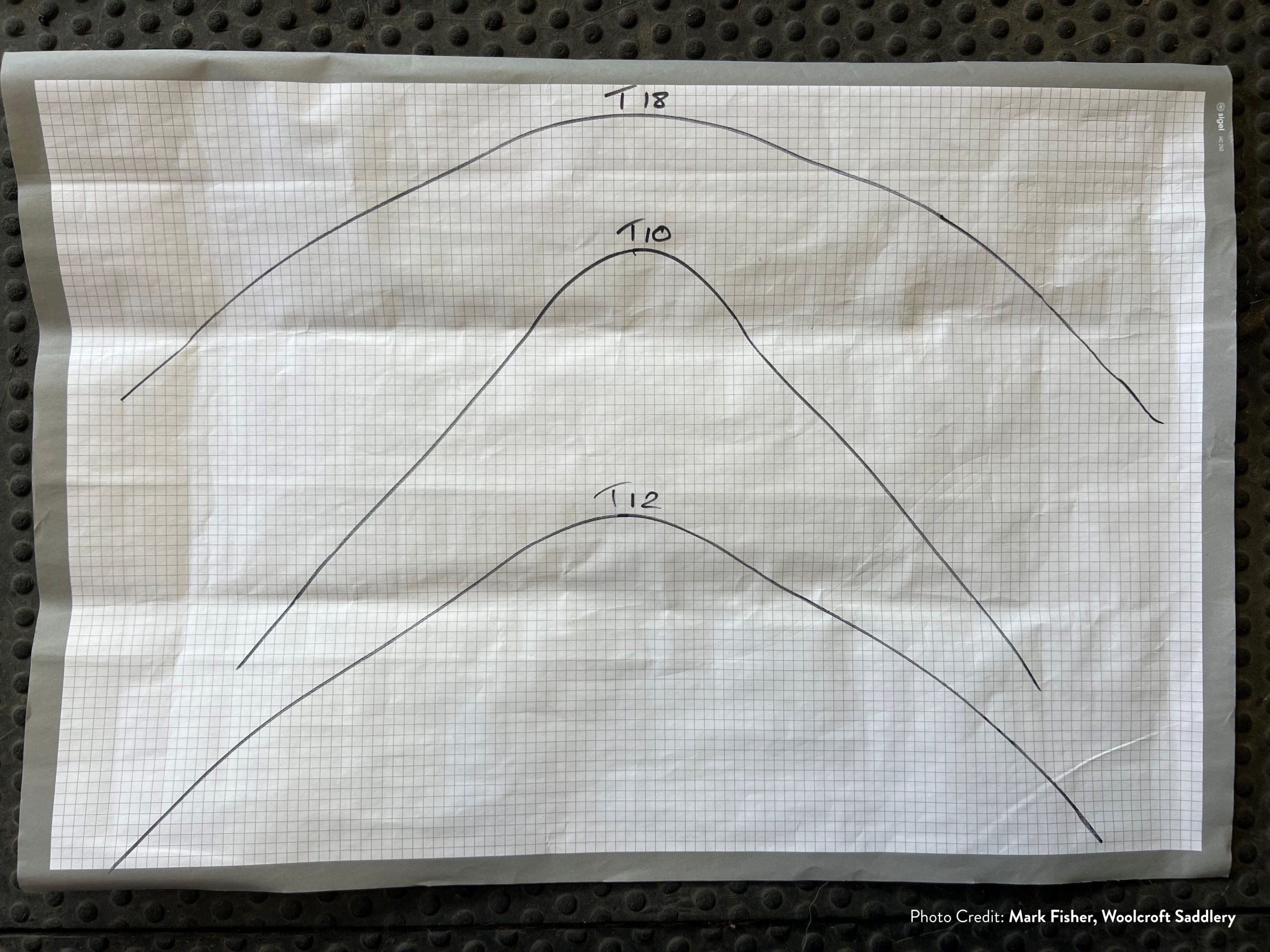
For many years now, saddle makers and saddle fitters have used flexicurves to take templates of horses’ backs in different locations to aid them in designing or fitting saddles or to check for changes since a previous fitting. Flexicurve templating can be problematic. The horse may move as the template is being taken, especially when the horse is being touched. Templates also rely on accurate identification of anatomical landmarks, and only a relatively small number of transverse thoracolumbar (back) profiles can be collected. However, with the improvements in 3D scanners and 3D scanning apps now widely available on phones, there is the possibility to quickly and accurately scan the whole saddle area in seconds without having to touch the horse at all. This approach could be used by saddle makers, saddle fitters and even horse owners to send monthly scans to their saddle fitter to check for changes.
In this study, we scanned endurance and dressage horses as two very different types. As might be expected, the biggest difference between endurance and dressage horse groups was at the front of the saddle area over the withers, where the endurance horses were narrower, and the least difference was at the rear of the saddle area. The next stage is to explore the development of an app for saddle fitters and owners to use and to make direct comparisons with Flexicurve templates.
Research Paper: Comparison of Transverse Thoracolumbar Angles in Dressage and Endurance Horses Using 3D Light Scanning and Comparison with Commercial Saddle Gullet Angles
David J. Marlin – Ergon Equine Ltd
Abstract:
The thoracolumbar profile is of interest in relation to saddle design and saddle fit. Flexible-curve rulers have previously been used to gather thoracolumbar profiles in horses; however, 3D light scanning offers a potential non-contact alternative method to estimate the cross-sectional shape of the region in greater detail. The aims of this study were to (1) describe the thoracolumbar profiles of endurance and dressage horses using 3D light scanning and (2) compare the wither profiles to saddle manufacturers’ gullet bar angles. 3D light scans of the thoracolumbar region were obtained from 23 fit and competing Arabian endurance horses and 21 dressage horses of mixed breed competing at advanced or higher, each from two different stables. Markers were placed by palpation on the caudal scapula (V1) and T18 (V4). Images were imported into Meshmixer. A transversely oriented plane cut was taken at the level of the marker of the left caudal scapula, perpendicular to the back surface (V1), and at the level of the marker at T18. Two further cuts were made at the base of the withers (V2) and the lowest point/midpoint of the back (V3). The mean transverse back angle at V1 was 87 ± 8° for the endurance horse sample and 99 ± 10° for the dressage horse sample (P < 0.0001), and at V4 was 141 ± 7° (endurance) and 144 ± 6° (dressage) (P < 0.0001). For both endurance horses and dressage horses, there was a significant effect of location on back transverse angle (V1 to V4; P < 0.001), with V1 the narrowest and V4 the widest. While there is little consistency in what gullet angle a “medium” gullet bar would actually be, the range of angles measured at the shoulder in the present study reflects the most common gullet sizes offered by six manufacturers of English saddles.
Click here to read the research paper – Comparison of Transverse Thoracolumbar Angles in Dressage and Endurance Horses Using 3D Light Scanning and Comparison with Commercial Saddle Gullet Angles
