


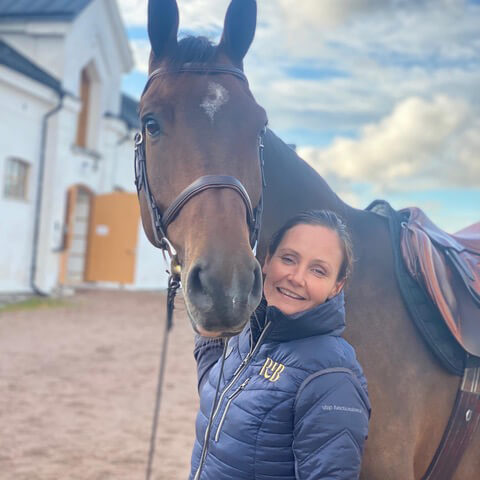
In this relaxed conversation, expert vet and rider biomechanics specialist Maria Terese Engel joins Animalweb’s Helen to discuss her groundbreaking research into rider asymmetry and movement patterns. Drawing on her unique background in both veterinary medicine and ballet, Maria shares insights from her current studies and the upcoming international launch of the Rider in Balance Academy.
She explains how improving rider awareness and technique off the horse can dramatically change riding performance in just six weeks. From Olympic riders to grassroots amateurs, Maria’s methods centre on building precise body awareness and correcting long-held movement habits. This episode is packed with practical takeaways, especially for anyone striving to ride more sympathetically, improve balance, or avoid unnecessary pressure on the horse.
Key Notes:
- Maria’s background combines veterinary medicine, equine lameness, sports science, and ballet.
- Her father’s work in Olympic sports biomechanics inspired her approach to analysing rider movement, not just the horse.
- Most riders rely on feel, but Maria emphasises that objective body awareness is critical for correct and repeatable technique.
- New research project compares unmounted technical rider training vs. traditional physical fitness work – early results show big gains in just 6 weeks with her method.
- Launching soon: Rider in Balance Academy (international version) and companion video coaching app.
- Common training mistake: riders being taught how the horse should go, not what the rider’s body should actually do to make it happen.
- Teaching precision in rider posture and movement could reduce the need for strong aids and improve welfare.
- Maria is also working on further product development following the popularity of her stirrups, including accessories and new rider tools.
Watch Maria’s previous webinar and videos with Animalweb here:
Webinar – Rider Balance with Dr Maria Terese Engell
Video – David meets Dr Maria Terese Engell – AAEP Convention
Transcription
Here is a transcription of the podcast. (Please note this is an automated transcription, so we apologise for any errors from the original podcast.)
Hello and welcome to another edition of Animal Web’s podcast. I’m Helen and today I am joined by one of our experts that we’ve had on a couple of times before but I’m so pleased to pin her down and talk to her again. We have Maria Therese Engel with us today and we’re going to be talking about Riders in Balance and Maria is going to tell us all about the things she’s been up to recently because I know she’s been very very busy researching.
I know that her and David have seen each other a few times recently and last year you guys caught up. So let’s start by introducing you, Maria, to people that don’t know who you are. Hello, Maria. How are you Fine, thank you. And I’m so happy to be here. Thank you so much for having me. We love having you. love having you. So Maria, can you tell us a little bit about yourself? Because I love your story.
it goes all over the place. Yeah. to vets and tell us a little bit about yourself because it’s a fantastic journey. Well, you know, I’m a horse nerd. That’s like the beginning of everything. So I’m a veterinarian. I also have like an equine clinic at home outside of Oslo. I’ve been working at the university and bigger private hospitals for many years.
But I also have a background from ballet, so that’s the dancing part. And I did ballet until I was like almost 19, 20. And then I jumped into the veterinary school. for me, was like, you know, if you love dressage, it’s like more or less like ballet in some ways, bringing two individuals to in some way move in harmony and move in that.
in a way that it’s art, I would say. And for me, that’s the way for the veterinary field as well. I’ve only been interested in the lane-less examination and sports performance. That’s my expertise. And I also have a father that’s been working in the Olympic Committee in Norway. And we have a student centre where we have all of the different sports combined.
So it’s like 35 different sports and he’s been like the head of the coordinative skills and technical development in more than 30 of these sports. And he has like, I remember when I was a little kid, he was like discussing slow motion videos with alpine skiers and golfers and curling and you know, so it’s been a crazy childhood in some way.
But in that sense, he told me and he teached me a lot about how to analyze human moving. And when I started in the veterinary field, I felt like that was a big knowledge that we didn’t know too much about. How do we actually start to analyze the riders? Because we’re so into how to analyze the horses. But it’s funny with this sport, you know.
because there is no other sport in the world that will only analyze one individual. Like if you’re an alpine skier, you know that it’s the skier that is to blame if it doesn’t work. Of course, in some way you can blame the skis in some way, but mainly it’s the alpine skier’s fault. But in the horse sport, I would say that we have mainly been focused on the horse and not the rider.
And that was like my main issue when I did my PhD studies. I wanted to start to analyze how can we understand and find a suitable way to measure riders objectively and how can we actually develop this sport in the future to develop good qualities in riders. So that’s like my ⁓ background. And that’s where we started with Rider Invalence actually. And that’s such a…
different perspective as well, I think for so many vets, I can’t think of a vet that’s ever said, well, how do you ride? It falls into their remit, it? They don’t even think about it, I suppose. I guess. Yeah, I think it’s changed a lot though, last year’s. And I also feel like, you know, from the veterinary perspective, more vets are very interested in learning this. So we have more vets in our
courses in our clinic and visiting and congresses and everything, people are interested in this field of knowledge, but still it’s not, it’s still an eye-opener for many, would say. ⁓ But for me, when I stand in the clinic and I have a lameness exam, of course there are many horses that only, they have a problem in their own body. It’s not blamed by the riders, not blamed by the, by the riding in some, in any sense, but
But some of those, it’s definitely a combination of two individuals. And I need to, as a veterinarian, understand and be able to analyze that situation. So your clinic that you have at home as well, you’re still treating horses ⁓ and you have a lot going on there. Yeah, I do. We have more or less 100 % only do sports performance issues, lameness exams.
So yeah, I steal and I will never drop out of that. I love it really. And I’m I know that it always comes up in conversation as well, but it is the ballet and dressage. think they’ve always been seen as very similar kinds of movements, but particularly for the for the horse and compared to a ballet dancer. But to think that when we’re looking at high level dressage,
And riders, you know, they are, they should move as one and they should, you know, it’s all very well thinking of Olympic, you know, level at it, but maybe we need to think a bit more at home when we’re riding our horses that we should be moving as one, which can be difficult for some. you know. Riding is difficult. I think that’s like the main thing we need to agree on. It’s difficult and especially depending on how good you want to become. But, but.
The horses, they are becoming so sensitive. know, the horses that we developed today, they are extremely sensitive. And that means that it puts you on the edge of really having extreme limitations to what you can do when you ride. That the horse should, they sense all you do all the time. So it’s not like they only sense the reins and hands and the legs. They sense your whole body.
And if you do a lot of stuff that you don’t aware of, the horse will sense it and they will cope with it. And I think what we need to make like put more focus on is body awareness is that you should know what you do and not with your legs and your hands. You should know what you do with your whole body. And when you know what you do and what you’re supposed to do related to the exercise, then you can see is it the horse or the rider that I need to blame and that I need to change.
But if you don’t know what you do, you just do something and you think you do it on your feel, then you don’t have a clue of what you actually do in real life. So that’s technical skill development. You know, for all the different sports my father’s been working on, it’s like you always think that when you’re Olympic athlete or a very good athlete in some way, you do things based on your feelings. But the feelings are based on body awareness.
It’s not based on what you’ve done and think that you did good. It’s based on precise body awareness. And that is the thing with writers that they do think based on the feelings, but the feelings are not actually what happens. It’s just a feeling. You need to base it on real objective body awareness. And when you do that, then you become very good. ⁓ I find that really interesting as well, because having a discussion, actually, a couple of days ago of
with the job that I do working with people like David and other experts as yourself, you see a lot of research and you see a lot of riders and then quite often obviously riders who participate in research are often doing it because they want to improve themselves and they’re keen for the whole sport to improve. And then they always want to sneak a peek at the results and say, and they all say things like, I’m a bit left-sided or I’m a bit heavy in the right, aren’t I? And it’s always amazed me how often they’re wrong.
Sometimes it’s not their left, it’s their right. Or sometimes because they’re aware of it, they overcorrect and then it goes too much weight the other way. And I always think it’s so interesting how much our brains are working because we know we need to be a symmetrical rider. I know that I need equal weight and I’m concentrating so hard that you can over egg it.
But you know, the big problem with all different sports, if you want to really be good, is that the brain is the way you move is based on the brain’s repetitions. That’s the only thing the brain will handle when you put yourself up in the saddle. The brain will say, ⁓ you didn’t been doing this before, Helen. So I know exactly how I should do my shoulder and your Travur, whatever you’re to do when you’re sitting there saddle. And the brain will pick.
the way that you saw it based on your repetitions. And if you do not have any clue on what those repetitions are, then you can have a feeling of a sideness or whatever, but you don’t understand the reason for it and you don’t know understand how to change it. So it’s like, I also have the feeling of many riders, they know that they’re in some way off, that they’re not 100 % symmetric, that they don’t do the technical skills good enough. But if you do not understand 100 %
What is the cause for it? Why do I do it? And if you do not have a strict plan on how to change it, the brain will just do the same repetitions all over again, because that’s the system that the brain knows. And that is the tricky part for all athletes is that you don’t need to dig into the objectivity. You need to dig into the sense of training unmounted to become very aware of what your system wants you to repeat. And then you need to change that.
And to change it, that needs to do in slow motion with very high precision. You know, we had 13 riders for the Olympic last year that I’ve been working for, for like many years. And what we did with all of these riders, if they are inventors or show jumpers or dressage riders, they need to do this process. They need to train unmounted for a long time, really understand what these repetitive happens from the brain are.
and how to change it. You can’t just think that if I ride more horses then I get better because you would just repeat the same errors all over again. You need to get off the horse, you need to understand the objective, retrain and get on the horse again. And that is ⁓ a bit of a tough process but that’s the only way to become better. Sure. And when they’re… Sorry, just to ask a couple of questions. When their training are mounted,
Is that on ⁓ the big yoga ball type situation, the balance and the… Yeah, so we have different system here at the clinic and also for our riders worldwide. But we have the basic things that we do like on a balance mat and on the yoga ball and stuff. But we also have this objective balance chair that we use so people, sit on this chair and we provoke them with different types of movement.
and they’re able to analyze themselves objectively by a screen in front. And then they can be able to evaluate themselves. And also I can tell them what they should start to see because when you see yourself in the mirror, you see Helen. But what I see when I see Helen in the mirror is that I actually see your asymmetries. But it’s very difficult to be objective on yourself if you don’t know exactly what you should look at.
So it’s the process of both starting to evaluate but also learn how to analyze and then learn how to change. And we use a lot of tools like the balance chair and mats and stuff to train that. And of course you need to bring that up on the horse and go back on the unmounted and swap between those two situations so the brain can adapt to a new way of riding.
And that’s, I think something you, we have your last webinar on our platform for anybody who wants to go back and have a look, rider imbalance webinar. That you talked a lot about there, you know, with the balance of the riders and how you work with them and measure them to ensure that they can manage their own bodies, regardless of almost what’s going on underneath them.
And is that something, have you developed that at all since we last talked about it or is that still the system that’s still working really well? I know you’ve had tremendous success with it in the stirrups that came out of it that many of our members have gone out and probably bought lots of because they were all going on about how brilliant they were. Yeah, thank you. Yeah, we, think we have developed a lot since last talk. ⁓
We also done like a very interesting study that we’ve been working on for now a couple of years and still have a year left. That we have been training riders in two different groups. So one group has been training with the RIP system. So training for six weeks, four to five times per week that they train unmounted with this type of method that they analyze themselves and do specific exercises.
And then they go back and test themselves in the written situation, pre and post. So after six weeks training. And the other group is just training standard physical training. strength training and core training. And then we test those groups afterwards. What is actually improving writing quality? Not strength and not just physical fitness, but what is actually improving writing?
And we have done two groups now. We’re starting the next group on Monday, actually. And then we finalized this study in the next year. And this study has taught me a lot. I must say that it’s so impressive how you can change your writing in six weeks and how much you can really learn about yourself and learn about those habits that you have and the patterns of moving that you have and how you can retrain it. And that’s like…
It’s all about how inspired you are to change. Because if you really want to be eager to change, you can develop so extremely much in six weeks. And in that, have really, by the study and by the work we have done, we have developed a big platform, an academy that is built with this method, like how to start to analyze, what exercises do I need to do, and
and how should I train towards becoming a show jumper or dressage rider or venture. And this Academy is now finalized to be an international platform in September. So we will launch it in September. That’s a membership platform. And by the side of that, we also developing an app so you can send us videos and we can give you feedback on what habits do you need to change? What is your aberrations that is not good for your riding?
So it’s a lot of happening since the last talk. And I think the next months for us are really interesting to launch those two new systems for us. We had the Academy in the national platform in Swedish and Norwegian for a longer time. And I also know that there is a kind of English speaking people that has the Norwegian platform, interesting enough. But of course you can see the exercises and stuff, but the international platform is ready now in September.
That’s exciting. Yeah, it is. Very. I love the idea of changing your riding or improving your riding within six weeks because I don’t know about maybe it’s just me and my age. But my social media is full of wall pilates, change your body in six weeks, learn to run in six weeks. You know, it’s all sort of fitness and everything is around the sort of magic six weeks, know, commit to six weeks and you’ll be
you know, the fittest, strongest, most beautiful woman by the end of it. I’ve yet to see that. But I do believe that that is a really good amount of time. If you could, you know, most people couldn’t commit to that. You would probably start to see a change quite quickly, wouldn’t you? Within a couple of weeks. That’s the interesting part, because when we shaped this study for a year, a thousand years ago,
I was discussing with the team like six weeks, for me that is pretty short. You know, I’ve been working with our Olympic riders for eight years. So six weeks, what is that? But you know, when you do studies and you want to have the group standardized and you don’t want to lose people and lose horses and everything, we couldn’t make the study too long. So we decided to go for six weeks and I was a bit like unsure if that was enough.
Of course, it’s not enough to become like the best rider in the world, but it’s definitely enough to become much better than you were. And to improve, can really improve. Like we could see changes like every week. And of course, we still, need to do the statistics and everything to see the significant values, but still from the subjective evaluation from the riders and also
from our subjective evaluation by working with them. It’s really funny how much you can change in so few weeks. I know I’ve read studies and the name escapes me, but there are studies about habit, isn’t it? And they say that it takes six weeks to form a definitive habit, whatever that habit might be. So it might be going for a walk for an hour a day or drinking more water. But they say if you do something every day for six weeks, it can then form that.
habitual behaviour. So it would also make sense then that not only would you improve within those six weeks, but then you become in the habit of doing those sorts of exercises and that way of and that I would assume. I think most of all, it’s about your mental status, right? It’s about how much would you like to change? How inspired are you to do a change? Because
I have riders here at the clinic that I’ve only seen a couple of times and they changed a lot because they really are so eager to do it. And then you have riders that you’ve been working on with a team, for example, been working on for months and years and you don’t feel like they really improve the way you want them to do. So it’s like, yeah, I think the most important stuff when you want to improve technique is about willingness to become better.
And so is this the study that you’ve been doing for that? Is that the only study you’ve been working on or if you have other things? Yeah, don’t remember the last time we spoke is a couple of years ago. So we have done a lot of lameness studies on the horses, especially hindlimbs study that I did with Elin Hanlon and Esalu. But ⁓ this is like the main study we’ve been focusing on. We also have a smaller study that we’ve been working on ⁓ evaluating how
riding trainers are teaching riders when they ride. And that’s kind of an interesting study that we did was a smaller study with Anna Byström, also with SLU and the Norwegian University, that we picked groups in Strømsholm, which is a big riding school in Sweden, and also at Staudum, which is a big riding school in Norway. And we analyzed the situation of
the teacher in the middle teaching the horse and the rider during a standard lesson. And we did, of course, objective measurements and stuff on the horses and the riders. And what is really like the big take-home message is that the teacher often teaches the horse. It doesn’t teach the rider what should you actually do with your body to make the horse do. It’s so easy to say that all the shoulders are out, the hindquarters are wrong.
The stride is not good enough. You need to change the rhythm, the collection, the nose, the bend. And you don’t tell the rider, what should you do with your head, with your trunk, with your seat, with your legs, maybe with your hands and your legs, but not with the body, how to mirror what you want. So you just in some way assume that the rider knows. But we don’t. That’s the thing. So I can have riders at high skill level and I say, okay, you…
So come to me and you tell me that you have problems with your canterpillet. And I ask you, what do you do when you do a canterpillet? I don’t want to know what the horse, I want to know what do you do to get a canterpillet? And they can’t explain it because it’s just based on your feeling instead of telling that, okay, I rotate my trunk horizontally in that way, pick up the outside rain, I sit on the outside seat, I do this wheel with my seat.
And I changed so much way to the inside, to the outside. What do you do? And if you can’t explain that, then you don’t know your technique. Yeah. You know, if you ask an alpine skier, how do you turn? They would define in millimeter position. How do they place your head over the trunk, over the pelvis, over the knees, over the skis? If it’s a faster, if it’s a slow turn, if it’s that type of weather.
they would know exactly how their body should do it, not what the skis should do. But we teach how the skis should turn. And that is our biggest issue, I would say, because that’s why I’ve now I may be provocative by saying this, but I think if we don’t know the technique, then we need stronger aids. Then we need to like do something more to make the horse do because we don’t do it with precision enough.
But if we can do it with precision, we don’t need to have those strong eights because then the precision would be a stronger eight. And I think that is what I really learned from that study is that we talk about rider position. We talk about it’s so important to stay in the middle, be balanced, be symmetric, but the riders don’t know how that is done. How should I do it?
It doesn’t help to tell you that Helen, now you’re off, sit in the middle because you don’t know what the middle is. No. You need to learn what the middle is. You need to learn how to make collection with your seeds. You need to learn how to turn. Yeah. I always remember, I mean, I’ve had a lot of lessons over the years with a lot of different training and you and you know, they’re all.
wonderful and all been super helpful but the most inspiring one I ever had was with a New Zealand lady who’s a good friend and ⁓ she would say things to me like you know you’d be coming around and she would like pretend like you you know tighten your bum and I’d go sorry what she said pretend like you’re holding a poo in or something and then something had happened I’ll go she go what what happened how did that feel blah blah blah
And it was, she was telling me different things of how to hold almost my insides of my body to make different movements and the difference that that made. And it was so different to how I’d ever been taught before, because you’re so used to them saying, well, you you need more bend, you need more hind, you need lift this, that, and you’re just pulling, kicking, squeezing, shifting to try and make those things happen. And it…
became much more finer details in your body in it, which would be like, try and lift your left hip up slightly. And you’d be, and you almost forget what you’re doing because you’re kind of going, how do I lift the left hip? And then all of a sudden this hind leg came flying forwards and she went, right, now that’s a half pass. now, you’d be like, And that’s the thing is that to be able to, as a teacher, also give you that type of precise knowledge.
They also need to be able to analyze what you do. And that’s the tricky part because we’re so, we have so much knowledge about analyzing the horse. We know exactly what we want the horse to do, but we have not learned the process of how should I analyze your head, your trunk, your pelvis, and what should you do with all of these different segments? And that is, that is the knowledge that we need to spread. So that is like my main mission in life.
is like really to be able to teach people how to analyze the riders. And that is not easy. That is really difficult. It’s like how to analyze a lame horse. That is difficult. And a human, it’s much more difficult than a lame horse. So it’s like, but we all can learn. And if we can get objective tools, like we can give you the app and we can give you different tools like the academy, et cetera, then we can spread knowledge. And
I really believe in that. think if we want to have a sport in the future with better welfare and better ethics than we have today, we need to improve the riders. Oh, that’s fantastic. Thank you for sharing that with us. so the Academy is already open to Norway and Sweden, did you say? Yes, we had it open to Norway and Sweden for almost two years now, and it’s been really
really fantastic results on that. So now we have dared to make it an international. So we made everything new, filmed everything again and ⁓ make a better version that we will release in September. exciting. And where can people go to find that? do you know? can go to riderinbalance.com and then they can click on Academy. Riderinbalance.com. Yes. And they’ll also see lots of other
stuff on there from you I would imagine and what you’re up to and what’s going on. Yeah and they can of course put themselves on the mailing list and we will send out all like news related to research and products of course but I’m really eager and spreading the knowledge that we get through research so we have monthly research newsletters. And you work with a few of our colleagues don’t you Russell and different
I’ll see Russell on Monday. will have data recordings on Monday. We start with this new group. So they will do these pre-tests. That means that they will be riding their own horse in the beginning of the week. So Russell will be there with his saddle mat. And then in the end of the week, they will do these unmounted tests in our human lab. But Russell will be there with us from a couple of days. So I love working with him. We always have a good taste.
It’s good fun. that’s great. Thank you so much for your time. And don’t forget as well, anybody have a look on social media, you’ve got a fantastic Instagram account where there’s always lots of pictures of you guys sticking bits on people. Markers all over the place. That’s great. Thank you very much. That’s riderinbalance.com.
And anybody who wants to catch up on the previous webinar we had with Maria, it’s on the website. ⁓ Just type in Maria Therese Ingle and all the different bits that you’ve done with us, because you did a little video with David previously as well. That’s all on there. And we’re hoping to have you back, aren’t we, in a few weeks to do another webinar for us. So ⁓ we’ll let the uni guys know the dates of that as soon as we’re ready to go. ⁓
that your webinar has always been one of our most popular and has thousands and thousands of hits where people have gone and watched it again and again. So we’re really excited to have another one, so that’s really cool. And I must also say, the stirrups, my God, our members group, the closed Facebook group, if there isn’t one discussion a month about those stirrups, I don’t know. They must be one of the most popular products that we’ve ever discussed, so.
Nice to hear. We are still getting you a leather straps and different tools related to the stirrups now also in the next few months. So a lot is coming up around the stirrups as well. So maybe we can show some more during the webinars. that would be great. Thank you very much. Brilliant. Well, thank you very much for your time. We’ve loved having you and we look forward to the webinar in a few weeks time. Thank you so much.
