


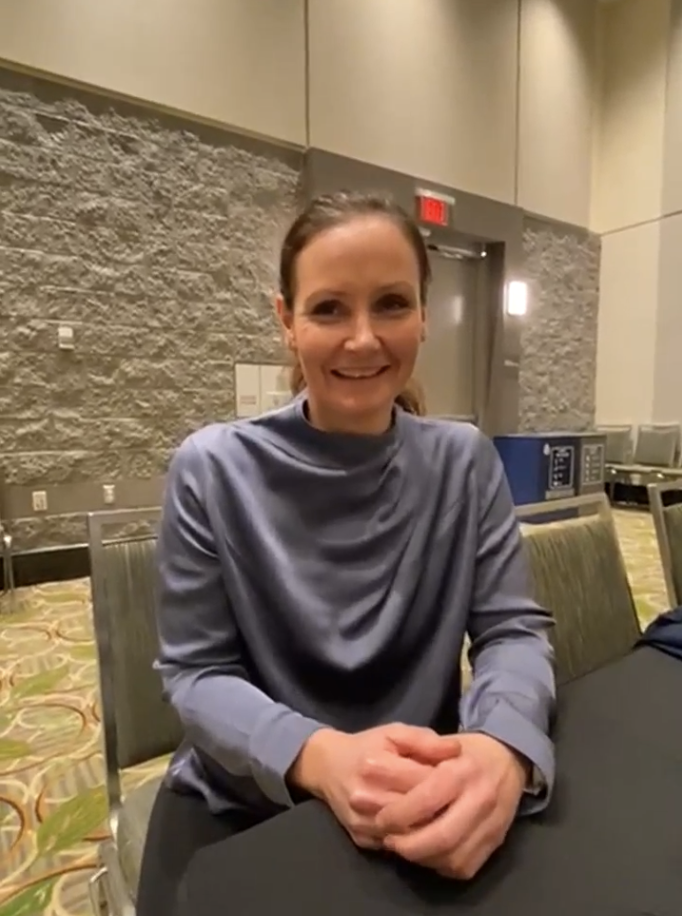
Dr David Marlin is at the 70th Annual AAEP (American Association of Equine Practitioners) Convention and he managed to catch up with Dr Maria Terese Engell. They discuss Maria’s attendance at the event and her journey as a vet, ballet dancer and work with world-leading riders.
(The sound is very quiet – we apologise for that. You will need to turn your sound up! A transcript is below to if you struggle to hear it clearly.)
CLICK HERE to watch Dr Maria Terese Engel’s webinar Rider Balance – Postural strategies in riders: Why do we see so much asymmetry?
Transcription
Here is a transcription of the podcast. (Please note this is an automated transcription, so we apologise for any errors from the original podcast.)
Dr David Marlin:
Right, hi, so I’m here at the AAP conference in Orlando and I’m here with Maria Terese Engel and Maria Terese is I think pretty unusual because you’re a vet and then you’ve also gone into human biomechanics and you’ve got your own vet clinic in Norway. What have you been speaking at the conference here?
Dr Maria Terese Engel:
If we can find a system to analyze riders in a lameness situation. it’s way of making sure that we can educate veterinarians to start analyzing riders. That’s a cool topic.
Dr David Marlin:
Okay. And I mean, how did you qualify as a vet, you’re working as a vet, and then suddenly you’re doing a PhD in human, well, a lot around rider movement. How did that come about?
Dr Maria Terese Engel:
Yeah, I have a background in ballet, so I’ve been like studying movement, since a little girl, at the same time I have a father working with top athletes in Norway for like 20 years of his life. He’s been working on the Olympic Centre in Norway and had the responsibility of educating technical skills in 35 different sports and that’s more like I think they got maybe three, four hundred Olympic medals and many thousands of World Cup medals.
But I understand that that is nothing that we have worked too much about in riders or in equestrian sport. know, that’s what’s fascinating me a lot is that when you have a young horse, you know exactly what you should skill it for. You know, to perform at three years old, four years old, five, six, seven, you know exactly how to build that level of skills. But the rider, which is supposed to be the pilot, which is supposed to guide that horse into those skilled movements. We don’t have a system to build the qualities in the riders.
Dr David Marlin:
Okay. So do we know what’s required though?
Dr Maria Terese Engel:
No, we don’t. Okay. That’s the thing. We haven’t done those studies yet. Now we’re trying to really focus on that, doing a three-year study to evaluate training on riders and see that actually helps develop the skills that make the horse perform better.
But it’s so funny, it’s like you have no other sport in the world that would say that if I have my skis on my feet, it’s only about making the skis perform. You would say, how do I perform with my body onto the skis so I get the best results? So all the focus has been on the horse and really not enough on the rider. I would say that that’s the main focus and we need to, like everyone says that you have to be symmetric, you have to be balanced, you have to have rhythmical skills. But what is that actually when you go into the details?
How should we train for it? How do we focus on building that in our younger athletes? And what is the prerequisite to actually talk about balance? And that is the position. And when it comes to position, how do we analyze it? We can’t just say that you’re hanging to one side or leaning to the other. We need to define what is your aberrations and what should you focus on and what should you do to change it.
Dr David Marlin:
That’s really interesting because I guess most riders or lot of riders now will be aware of this kind of idea, talk about symmetry, know, we talk about asymmetry generally as being bad and we want symmetrical movement. But you use the term positional aberrations, which is obviously not symmetry. What do people probably wouldn’t have heard? I wasn’t familiar with the term positional aberrations. What does that mean?
Dr Maria Terese Engel:
That means that it’s a way of saying that you’re not in symmetry, but it’s also, you know, when you analyze human you can’t just talk about right and left you need us to talk about front and back and you need also to look at the person from like being a bird looking up and looking down and see if there’s like horizontal rotation. And when you have changes in different views, that is just not something symmetry. is postural aberrations. That’s something away from the normal alignment.
Dr David Marlin:
So I could be leaning forward and from any view, essentially I am symmetrical. If I’m looking from the front, I’m symmetrical, but that would be a positional aberration if I’m leaning too far forward.
Dr Maria Terese Engel: It’s being away from the normal alignment.
Dr David Marlin:
So you started this, what we call your academy – Rider In Balance. I’ve actually talked before about your stirrup system, which is really interesting. What is it that you offer through that?
Dr Maria Terese Engel:
We offer a way for you to start to learn how to analyze yourself or your students or your writers and learn how to build the technical skills that you need to perform better. I always divide writing skills into three different points. So number one is that you need to analyze yourself or your students. You need to make sure that you can describe how to get into a good alignment position.
Then number two, you need to know how to ride a circle, how to do a shoulder in, how to do a traverse, period, change, and that you should actually be able to do it unmounted. I have my Olympic riders, they sit on a ball during their discharge program unmounted. If they can’t do it on a ball, how can they do it on a horse? And the third thing is to be able to change your way of doing your movements adapting to the individual horse.
this horse needs some extra something, then you need to change that and visualize it and train for it. But you need to make sure that you first have control of yourself and you know what to do and then you can change the plan and adapting it to the individual horse.
problem. How could they do that?
