


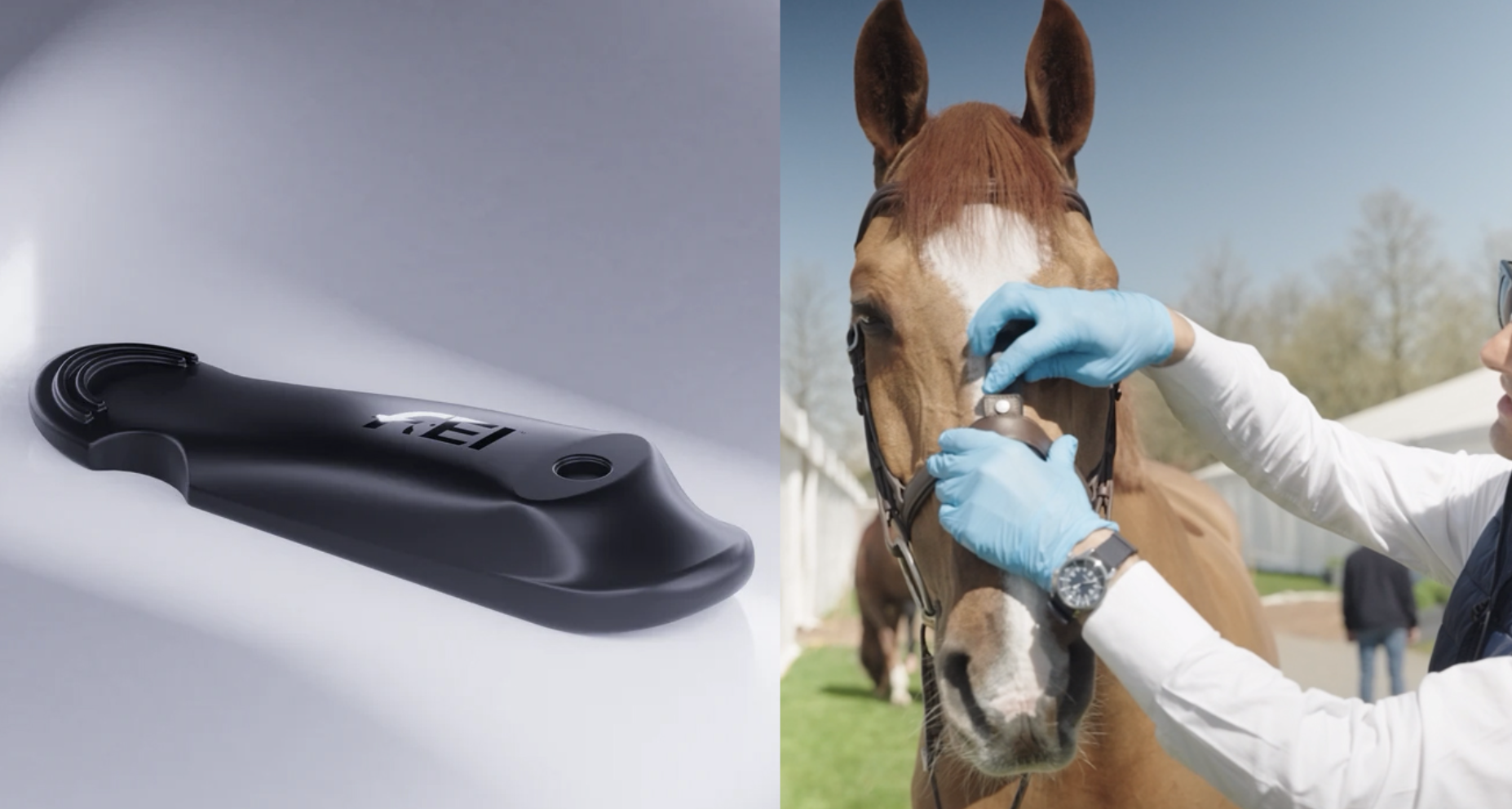
In this highly relevant Animalweb podcast, Dr David Marlin is joined by Animalweb’s independent bit and bridle fitting expert Emma Busk to unpack the introduction of the new FEI noseband gauge, now in use on the international competition circuit. Together, they explore what the measure means in practice, why it has been introduced, and how riders, stewards, and horse owners are reacting to it.
Emma, who has worked with both the FEI and ISES gauges, shares her practical experience using the new tool and highlights some of the challenges around consistency, fit, and application across different types of nosebands and horse sizes. She and David discuss whether the gauge goes far enough in protecting horse welfare, and what more could be done.
Beyond the gauge, they delve into the broader topic of bit and bridle fitting, exploring why it matters, its impact on performance, and how to assess fit both in the stable and under saddle. Emma emphasises that every horse is different and that correct fit can’t be judged by looks alone. They touch on the importance of collaboration between vets, dentists, physios and fitters, and how past trauma or pain can affect a horse’s response to tack.
The episode closes with some top tips for checking noseband fit and an honest conversation about pressures in the competition world, rider habits, and the myths around stronger bits.
READ Emma’s blog – Noseband Tightness in International Sport
CLICK here to head over to the main Podcast page to see the complete list of podcasts available.
Transcription
Here is a transcription of the podcast. (Please note this is an automated transcription, so we apologise for any errors from the original podcast.)
Hi and welcome to this Animalweb podcast with me Dr David Marlin and Emma Busk and Emma is our bit and bridle expert. Emma, hi. Hi David, nice to be here. Thanks and but for those who probably maybe you don’t know about you I mean I know a lot will but
What’s your sort of background? My background, 40 odd years in horses, amateur competitor. And I actually, what piqued my interest in initially BitFit and BitChoice was a particularly challenging horse that I had who ended up being my horse of a lifetime. But I really was having difficulties
maintaining a consistent contact, you know, he was coming up with all sorts of evasions. And more by luck than judgment, I found a bit that he absolutely adored. Our dressage scores went up eight to 10 % overnight. And I wanted to find out why, you know, why did that make such a difference? Why did this bit, you know, when I’ve been made so many other recommendations because of his behaviors,
why did it work? And that’s what led me to study bit and bridle fitting. And I’ve studied both with the Noyeshula Academy and with Horsebitfit. So… You run your own business, obviously. I do. I mean, I do bit bridle fitting consultations. You know, I’m totally independent. I’m not incentivized or affiliated to any particular manufacturer. Very much led by
the research. And I also give quite a lot of talks, know, I attend camps, you know, for me, it’s very much about education, sharing the knowledge and equipping horse owners with that knowledge so that they can make better choices for their horses. Yeah, and I think that’s, you know, that’s one of the things that the ethos of Animal Web isn’t to tell people what to do, it’s to tell them what questions they should be asking or what they should be thinking about
help them make the right decisions because it’s not it is a cliche but every horse is an individual and you can’t say just because this works on this horse it’s going to work on the next horse or the one after and I think that’s probably the skill isn’t it still in in equestria and is working out what works for your horse. Exactly and I think you know certainly with bit and bridle fit
the main, you know, the starting point is that horse’s individual anatomy, be that overall facial or cranial, you know, that we can assess and we can assess that objectively. What we can’t assess without involving the horse is their preferences. So, you know, I find quite a lot that, you know, I will go, I will do a stable assessment of the horse. I will assess their current bit and bridle. And then I will see them
ridden, that initial assessment guides me in my choice of bit what I feel will probably suit that horse. But when we make those changes, we make one change at a time so that we are able to assess, you know, it’s no point changing the bridle and the bit at the same time. What was it that made the improvement? And the ridden assessment is really very simple. It’s walk, trot, upwards and downward transitions.
And, you know, I basically, you know, I get my baseline for that horse in its current set up. then that horse’s behavior, way of going, know, how acceptance of the contact, how quiet its mouth is, the length of its stride, all of this, you know, whether it’s sort of been on the forehand and it is now actually just sitting back a little bit. And the
you will riders feedback will inform the final decision. And I mean, how much of a issue is the horse’s previous experiences? Because if you know, if we see a horse that is reluctant to having the girth tight and reluctant to the ride, a mountain wants to move off as the riders mount, we often think about what does that horse have current back pain or you examine the horse, the horse is examined by the vet.
no evidence of back pain, but that previously there has been a history of back pain. Presumably the same issues occur around bit and bridle fit. The horse has had a bad previous experience, then that can be reflected in how the horse reacts. can and you can, know, I mean bridle particularly can, you know, sort of cause bridle shyness and, you know, difficulty putting the bridle on. I do find, and I found this both with
many of my own horses as well as clients’ horses, that one, it may take a little while, but current experiences can reprogram previous experiences. And I think, you know, I mean, thinking back to Harvey and his behaviors, when we found the right bit, he was much, happier. He was much more willing to be tacked up. Thing is, you know, I am looking at bit and the bridle. That may not
be a problem with that horse. And I think it’s very important for all professionals to communicate and work together. I I work very closely with my own equine dentist. And I’m happy to talk to vets, farriers, dentists, body workers, whoever. And sometimes I may see something that I can say, OK, that horse is not quite
sound behind or know that horse is doing this that the other but I’m not there to diagnose that so from my perspective you know I can you know offer non-professional advice that I would probably consult a physio or vet or dentist and I think it’s important that everybody you know works as a team. Right absolutely and I mean many problems that once you actually start to
dig into it, it’s not one single thing that’s going on. The thing you’re looking at may have been the last thing in the line. And it started with a hind limb lameness, then progressed to a back problem, then it’s behavioral problems. Funny enough, one of the things you said there made me really think, and it’s something I don’t hear talked about really as much as it’s something I always think of is when you’re seeing a horse trotted up in a bridle, I’m always thinking bridle lameness, if the horse is lame.
And I remember the first time I discovered this was about 40 years ago with, it was one of the vets at the A.H.T. and we were trotting up one of our horses and he said, can you just trot it in a head collar, please? And the horse was absolutely completely sound in a head collar, put the bridle back on and the horse is like two out of five lane. Yeah, really obviously lane. And it’s not something I hear people talking as much about today. Is it?
still something you recognize? think again, you know, this is I’ve never encountered that degree of lameness, but I have certainly when when there has been an issue with either bit or bridle, what I have seen is a significant lengthening of stride or maybe, you know, improved ability to do some lateral work. We have to think about the anatomy and, you know, we get
This is a whole, well, I discussed it in one of the webinars or both of the webinars. What happens in the head with the TMJ, with the hyoid apparatus, the hyoid is, you know, linked directly through long muscles to the sternum and to the inside of each scapula through the sternohyoideus and omohyoideus. Now, if you think about that, what is happening in the horse’s head,
that direct muscular connection to the forelimbs and then through the muscle chains right back and the myofascial chains right back to the hind limb. So if you are inhibiting the function of the tongue, which is attached to the hyoid via the lingual process, you’re impacting the horse’s ability to move its jaw naturally.
That is going to create tension which is going to pass through the rest of the body. That makes sense. we are, the purpose of this sort of podcast was really to talk about nose bands because that is a, it’s quite a hot topic at the moment, obviously with the release of the introduction and of the FEI nose, nose band gauge. So thinking of nose bands,
What’s the purpose of a noseband? Why do we, from your perspective, why do we have or why do we need nosebats? Do we need nosebats? In fact, a noseband, even a correctly fitted caverson, i.e. a caverson that is not overly tightened, does not inhibit jaw movement, does provide a stabilizing effect to the bridle itself. And you can actually test this out.
When I’m fitting a bridle, I want to be able to fit my fingers under the headpiece without the noseband on up. Do the noseband up and you can feel that there is slightly more pressure there. That’s even when you’ve got your two fingers on the nasal bone. There is also ascetics and tradition, but there is no detrimental effect to a correctly fitted noseband.
Where we do see detrimental effects is over tightening of nose bands when I And i’m not prepared to say how long ago it was started Riding and coming up through pony club. There was no such thing as a crank nose bend You know this is and rarely did you see? As far as I remember as many tight nose bands as we do today No, it’s my recollection as well
I mean, I think I do remember seeing quite a lot of tight nose bands on racehorses. But, you know, mean, fashion comes and goes. All right. So why does somebody want to have the nose band really tight on their horse? Well, you know, this is conjecture, but I believe that it’s down to the actually mistaken belief that it’s going to improve performance.
And I think where you have competitions, obviously everybody wants that to maximize their chance in a competitive environment. Dressage, for example, we know that the horse will get marked down for opening its mouth. We know that the horse will get marked down for sticking its tongue out. There is also that control issue. If the horse is evading the bit, opening its mouth tongue over bit.
that kind of behavior, that is going to negatively impact control communication. So I think this is why we see it in sport, and especially in dressage, for example, where the horses are judged in part with what is going on in their mouth or with their mouth. So that would be my belief. And the tight nose band are
could also be cynically to mask those evasions in front of the judge. I mean, have increased in evidence that tight nose bands are probably painful, may be contributing to suppression of behaviors or actually expression of more conflict behaviors. So,
I mean, we’re getting the evidence more and more that a tight nose band really isn’t something we should be promoting or allowing. seeing that there is now, you know, a nose band gauge that surely I would think everyone would think was a positive step, but it doesn’t seem it’s that way. There seems to be quite a bit of politics creeping in. Obviously there.
There has been the International Society of Equitation Science Noseband Gauge around for a long time. Obviously, you and I don’t have, I don’t believe any insight into why the FEI chose to go with their own gauge over the ISCS gauge. I guess the FEI one is very simple. We obviously got hold of one of the gauges from the FEI and sent that to you to have a look at. I believe you’ve got.
experience of working with the ISES gauge as well? Yes, I don’t honestly I don’t feel that the FEI one is any better or particularly more simple to use. It’s a different method of you know it’s a pass or fail depending upon whether the the gauge will move through or between the nasal bone and
the nose band at the front of the face. With the ISES one, it was a case of you got a one finger tightness mark and a two finger tightness mark. And the ISES had the added functionality of being able to measure shank length and mouthpiece thickness. But it’s
There is no doubt it is simple to use the FEI one and all the horses that I’ve tried it on have tolerated it well. I mean, I think it is, you my opinion is it is definitely a step in that direction. We need to bring as much objectivity into assessment of tack fit and in this case, nose bands as possible. It’s not fair on stewards to be
you can’t allow tight nose bands. mean, that’s putting far too much on their plate. So this is a positive thing. As I say, I’m just preaching for it. The dimensions that they’ve chosen, the style, mean, whether it’s also, it’s probably also revenue generating because anybody can buy them.
I think that in itself is a good thing because if you’re a horse owner, if you’re a yard owner, a trainer, rider, amateur professional, you should be able to assess that your noseband is appropriately fitted. And I would have thought there’s not much benefit to training at home with a noseband cranked up as high as tight as you can do it and then having to have to ride
at the gauge tightness in competition. You know, can’t imagine that would be advantageous to train in one situation and then have to compete in another. I’m not sure. tend to, you my gut agrees with you, but then, you know, what is the
some riders will ride warm up and train in high perplexion. Is it because that relief that is offered when, for example, the noseband is loosened prior to entering the arena, is there an opinion or a feeling that that is going to contribute to the performance? So really, we’re going to have to have checks during warm up as well.
Yeah, I mean that you would think that I think this is this is something else in terms of FEI competition. What surprised me slightly is that there is not a set time that this that the gauge should be used that the noseband should be checked. It can be pre competition or post competition. So but there are.
know, stated penalties for that and that’s either, you know, you may not compete unless the noseband is adjusted appropriately or elimination if it’s post-competition. That to me doesn’t actually protect the horse much. No, I mean I guess if it was done on every horse at the bit check the rider won’t have, there’s no opportunity to
or there shouldn’t be an opportunity to loosen the noseband as you’re riding out from the arena. that anyone found to have too tight noseband would be eliminated. So there’d be no point in having the noseband too tight. And as you say, everyone can have the gauge. there should be no, I guess there’s gonna be a tiny bit of subjectivity. You know, how much, if you have to,
If it goes, if it slips through without, know, if you, you basically the horse’s head’s vertical and you put the gauge in and it falls through, that’s clearly, you know, that’s a pass. If you have to push it a little bit, then that’s still a pass. What about if you have to actually push it quite hard to get it through? You know, that’s. I think there needs to be more clarity within the rules and the usage instructions. And, you know, I think even just including
the pass freely would help. What is… Then we’re gonna have to define pass freely. That is true. Pressure on it is passing freely. Yes, unless you actually put a pressure sensor on the top. But you know, that’s the realms of… I mean, we shouldn’t be doing that anyway. What does slightly…
what I have found and what the instructions from the FEI actually state that, you know, with your free hand, you squeeze the noseband or to move it to the front so that obviously the laxity is now concentrated at the front of the noseband. And then you pass the gauge through. Now, if you are really pushing that noseband
forward, there will be slight compression on the sides of the face of that soft tissue. That’s not going to be immense, but in marginal cases, there is the potential, I guess, for that to make a difference. I also found when I was trialing this that the design and the suppleness of the noseband did have an effect.
a slight effect. Again, it’s very slight, but with the thicker padded nose bands that have less flexibility around the front, I was having to work harder to make that room. And that, again, goes back to. The wider the nose band, the more of the gauge you’re going to have in contact. So the greater the friction.
between the gauge and the nose band. So the wider it is, the more force you’re have to use to push it through. Compared to sort of centimeter wide nose band, if you’ve got a really wide one, that would- So there are variables that, I mean, as I say, this is a very big step in the right direction, but there are challenges as well because, I mean, the other thing,
I see a vast array of horses. You know, you have a big horse with a big head, you know, maybe warm blood or whatever, for, you know, that’s 17,2 in an extra full bridle. And, you know, this is used in all FEI disciplines. You may have a pony or, you know, a small horse with a very fine head. The proportion of
jaw movement is different for those because the size of the gauge is the same for both. Yes, that’s a good point. So with a pony and 18 hand show jumper dresser horse are going to have the same allowed clearance. Yet the larger the horse, the greater the extent of the jaw movement.
So that they will have proportionally less ability to move the jaw than your 14 hands. Yeah, that’s very true. That’s interesting observation. mean, thinking about obviously we’ve talked about started talking about caversons, but how common a caversons, you know, there’s a lot of different types of nose bands in use. And of course, anything that’s got a attachment that goes
onto the lower part of the mouth, around the bit, how’s that going to be affected by? I cannot see that. I mean, this gauge, in my opinion, does not address that at all. And primarily, this will be an issue for flash straps. And we regularly see overly tight flash straps. And that, while…
an overly tightened crank nose band or caverson will inhibit your movement. Obviously that is designed specifically to keep that mouth shut. But because that strap crosses the nose beneath the nasoincisive notch, which is the top of the expandable part of the nostril, it causes more issues in terms of affecting the horse’s breathing, know, cross country. And, you know, that’s particularly
relevant where you have, you know, fast and, you know, stamina and speed. You’re really looking out there. There are other nose bands. mean, a drop nose band, well, a drop nose band this you couldn’t really use on because that’s, again, where it sits. You’ve got to, you know, it sits lower down the face. So
this does affect, you what is the correct fitting if you’re using a drop noseband? They’re not as common these days as they used to be. A grackle? Well, you could potentially use it with a grackle, but is that going to cause more problems? You know, because you can only use it on the crossover portion of the noseband. you know, are you, which, you’ve got the upper,
straps and the lower strap and again you know it’s not really suitable for measuring that combination nose bands you know myculum types again they’re all slightly different you know you you’re going you can’t completely eliminate the human part of the assessment yeah i mean i think there was some work done on inter individual
ability to use the gauge wasn’t there. So they looked at if different people came up with the same conclusion on using the gauge. I mean, it is going to be all of these things tend to be difficult to introduce and to have problems early on. I’m with you though. think this is a positive step forward. I think what I worry about is the politics around
It should have been this gauge. should have been that gauge. Why didn’t they do this? Again, there’s often a lot of probably things that we’re concerned we’re not aware of. Yeah, it might be that the FBI is trying to make a little bit of extra money by selling them. You know, I don’t know that they’ll make a lot, but it would if you’re going to be competing and you’re going to be tested, then it would make sense that you get one and you make sure that you are.
compliant so that you don’t have that embarrassment of being, I mean, I’d be mortified if I was competing and I was asked to loosen my nose band. I mean, although can you see a situation where you have correctly fitted your nose band in the stable and then as a result of riding and shifting of movement of the, maybe increased blood flow, I don’t know, muscle tension.
Could you be in a position where the noseband doesn’t actually meet the criteria? I don’t know if I can answer that. You know, think you’ve got so blood flow, muscles, I mean, you’ve got, they are all can all be compressed, but we are measuring on the nasal bone at the front.
which is not going to be affected. So again, if we go back to the method of use, using your free hand to hold the noseband away from the face, put it through, I think the warm up would probably create, if there are any changes, they would be minimal. And if it’s a borderline case, then
yeah, I would be very surprised if.
A noseband was, you know, started off loose enough and then became…
I guess with sweat it might pass through even easier. Or it might have the opposite effect. Well, I guess all of these things are kind of going to come out in the wash in use. I mean, in terms of the people you’ve shown the gauge to and used it with, what sort of have you gauged as the reaction? Is it generally positive? Yes, generally positive. And, you know, my
My clients, they tend to get me in because they are concerned primarily about their horse’s comfort. Is my horse happy with this? Is it okay? Yes, I do see quite a lot who have certain behaviors that they think may be down to the bit. And it’s, from my perspective, I’m there to make the horse more comfortable.
And sometimes it is just ruling that out, you know, because there can be so many issues, be it schooling, be it brighter skill, be it, you know, and something else wrong with the horse saddle fit, you name it. But as I say, my I’ve had positive feedback because my clients, you know, are very they tend to be primarily concerned with welfare. So let me ask him a slightly different question in terms of a bit and bridle that you fit in the stable. You’re happy with it.
looks great. Is there a possibility that that fit isn’t acceptable if once the horse is in a collected outline with a head vertical head and neck position vertical from the sort of relaxed head out position in the stable to the collected? That’s why the ridden assessment is absolutely crucial. So just because it looks good in the stable, you should be checking that when ridden as well, which is definitely
the top so potentially how if you’re on your own, what would you do get someone to video you? You can do that. I mean, I you know, it depends. I Mean, I’ve I changed my own horses bridle sometimes or bits When you know your own horse, you know when they are More relaxed, you know when they’re more willing and they’re happier but
You know, yeah, have a friend video is always helpful because, know, we always see, you know, we know what we’re feeling up there, but we can’t always see what somebody on the ground can. And of course, you recently looked at some images for me to do with some training welfare stewards and looking at those different. I don’t think very many of them were ideal, were they? think one was.
One out of 15, think. Those were horses competing. Obviously, it was done anonymously. And it was just a sort of random sample. yeah, one out of 15 isn’t great. why is this? Is this basically along the same lines of, you know, a lot of people don’t think saddle fits that important. A lot of people don’t think bridle fits that important.
Is it people underestimating the importance of tack? Yeah, I believe so. And I think that more people are pro saddle fit. And I think there can be age, there can be what kind of riding you’re doing can affect whether you believe that bridle fit can make a real difference to your horse’s performance as well as welfare.
we can’t underestimate the pressure that is on elite athletes. we’ve got to, think, when we go back to noseband tightness, I think what we’ve got to consider with the FEI is it’s not just a tact check issue. It’s got to also be a judging issue. We know, and this is a completely different topic, but it’s
everybody involved in the sport, equestrian sports, whatever discipline, you know, it has to be consistent. And I think that was all something that also, you know, occurred to me when I was, you know, looking at this is the fact the FEI have done it is great. But what we, you know, each national governing body really needs to synchronize what they’re doing. Yeah.
There’s no reason why this can’t be rolled out, you know, at national level competition as well. Doesn’t just have to be FEI, does it? No. And I think there’s going to be pressure for that to happen. And hopefully that will. I suspect a lot of the governing bodies are sitting watching to see what the response to the FEI introduction will be. And then probably we’ll move on it. But hopefully that won’t be too soon.
Okay, for everyone who’s going to go tonight to the stable and going to ride or this morning to the stable and ride, Parra’s nose bands, what would be your top tips? My top tips, ensure that there is sufficient space between the end of the facial crest, the prominent cheekbone and the top of the nose band. Feel your horse’s nostrils and work gently up to where that
fleshy, know, the expandable part of the nostril ends. Beneath that you have the nasal bone is so incredibly delicate and fragile. So a noseband really has to sit above that. Make sure you can get two fingers in the front. I mean, the FEI gauge actually is deeper than my fairly skinny fingers.
But the horse must be able to move its jaw. I quite often say to people when giving talks, it’s like if you actually try and talk with your teeth together, it’s very quickly you start getting pain around your TMJ. And listen to your horse when you are. If the horse is showing signs of discomfort, check the bridle, check the bit.
you know, watch one of the webinars because they give a great deal of information to help people assess their own tax setup. And yeah, as I say, listen to your horse. That’s fantastic. You obviously, yeah, we’ve got some webinar content around this sort of range of topics and we’ve also got
blog article from you, Noseband Tightness in International Sport, which people will be able to see in the links associated with this podcast. So Emma, thanks very much. you’re welcome. Thank you for having me.
