


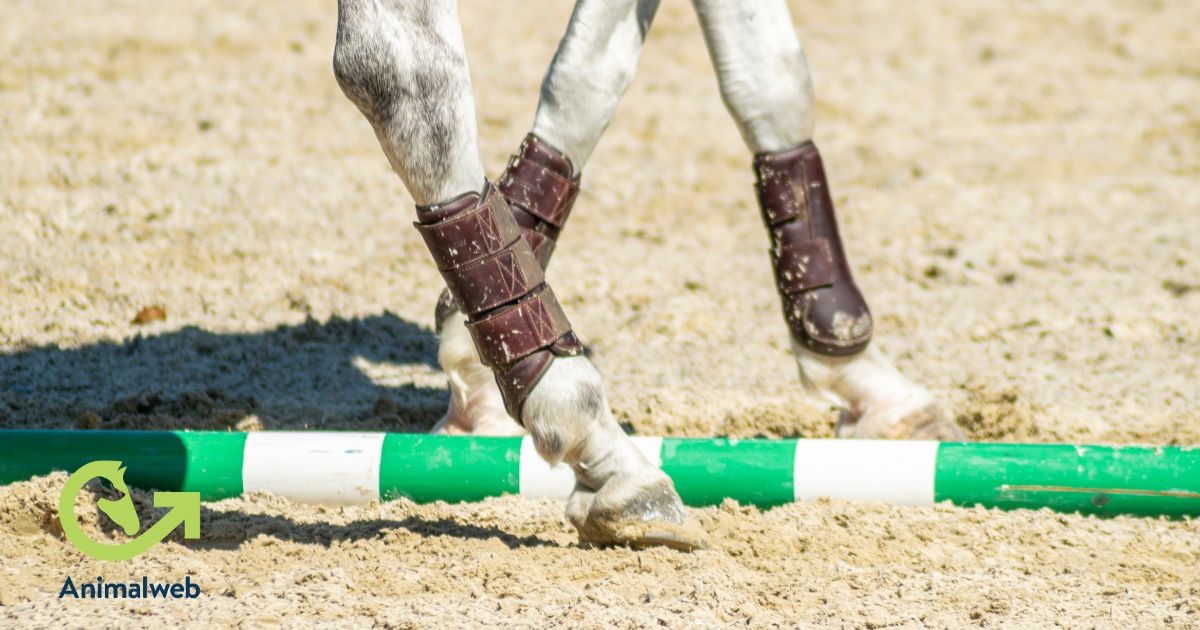
New research from Anglia Ruskin University’s Writtle campus has provided fresh insight into how pole work and kinesiotaping may influence core muscle activity and movement in horses, Anna Srutova, Hope Jameson with Animalweb expert Professor Roberta Blake recently published the study.
The study, published in the International Journal of Equine Science, investigated the immediate effects of ground poles and abdominal kinesiotaping on muscle activation, pelvic symmetry and movement patterns in horses trotting in hand. Researchers evaluated 11 riding school horses under four different conditions: normal trot work, poles alone, kinesiotape alone, and poles combined with kinesiotape.
Using surface electromyography (sEMG), inertial sensors and high-speed video analysis, the team focused on activity in the rectus abdominis and longissimus dorsi muscles, alongside lumbosacral movement and hindlimb kinematics.
The findings showed that trotting over poles significantly increased peak activity in the rectus abdominis, one of the horse’s key abdominal muscles associated with core stability and engagement. Pole work was also linked with changes in lumbosacral flexion, supporting the idea that poles can influence trunk mechanics and abdominal recruitment during exercise.
However, kinesiotaping on its own did not significantly alter muscle activity or most movement parameters, although researchers noted that further investigation is still needed, particularly into any longer-term effects and how taping may interact with other rehabilitation exercises.
The authors concluded that pole exercises may have a useful role within conditioning and rehabilitation programmes aimed at improving core strength and maintaining lumbosacral mobility, although they stressed that pole spacing and individual horse factors remain important considerations.
