


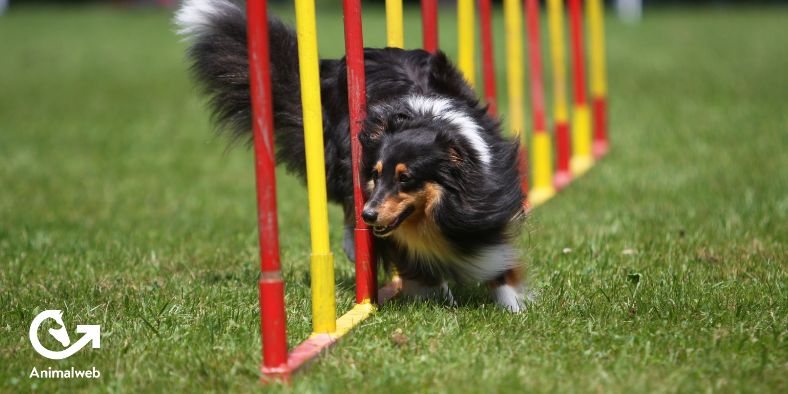
A new study investigating the biomechanics of weave pole performance in agility dogs has revealed significant differences in limb loading depending on gait style, raising important questions about long-term injury risk in canine athletes.
The paper, Gait style during weave pole performance affects limb dynamics in agility dogs, was led by Charlotte Ramsey and co-authored by Prof Roberta Blake, who is also one of our Animalweb Experts.
This is currently the only published study to objectively analyse the kinetic demands of weave poles and compare the three most common forelimb gait styles seen in competition dogs.
Why weave poles matter
Under UK Kennel Club regulations, weave poles are a mandatory obstacle. Dogs must enter with the first pole on the left shoulder and complete either six or 12 poles, often in under three seconds at championship level.
Unlike jumps or contact obstacles, weave poles demand rapid side-to-side motion combined with forward speed, lateral spinal flexion and shoulder abduction and adduction. Despite this complexity, they have received relatively little biomechanical research attention compared with the dog walk, A-frame or jumps.
Reported injury rates for weave poles are lower than some other obstacles, between 6.3 percent and 13.9 percent in retrospective studies, but shoulder and spinal injuries remain common across agility as a whole. This study set out to explore what forces are actually acting on dogs during weave performance.
Three gait styles under the microscope
Seventeen experienced competition-level agility dogs completed a set of six regulation weave poles while moving across pressure-sensing walkways.
Dogs were classified into three dominant forelimb gait styles:
- FFSS/RD, front-feet single-stepping rear double, n = 8
- FFDS, front-feet double-stepping, n = 4
- FFH, front-feet hopping, n = 5
Researchers measured peak force, peak vertical force, vertical impulse and stance time in both forelimbs and hindlimbs. Forces were normalised to bodyweight to allow comparison between dogs of different sizes.
Outer limbs carry more load
Across all styles, there was a clear and consistent asymmetry between inner and outer limbs during the weaving motion.
Outer limbs showed significantly higher peak vertical force, peak force, vertical impulse and stance time than inner limbs, in both forelimbs and hindlimbs. This is consistent with what is seen in turning manoeuvres in other canine sports, where the outside limb generates turning power and absorbs greater load.
Hopping style shows higher peak forces
Dogs using the front-feet hopping style showed significantly greater peak vertical force and peak force in both outer forelimbs and outer hindlimbs compared with the other two styles.
In contrast, dogs using the single-stepping style, FFSS/RD, showed longer stance time and higher vertical impulse in the outer forelimb. That longer contact time appears to help distribute force over a greater period, resulting in lower peak forces compared with hopping.
However, the FFSS/RD style also showed greater asymmetry in load distribution between inner and outer limbs, with a pronounced shift towards the outer hindlimb.
Speed is not the main driver
Interestingly, speed did not significantly affect most of the kinetic variables, apart from forelimb stance time. This suggests that the differences observed were primarily linked to gait style rather than simply how fast the dogs were weaving.
What does this mean for injury risk?
Although weave poles are not the highest reported obstacle for injury, the study highlights several important considerations:
- The hopping gait is associated with higher peak forces, which may increase stress on limbs.
- The single-stepping gait concentrates load heavily on the outer limbs, particularly the outer hindlimb.
- All styles involve clear inner versus outer limb asymmetry.
The authors stress that the long-term implications of these force patterns are not yet understood. However, the combination of high peak forces or marked asymmetry could potentially contribute to cumulative strain, particularly in the shoulders and spine.
Importantly, different gait styles may represent adaptive strategies. For example, dogs using the single-stepping style appeared to shift their centre of mass caudally and increase stance time to reduce peak force through the forelimb. Hopping dogs appeared to distribute load more evenly between limbs at landing, despite experiencing higher peak forces overall.
Size and gait preference
Consistent with earlier observational work, smaller dogs in this study were more likely to use the hopping gait, while larger dogs tended to use single-stepping or double-stepping patterns. This may relate to body size relative to fixed 600 mm pole spacing.
The weave pole distance does not change with height category, meaning larger dogs may need greater lateral flexion to negotiate the obstacle.
A starting point, not the final word
The authors acknowledge limitations, including small sample size, heterogeneous breeds and the inability to control velocity in a real agility setting. Training methods and previous injury history were not controlled for and may influence gait preference and biomechanics.
Nevertheless, this research represents the first objective kinetic evaluation of weave pole performance and provides a valuable foundation for future work.
Longitudinal studies following dogs over time, larger trials incorporating 12 poles, and investigations into spinal and shoulder kinematics are all logical next steps.
For agility handlers, trainers and veterinary professionals, this study reinforces an important message: gait style matters. Understanding how individual dogs move through the weaves may help inform training approaches, conditioning programmes and injury prevention strategies.
