


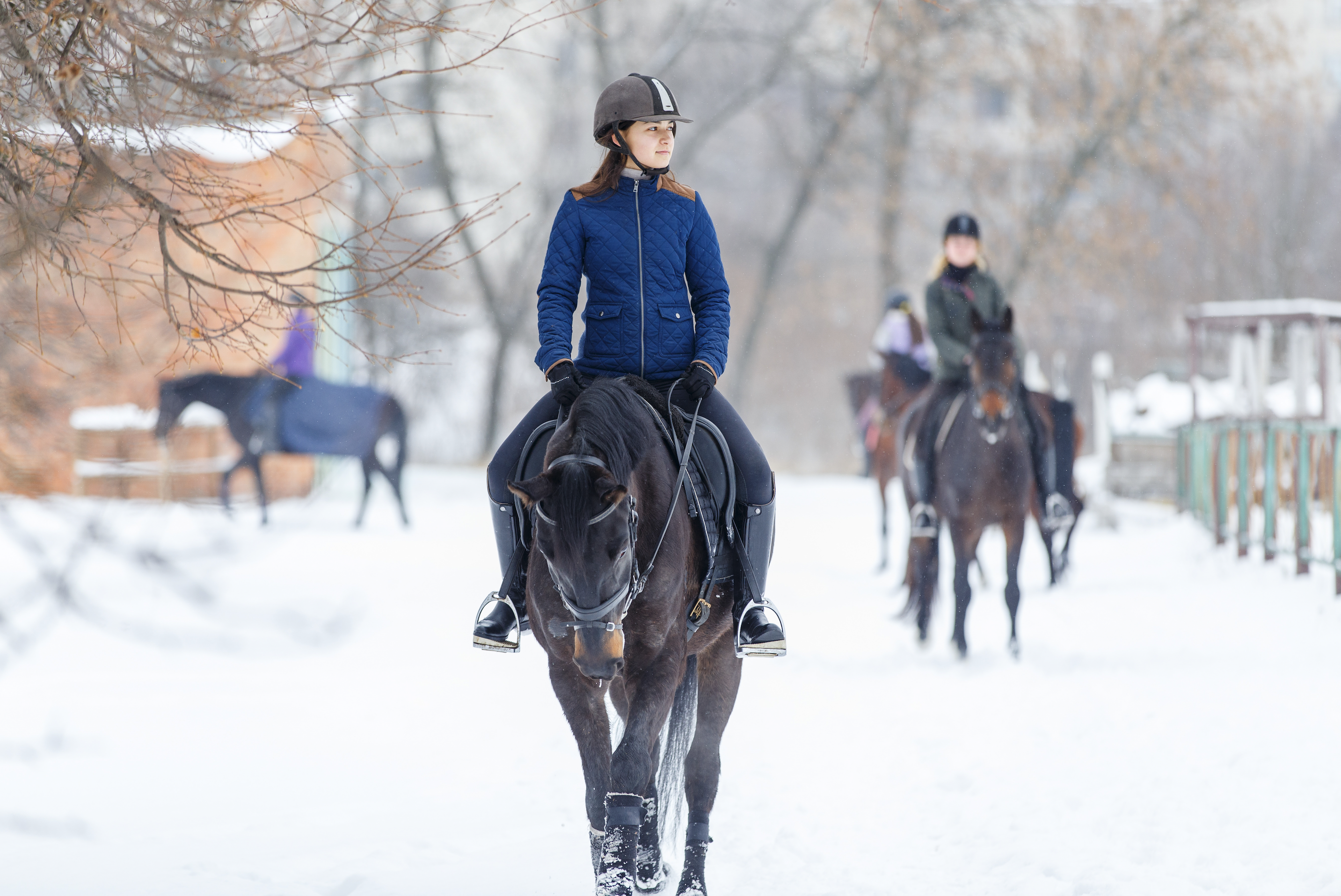
Skiing and horses. What could possibly be the link? Respiratory problems caused by cold air.
Effect of cold air on exercising people
In the 1900, doctors first noticed that some people developed difficulty breathing during or after exercising in cold weather. It wasn’t until the 1960s that scientists and medics started to study this phenomenon more closely in athletes exercising in cold weather, particularly skiers. It was found that exercising hard in cold air caused the airways to constrict (bronchoconstriction) and that this was worse (greater) in people who were asthmatic. In the 1980s and 1990s researchers and medics started to use the term “ski asthma” or exercise-induced bronchoconstriction (EIB; narrowing of the airways and difficulty in breathing). Today ski asthma is recognised to be a very common condition amongst those who exercise regularly in cold weather, such as skiers, snowboarders, ice-hockey players, skaters, etc.
But what exactly causes ski asthma?
The main cause of ski asthma is not cold air itself, but the fact that cold air is very dry. For example, air at 0°C (32°F) can hold a maximum of 5g per cubic metre (1000 litres). This would equate to a relative humidity of 100% – that is, the air is saturated with moisture. 5g is equivalent to 5ml, i.e. a teaspoon. And this equates to only 5/1000ths of a teaspoon per litre. A tiny amount of moisture. At -10°C (14°F) the amount of water is half a teaspoon per 1000 litres (2.3ml). Compare this to 17.3ml/litre at 20°C (68°F) or 30ml at 30°C ((86°F). At rest, we breathe mainly through our nose, which warms AND humidifies the external air before it reaches the lower airways in the lung. But as we work harder, we switch from nose breathing to mouth breathing, and the mouth has a much lower ability to warm and humidify cold air. So there are a number of things going on that lead to a risk of “ski asthma”.
- Cold/dry air drying the airways
- High ventilation rates during exercise
- Mouth breathing and reduced warming and modifying of inhaled air
- People who are already asthmatic
- Airway narrowing (bronchoconstriction) and airway inflammation
- Regular exercise in cold weather
In people the symptoms of ski asthma include…
- Wheezing
- Shortness of breath (SOB)
- Chest tightness
- Persistent coughing
- Poor or reduced exercise tolerance
In people, management or treatment of ski asthma involves….
- Avoiding exercise in cold weather
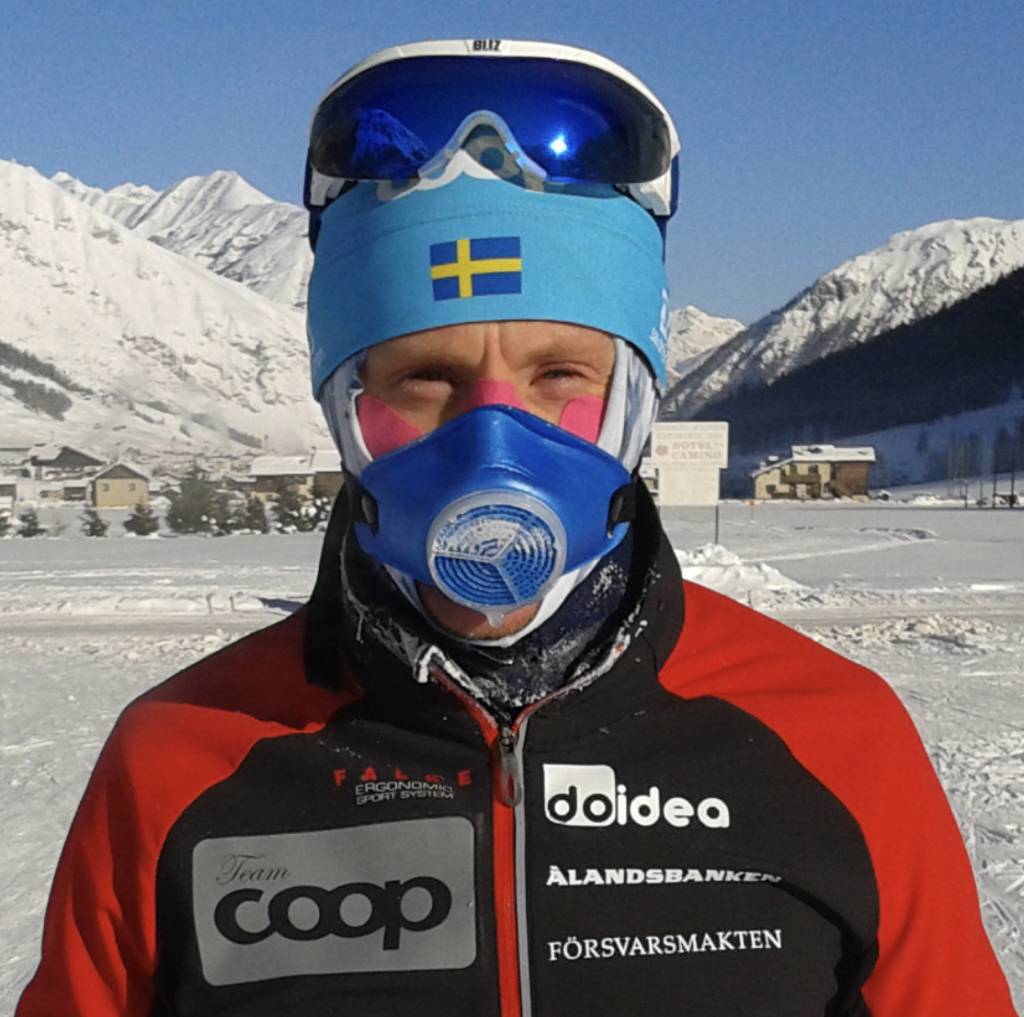
- Wearing a scarf or mask over the mouth and nose to trap heat and moisture
- Wearing a specially designed cold weather mask
- Medication: bronchodilators, inhaled steroids
- Modified training e.g. slower and longer warm-up
- Regular lung function testing
So what does any of this have to do with horses?
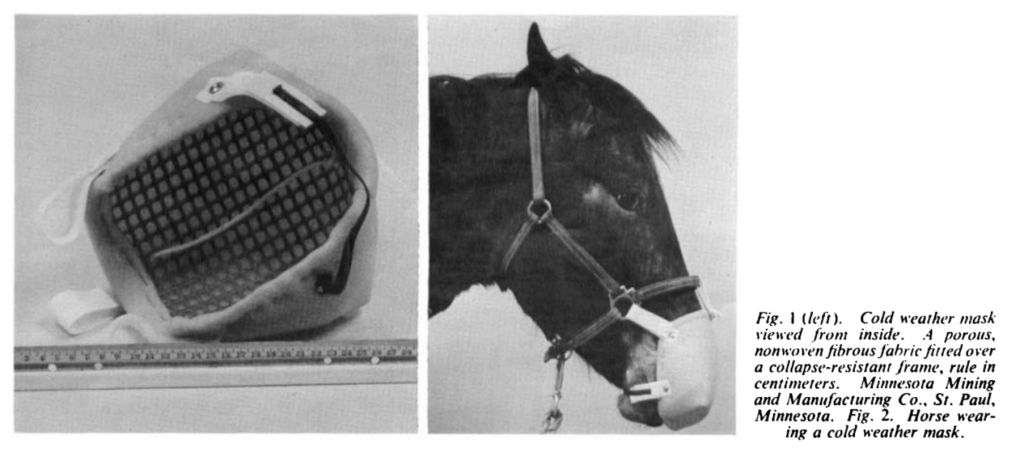
Around the time that researchers and medics were studying the effects of cold air on people, researchers at the veterinary school in Minnesota (USA), which can experience very cold winters, were investigating the use of cold weather masks for horses (1970s). This is an excerpt from their introduction from a paper published in the Equine Veterinary Journal in 1973: “Winter harness racing is a popular sport. In the northern part of the United States, horses are often trained or raced when the air is both cold and dry. These conditions are believed to be harmful to the health of the horse, because epistaxis (bleeding from the nostrils) occurs sometimes following strenuous exercise at sub-freezing temperatures. Horses may be disqualified from competition because of epistaxis. The use of a cold weather mask has been tried by a few trainers, but there has been concern that the mask, although warming and moistening the inspired air may interfere with normal air flow during severe exercise.”
So even in the 1970s, there was concern that intense exercise in cold air might be detrimental to horses, although the focus was on epistaxis (bleeding from the nostrils) as opposed to equine asthma. At this time, there were few vets using endoscopes to look into the trachea and lower airways, and whilst “heaves” (equine COPD or “broken wind”) were well recognised from symptoms, there was little appreciation of subclinical respiratory disease or how common it was or its effect on health or performance. Around 20 years later a number of papers would be published to show an association between exercise-induced pulmonary haemorrhage (EIPH or lung bleeding) and cold air.
In 2000, I collaborated with Prof Michael Davis and colleagues from the Equine Athletic Performance Laboratory, Oklahoma State University College of Veterinary Medicine in Stillwater, where we developed a way of cantering fit Thoroughbred horses with no history of respiratory disease on a treadmill whilst breathing air at 5°C (41°F). We then followed this up by galloping the horses in the air at 4-5°C (41°F) and then collected samples of cells from the airways by BAL (broncho-alveolar lavage). Exercise in cold air increases the number of ciliated epithelial cells. These are the cells that line the airways, and increased numbers are a result of airway injury. This is similar to that which has been described in human athletes exercising intensely in cold air. This research was published in 2002. We then followed this up with a similar study where horses were exercised for 15min breathing air at 25°C (77°F) or -5°C (23°F). In this study, we measured lung function using the non-invasive technique known as impulse oscillometry.
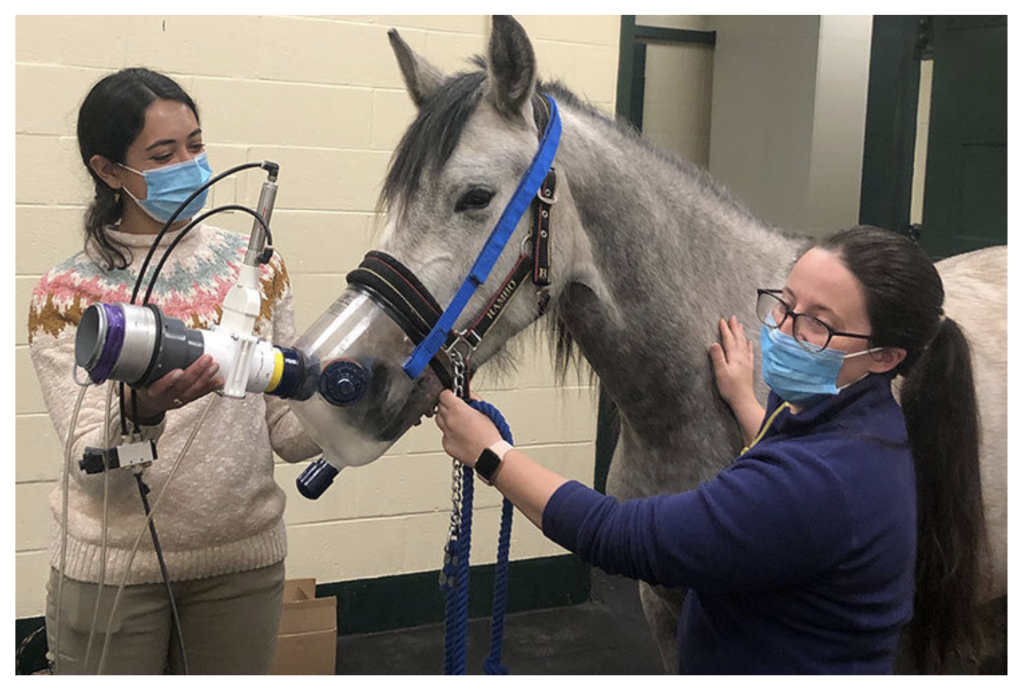
Lung function testing using impulse oscillometry (IOS) at Cummings School of Veterinary Medicine at Tufts University, USA.
We didn’t see any significant effect of breathing cold air on lung function at 5h after exercise but we did measure a decrease in lung function at 48h after exercise in cold but not warm air. This provides evidence that horses develop what is known as “late-phase bronchoconstriction” after only 15min of light exercise in cold air (-5°C, 23°F).
In several other studies, Dr Michael Davis and other collaborators showed that exercising in cold air also resulted in the influx of inflammatory cells, including neutrophils and “cytokines”. Cytokines are are small proteins that play a critical role in regulating the immune system and mediating communication between cells. They are produced by a variety of cells in the body, including immune cells (like T cells, B cells, macrophages, and mast cells), as well as other non-immune cells like endothelial cells and fibroblasts. Again, these effects are very similar to those seen in human athletes exercising in cold air.
Summary
Today, we have very good evidence that exercise in cold air (below 5°C) leads to airway damage and inflammation, even in normal, healthy horses with no history of respiratory disease. Horses with equine asthma are likely to be even more severely affected.
So what steps can you take?
- Regular endoscopy – many horses have ongoing airway inflammation but don’t show any clinical signs such as cough or nasal discharge
- Don’t ignore the occasional cough or the few coughs when you start warning-up. Healthy horses DO NOT COUGH – at all
- Use the best quality bedding you can find
- Soak or steam hay
- Ensure good ventilation – add a heavier rug rather than close up ventilation
- Avoid hard exercise in cold weather for any horse with a history of respiratory disease such as equine asthma or EIPH
I hear some common responses whenever this topic comes up. The two main ones are…
“But I’ve been training horses in cold weather for years and never had any issues”
But were you actually looking? Many horses will have ongoing damage and inflammation of the airways but without showing any external signs. Until it’s too late.
“So what am I supposed to do? Not train if its cold?”
That’s your decision. It might be wise to do all you can to ensure your horses have a high level of respiratory health and that any with a history of equine asthma are not worked hard on very cold days.
References
Jones RS, Buston MH, Wharton MJ. (1962) “The effect of exercise on ventilatory function in the cold.” Lancet. 1962;279(7210):613-616.
Dziuk HE, Usenik EA, Myers VS. (1973) Respiration in exercised horses wearing cold weather masks. Equine Vet J. Jul;5(3):131-4.
Frederick E. Hargreave and Jay A. Nairn. (1976) “The effect of inhalation of cold air and exercise on airway obstruction in asthmatic patients.” Clin Allergy. 1976;6(2):109-120.
McFadden ER Jr., Deal EC Jr. (1979) “Intra-airway thermal profiles during exercise and hyperventilation in normal man.” J Clin Invest. 1979;64(1):100-109.
Anderson SD, Daviskas E. (1980) “Exercise-induced asthma: A review.” Br J Dis Chest. 1980;74(2):129-153.
McFadden ER Jr., Pichurko BM. (1985) “Intra-airway thermal profiles during exercise and hyperventilation in asthmatic subjects.” J Clin Invest. 1985;76(3):1007-1010.
Larsson K, Ohlsén P, Larsson L, Malmberg P, Rydström PO, Ulriksen H. (1993) “High prevalence of asthma in cross-country skiers.” BMJ. 1993;307(6915):1326-1329.
Heir T, Oseid S. (1994) “Self-reported asthma and exercise-induced asthma symptoms in high-level competitive cross-country skiers.” Scand J Med Sci Sports. 1994;4(2):128-133.
Lapointe JM, Vrins A, McCarvill E. (1994) A survey of exercise-induced pulmonary haemorrhage in Quebec standardbred racehorses. Equine Vet J. Nov;26(6):482-5.
Davis MS, Lockard AJ, Marlin DJ, Freed AN. (2002) Airway cooling and mucosal injury during cold weather exercise. Equine Vet J Suppl. Sep;(34):413-6.
Davis MS, Malayer JR, Vandeventer L, Royer CM, McKenzie EC, Williamson KK. (2005) Cold weather exercise and airway cytokine expression. J Appl Physiol (1985). Jun;98(6):2132-6.
Davis MS, Royer CM, McKenzie EC, Williamson KK, Payton M, Marlin D. (2006) old air-induced late-phase bronchoconstriction in horses. Equine Vet J Suppl. Aug;(36):535-9. C
Davis MS, Williams CC, Meinkoth JH, Malayer JR, Royer CM, Williamson KK, McKenzie EC. (2007) Influx of neutrophils and persistence of cytokine expression in airways of horses after performing exercise while breathing cold air. Am J Vet Res. Feb;68(2):185-9.
Davis MS, Williams CC, Meinkoth JH, Malayer JR, Royer CM, Williamson KK, McKenzie EC. (2007) Influx of neutrophils and persistence of cytokine expression in airways of horses after performing exercise while breathing cold air. Am J Vet Res. 2007 Feb;68(2):185-9.
Hinchcliff KW, Morley PS, Jackson MA, Brown JA, Dredge AF, O’Callaghan PA, McCaffrey JP, Slocombe RF, Clarke AF. (2010) Risk factors for exercise-induced pulmonary haemorrhage in Thoroughbred racehorses. Equine Vet J Suppl. Nov;(38):228-34.
Crispe EJ, Lester GD, Robertson ID, Secombe CJ. (2016) Bar shoes and ambient temperature are risk factors for exercise-induced pulmonary haemorrhage in Thoroughbred racehorses. Equine Vet J. Jul;48(4):438-41.
