


One in four horses are euthanised by vets every year because of intractable laminitis, usually after a prolonged and painful period when attempts are made to save it. So it’s a very serious disease and must never be underestimated. If spotted EARLY and managed CORRECTLY from the start, it may be possible to achieve a successful outcome for each horse.
This guide will help you to spot the disease as soon as it appears and give you some tips on first aid. Every laminitis case should be seen by a vet, who will provide pain relief and help devise a strategy for the management of the case
Step 1 – Spotting the disease
The onset may be insidious and slowly progress until it becomes obvious, or it may appear to be severe from the start. In the latter case it is often because the early signs were simply not noticed
Stage 1 (mild)
- The first signs are often slow walking. A pony which normally trots to the gate on your arrival at the field may instead just walk to the gate. It may walk normally on a soft surface (for example on a sand school) but on tarmac or concrete it will show a shortened stride in front.
- If asked to turn in hand on a hard surface, the head will be raised as it spins on the inside leg, and it will look uncomfortable as it turns. Pain on turning in-hand on a hard surface is often the first obvious sign (and the last to disappear on recovery). The pony will usually allow a foot to be lifted and held up for a reasonable period.
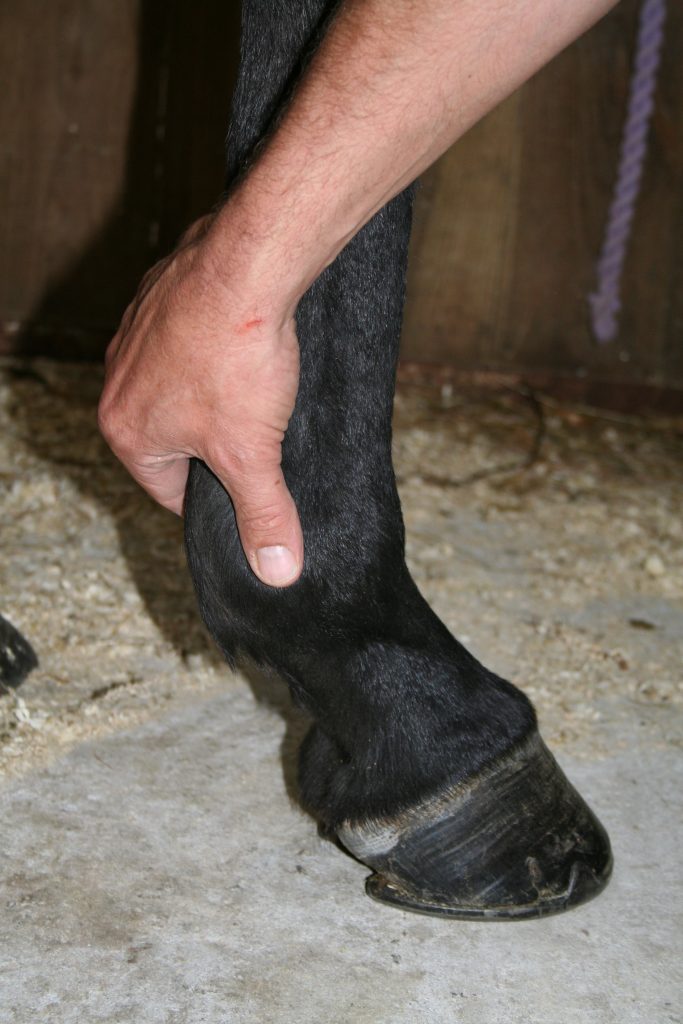
- The feet may be uniformly unusually warm (i.e. the left fore is the same temperature of the right fore) although the temperature of the feet is probably the least reliable indicator of laminitis (PHOTO 1)


The digital pulse will feel stronger than normal. Here are the rules for feeling the pulse
- A faint pulse can be felt in every horse if you’re patient and know where to feel it. In laminitis, it is the STRENGTH of the pulse that changes. In laminitis, the pulse is described as ‘bounding’ i.e is really obvious.
- To feel the pulse the limb must be fully weight-bearing, in its normal position under the horse. If the limb is off-loaded (even slightly), the pulse will feel normal.
- Facing backwards place the tips of your fingers on each side of a fetlock at its widest part, and slightly towards the back (photos 2 and 3). (Some people feel the pulse only on the outside, below the fetlock, but it is more obvious higher up).
- Wait until you feel the pulse. Be patient. The horse’s heart rate is slow. Note how strong it is.
- Now go to the other front leg and compare. In laminitis, both will be the same.
Stage 2 (moderate)
As the disease progresses, these signs will be seen:
- Obvious reluctance to walk and turn (VIDEO 1 and 2). When walking if the hind limbs are affected, these limbs are sometimes flexed more than normal
- Weight shifting when at rest. The limbs are lifted alternately
- Reluctance to allow a limb to be lifted. When the limb is replaced, the horse immediately lifts the opposite limb
- On turning in hand, the head is obviously lifted
- The digital pulses are very strong
- The pony’s pulse rate is often increased
- The pony may lie down more often than normal
Stage 3 (severe)
- The laminitic stance is adopted. The forelimbs are extended and the horse leans back on its heels (PHOTO 4)
- There is frequent weight shifting in front (VIDEO 3)
- The pony is very reluctant to allow its limbs to be lifted. Some will refuse entirely
- There is a great reluctance to walk, and the pony may refuse to turn
- The pony is clearly in severe pain. It may sweat and breathe heavily
- The pony spends a lot of time lying down and it may be difficult to persuade it to stand. Severe cases may refuse to stand

