


Gastro-intestinal, Gut, Large Intestines, Hindgut, Gastric, Stomach, Ulcers, Gut Balancers! – No wonder many horse owners are confused!
These different terms are all in common use, but they often seem to cause confusion. Much of this may relate to how the terms are used in supplement product names and how they are used in marketing, sometimes possibly even those writing the marketing or articles don’t understand the difference. So in this article we will break this down and if you read it you should never be confused again.
The term Gastro-Intestinal Tract or often shortened to just GI tract describes the whole of the digestive tract from the mouth to the anus, and therefore includes the mouth, the oesophagus, the stomach, the small intestine, the large intestines and the anus. Gastro refers to the stomach (derived from the Greek word gaster) and Intestinal refers to the small and large intestines. Gut is also a term that refers to the whole of the digestive system from mouth to anus i.e. Gut, GI Tract and Gastro-Intestinal Tract are all terms referring to the whole of the digestive system.
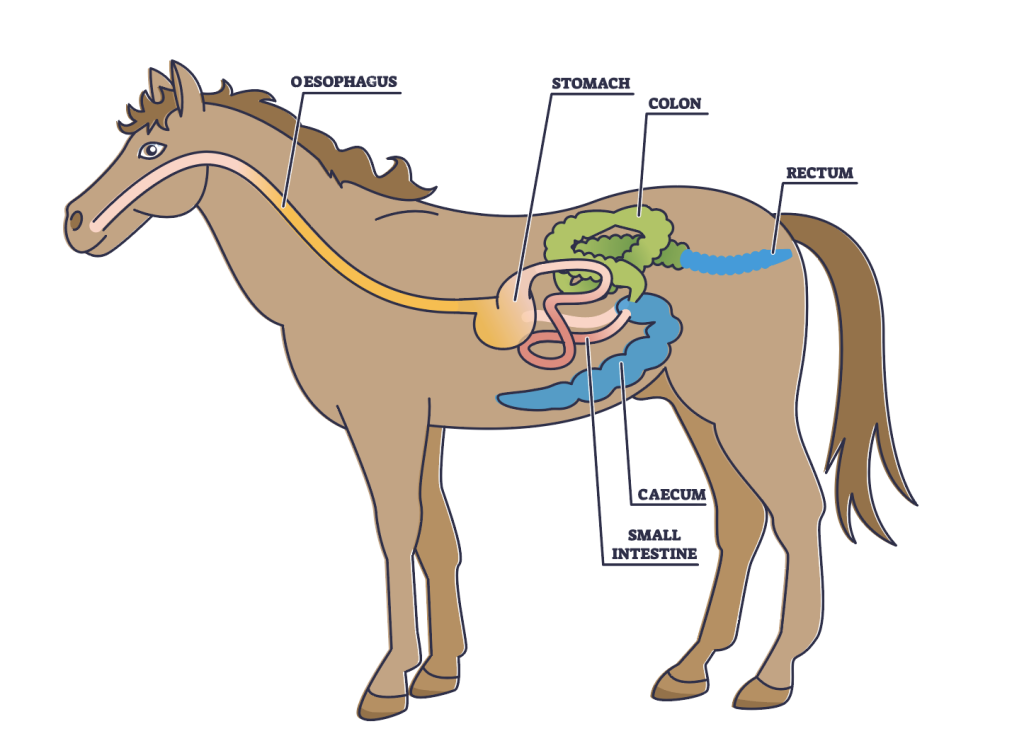
Therefore, Gastro, Gastric and usually “Ulcers” are referring to the Stomach! And in contrast, Large Intestines and Hindgut are referring to the larger part of the digestive system nearer to the anus and further from the mouth.
What about Gut Balancers? This is where things can be confusing. Most of these types of products are targeting Hindgut/Large Intestinal problems although some products may target both the stomach and the Hindgut/Large Intestines. In contrast, supplements with Gastri or Gastro or Gastric are likely to be targeting Stomach health. Some products may also be formulated to support both Stomach and Hindgut/Large Intestinal health. Sometimes the only real way of knowing is to check out the ingredient list.
Below is a table that lists the common ingredients in the different types of digestive supplements.
Common ingredients in Gastric/Stomach and Hindgut/Large Intestine Supplements
| Stomach/Gastric/Gastro | Hindgut/Large Intestines/”Gut Balancers” |
| Buffers e.g. magnesium hydroxide, calcium carbonate | Live Yeast (Saccharomyces cerevisiae) |
| Brewer’s Yeast (Saccharomyces cerevisiae – dead) | Brewer’s Yeast (Saccharomyces cerevisiae – dead) |
| Threonine | Threonine |
| Lecithin | Fructooligosaccharides (FOS) |
| Apple pectin | Mannanoligosaccharides (MOS) |
| Vitamin C | Beta-glucans |
| Vitamin E | Inulin |
| Aloe vera | Psyllium |
| Liquorice | Glutamine |
| Marshmallow root | Mycotoxin binders |
| Omega 3 Fatty acids | Digestive enzymes |
| Slippery Elm | Butyric acid |
| Glycine | |
| Sea Buckthorn |
Bottom Line
Make sure you are buying the right supplement by checking the ingredient list. Also, remember that just because its on the label, doesn’t mean there is enough in the product to do any good. Sadly very few supplements have sufficient amounts of the right active ingredients; usually because it makes the products expensive. Beware clever or hyped-up marketing. Look for products backed by clinical trials. In the UK companies may not be able to refer directly to clinical trials in their marketing due to Veterinary Medicine Directorate regulations but they can tell you about them if you phone up and ask.
Will stomach/gastric/ulcer supplements be of any help to horses with hindgut/large intestinal problems such as loose droppings or colic?
It’s unlikely that effective products for these different parts of the GI tract would normally contain very different active ingredients, although there is some overlap. For the stomach, we are normally looking for ingredients that may decrease acid production, buffer stomach acid (reduce the acidity of the stomach contents), protect the stomach lining (mucosa) or help with repair of the stomach lining. When it comes to the hindgut/large intestines, we are looking for ingredients such as probiotics and prebiotics that help encourage the growth of “good” or “beneficial” bacteria, which in turn also may suppress the growth of potentially harmful bacteria. One example of an ingredient which can help both the stomach and the hindgut is Brewer’s yeast also known as Saccharomyces cerevisiae. Brewer’s yeast is a byproduct of the brewing industry and is essentially dead yeast (as distinct from live yeasts). In the stomach, Brewer’s yeast can help improve stomach/gastric function by supplying threonine, B vitamins, beta-glucans and chromium.
